

Lesson 1: Returning to the “common home” with a new status.
The merger of Can Tho City, Hau Giang Province, and Soc Trang Province in this administrative adjustment can be seen as a "return to the common home" for these localities, but with a completely different status. After the merger, Can Tho City possesses full potential, advantages, and a "golden" opportunity for breakthrough development in the future.
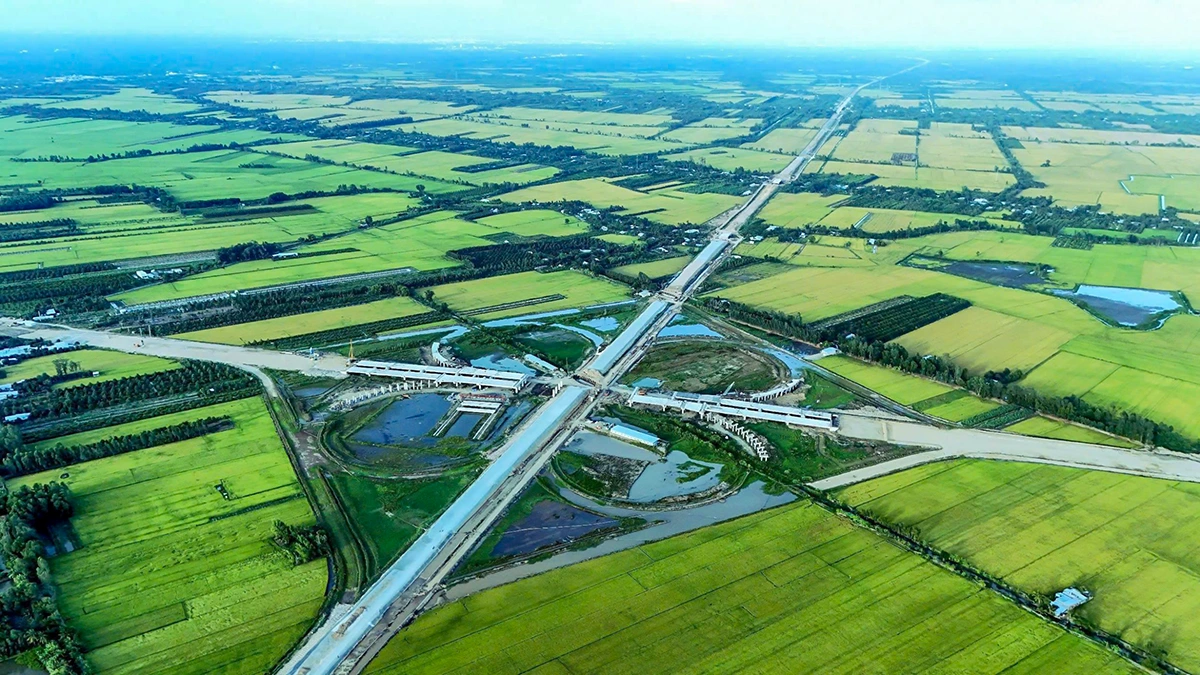
Expressways open up opportunities for Can Tho City to achieve breakthrough development in the future. In the photo: The Can Tho - Ca Mau expressway, passing through Can Tho City, is being constructed at an accelerated pace.
Possessing numerous potentials and advantages.
The reason for saying this is because these three administrative units were once "under one roof." After the complete liberation of the South and the reunification of the country, the Government issued Decree No. 03/ND-76 on March 24, 1976, deciding to merge Can Tho province, Soc Trang province, and Can Tho city to form a new province called Hau Giang. In response to practical needs and development requirements, in December 1991, the 8th National Assembly issued a resolution separating Hau Giang province into two new administrative units: Can Tho province and Soc Trang province. Then, on January 1, 2004, Can Tho province underwent further administrative boundary adjustments. This time, Can Tho was separated into Hau Giang province and Can Tho city.
Looking back, it's clear that these three administrative units have been divided and merged several times depending on the country's management and development needs at different stages. This merger not only has administrative significance but also represents a re-establishment of existing connections, aiming to maximize the potential and advantages of a region rich in tradition and vitality in the Mekong Delta.
Mr. Truong Canh Tuyen, Deputy Secretary of the City Party Committee and Chairman of the People's Committee of Can Tho City, stated that, with its central location, Can Tho City has convenient connections with Ho Chi Minh City and other provinces in the Mekong Delta region; and also plays a role as a gateway connecting the region with the international community. Can Tho contributes significantly to the Mekong Delta's seafood and rice exports. Transportation infrastructure is being heavily invested in with expressways, creating a network that connects quickly with major industrial centers. In addition, Can Tho is also an educational center, with many universities and research institutes, facilitating the training of high-quality human resources and technology transfer. With its location and abundant natural resources, the city has great potential and advantages for developing agriculture, processing and exporting agricultural and aquatic products, industry, services, tourism, and trade.
Dr. Tran Khac Tam, a representative of the Can Tho City People's Council, a member of the Executive Committee of the Vietnam Federation of Trade and Industry, and Vice Chairman of the Council of Business Associations in the Mekong Delta, believes that after the merger, Can Tho City will have a fairly large area of agricultural land. Businesses that are currently investing or planning to invest will easily be able to expand their cultivated area and implement high-tech scientific and technical applications. This is especially true for the former Soc Trang and Hau Giang provinces – two provinces with large areas of agricultural land and strengths in rice cultivation, fruit trees, and aquaculture.
According to Mr. Tran Khac Tam, with this advantage, businesses and investors producing and trading in a large city like Can Tho will have a seamless agricultural supply chain, convenient for storage and deep processing. Importantly, businesses will also have more opportunities to promote investment and cooperate with foreign businesses, thereby gaining a larger consumer market. In addition, businesses and investors will find it very convenient to export agricultural products through existing ports (Cai Cui Port, Tra Noc Port), Can Tho International Airport, expressways, logistics centers, Tran De Port, etc.
According to experts, with its current scale, Can Tho possesses abundant natural resources, favorable for the strong development of the tourism industry. In recent years, many famous destinations have left a lasting impression on tourists, such as Cai Rang floating market, My Khanh tourist village, Son Island, ecological gardens along the Xa No canal, Lung Ngoc Hoang Nature Reserve, and the coastal area and ecosystem of Cu Lao Dung. Each location is effectively exploited by tourism businesses through the design of tours and routes linked to the local ecological and cultural characteristics, creating unique experiences.
Major directions
The First Congress of the Can Tho City Party Committee, for the 2025-2030 term, set the following goals: By 2030, Can Tho City strives to become a national growth pole, playing a driving role in development, spreading and leading the entire region. It aims to be the regional center for trade, tourism, logistics, marine economy, processing industry, concentrated digital technology, high-tech applied agriculture, education and training, specialized healthcare, a center for entrepreneurship, science and technology and innovation, and the development of culture and sports; a core urban area of the region; and to cultivate Can Tho people with rich identity, revolutionary ideals, ethics, intelligence, and a prosperous and happy life. The goal is to build a clean, strong, and comprehensive Party organization and political system; ensure solid national defense and security; and maintain political stability and social order. By 2045, the city aims to be an eco-friendly, civilized, and modern city, striving to be among the moderately developed cities in Asia and becoming one of the most livable cities in Vietnam.
The 28 targets set by the Congress demonstrate the city's strong and breakthrough development aspirations. Specifically, the Gross Regional Domestic Product (GRDP) at current prices is projected to reach at least 717,000 billion VND by 2030; GRDP per capita is expected to reach approximately 215 million VND/person/year by 2030; GRDP growth rate for the period 2025-2030 is projected to be 10-10.5% or higher per year; export turnover, services, and foreign exchange earnings are expected to reach 8.2 billion USD by 2030, with an average annual increase of 11% during the period 2025-2030; average per capita income is expected to reach at least 8,500,000 VND/person/month by 2030; total annual budget revenue is projected to increase by approximately 15%, reaching an estimated 57,000 billion VND by 2030…
Mr. Dong Van Thanh, Permanent Deputy Secretary of the City Party Committee and Chairman of the People's Council of Can Tho City, affirmed that the City Party Committee remains steadfast and firm on the ideological foundation and principles of the Party. The city will continue to streamline the political system's organizational structure to be lean, effective, and efficient, suitable for a two-tiered government system. It will review and issue policies to attract resources, develop the digital economy, green economy, and circular economy; and promote the development of science and technology, innovation, and digital transformation.
Furthermore, it is essential to promptly and effectively implement approved plans; maximize potential and advantages to create breakthroughs in development. This includes completing strategic infrastructure, especially a synchronized and modern transportation infrastructure connecting key national transportation routes. Developing marine economic sectors, waterway transportation, and logistics systems; forming multi-sector marine economic clusters, linked to the construction of marine economic centers in coastal communes and wards…
In his address at the First Congress of the Can Tho City Party Committee, term 2025-2030, Mr. Tran Thanh Man, Member of the Politburo and Chairman of the National Assembly, emphasized: “Can Tho possesses many advantages and potentials that few other places have, including a comprehensive road, waterway, air, and seaport transportation system, a unique riverine culture, and dynamic and compassionate people. Therefore, the demands placed on the city must be higher and more comprehensive than those on other localities. To achieve the goal of becoming a developing country with modern industry and high middle income by 2030, the 100th anniversary of the founding of the Party, and becoming a developed country with high income by 2045, the 100th anniversary of the founding of the nation, the City Party Committee must have a vision not just for a few years or one term, but for the longer term, with appropriate methods and steps for each specific stage.”
TRUONG SON - CAM LINH
Lesson 2: Trust from the two levels of local government
Source: https://baocantho.com.vn/co-hoi-vang-de-can-tho-cat-canh--a192403.html

![[Photo] The General Secretary, President and his wife begin their state visit to the Philippines.](https://vphoto.vietnam.vn/thumb/1200x675/vietnam/resource/IMAGE/2026/05/31/1780230559452_anh-man-hinh-2026-05-31-luc-19-28-11.png)
![[Image] Hanoi Police officially crowned champions of V-League 2025/2026](https://vphoto.vietnam.vn/thumb/1200x675/vietnam/resource/IMAGE/2026/05/31/1780244769054_ndo_br_039d561b692be875b13a-jpg.webp)















![[Video] Sunset at Lap An Lagoon – Where the sun sets over the fishing nets](https://vphoto.vietnam.vn/thumb/340x192/vietnam/resource/IMAGE/2026/05/31/1780192137701_beach-landscape-sea-water-nature-grass-745871-pxhere-com.jpeg)


![[Photo] Admire the coral "masterpiece" amidst the million-year-old heritage of Dak Lak province.](https://vphoto.vietnam.vn/thumb/1200x675/vietnam/resource/IMAGE/2026/05/31/1780221235105_anh-man-hinh-2026-05-31-luc-16-53-27.png)
![[Photo] Solemn bathing ceremony and Buddha procession in Hue](https://vphoto.vietnam.vn/thumb/1200x675/vietnam/resource/IMAGE/2026/05/31/1780228263543_1-jpg.webp)




























































Comment (0)