

Amidst growing legal hurdles and privacy concerns surrounding facial recognition, a South Korean tech company is proposing iris recognition as the next generation of biometrics, capable of accurate identification at long distances and in harsh environments.
At a technology presentation to international journalists at the recent Global Media Meet-up in Seoul, South Korea, Edward Jung, CEO of AJ2, stated that they focus on advanced biometric security, with the iris being considered one of the most stable and difficult-to-forge biological characteristics of humans.
According to scientific research, the iris is formed at birth, remains virtually unchanged throughout life, and has an extremely low degree of overlap between individuals.
Why are irises superior to facial features and fingerprints?
Compared to facial recognition—which is easily obscured by masks, glasses, lighting, or camera angles—iris recognition contains a much larger number of biological characteristics. A company representative stated that while DNA has approximately 4,000 identifying characteristics, the iris has over 170 independent characteristics, resulting in an accuracy rate of up to 99.99%.
Moreover, popular biometric technologies such as facial recognition and fingerprint scanning are increasingly being restricted by personal data protection regulations in Europe and many other countries.
In this context, the iris is seen as a solution that strikes a balance between high security and privacy, thanks to its ability to encrypt complex and irreversible biological data.
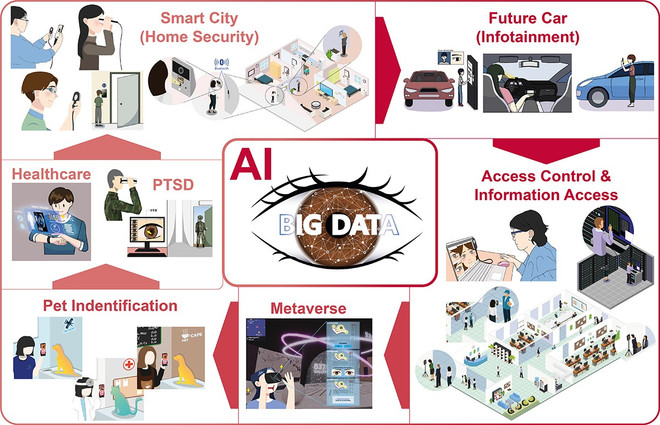
Solving the "bottleneck" problem in the iris market.
Despite its academic merit, iris recognition technology has faced numerous obstacles in practical implementation: requiring users to stand very close to the device, high costs, sensitivity to light, and difficulty using it outdoors.
This South Korean company stated that it simultaneously addressed these bottlenecks by developing its own specialized cameras, IR LED modules, and proprietary AI algorithms, instead of relying on commercially available components and algorithms.
Notably, their system allows iris recognition at distances of 1 to 3 meters, even when the user is wearing glasses and in sunny outdoor environments – something that most current solutions cannot achieve. According to company representatives, this technology is not just in the testing phase but has already been fully patented.
From the laboratory to the international airport
This company's long-range iris recognition technology has already been deployed at several airports in the US and Canada, through the provision of recognition modules integrated into security control systems.
Edward Jung said they are also participating in government- level biometric tenders in Singapore and preparing for large-scale projects in Mexico.
Beyond border security, this technology is also being tested in contactless payments, online identity verification, and citizen identification systems, where a higher level of security than facial recognition is required while still ensuring a contactless experience.
Anticipating post-AI and post-facial recognition trends.
According to business assessments, the explosion of generative AI and deepfakes is increasing the risk of large-scale facial forgery. Meanwhile, the iris is almost impossible to accurately recreate using synthesized images or videos .
"The fact that many countries are beginning to restrict or ban facial recognition in public spaces actually opens up huge opportunities for next-generation biometrics," a company representative stated, while also aiming to build an identification ecosystem with over 100 million registered irises in the future.
From a technological perspective, the story of the South Korean company AJ2 shows that iris technology – once considered too complex and expensive – is being redefined through a combination of self-developed hardware components, AI, and cost optimization, opening up a new direction for the global biometrics market.
Source: https://www.vietnamplus.vn/cong-nghe-nhan-dang-mong-mat-tam-xa-huong-di-moi-cua-sinh-trac-hoc-trong-ky-nguyen-hau-nhan-dien-khuon-mat-post1083164.vnp
![[Image] Leaked images ahead of the 2025 Community Action Awards gala.](/_next/image?url=https%3A%2F%2Fvphoto.vietnam.vn%2Fthumb%2F1200x675%2Fvietnam%2Fresource%2FIMAGE%2F2025%2F12%2F16%2F1765882828720_ndo_br_thiet-ke-chua-co-ten-45-png.webp&w=3840&q=75)
![[Photo] Prime Minister Pham Minh Chinh receives the Governor of Tochigi Province (Japan)](/_next/image?url=https%3A%2F%2Fvphoto.vietnam.vn%2Fthumb%2F1200x675%2Fvietnam%2Fresource%2FIMAGE%2F2025%2F12%2F16%2F1765892133176_dsc-8082-6425-jpg.webp&w=3840&q=75)

![[Live] 2025 Community Action Awards Gala](/_next/image?url=https%3A%2F%2Fvphoto.vietnam.vn%2Fthumb%2F1200x675%2Fvietnam%2Fresource%2FIMAGE%2F2025%2F12%2F16%2F1765899631650_ndo_tr_z7334013144784-9f9fe10a6d63584c85aff40f2957c250-jpg.webp&w=3840&q=75)

![[Photo] Prime Minister Pham Minh Chinh receives Lao Minister of Education and Sports Thongsalith Mangnormek](/_next/image?url=https%3A%2F%2Fvphoto.vietnam.vn%2Fthumb%2F1200x675%2Fvietnam%2Fresource%2FIMAGE%2F2025%2F12%2F16%2F1765876834721_dsc-7519-jpg.webp&w=3840&q=75)










































































Comment (0)