

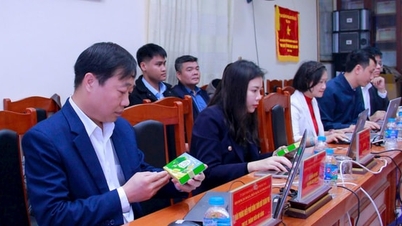
(PLVN) - In Can Tho City, the Vietnam Rice Industry Association recently organized a forum on solutions for replicating successful pilot models of the sustainable development project of one million hectares of high-quality, low-emission rice monoculture linked to green growth in the Mekong Delta by 2030.
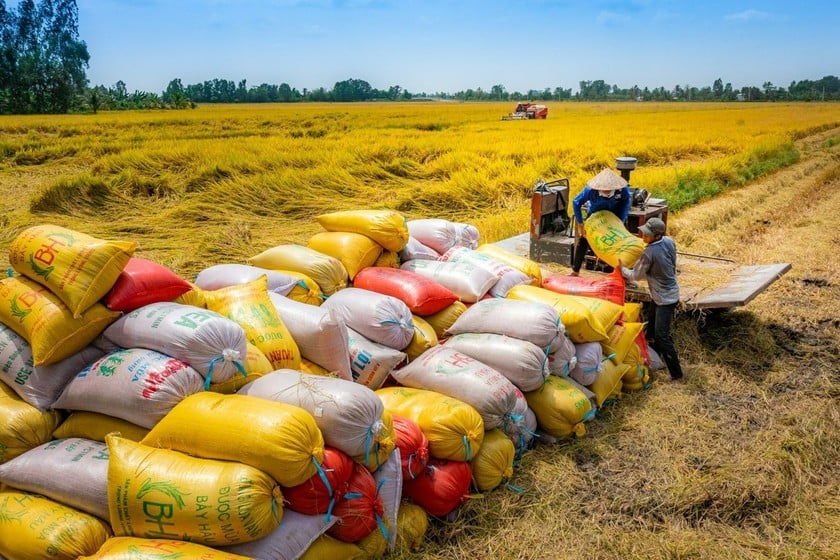 |
| The project to cultivate 1 million hectares of high-quality rice is currently implementing 7 pilot models. (Photo: Nhat Ha) |
(PLVN) - In Can Tho City, the Vietnam Rice Industry Association recently organized a forum on solutions for replicating successful pilot models of the project to sustainably develop one million hectares of high-quality, low-emission rice monoculture linked to green growth in the Mekong Delta by 2030.
The project to cultivate 1 million hectares of high-quality rice, implemented by the Ministry of Agriculture and Rural Development in coordination with localities, organizations, and businesses, has seen seven pilot models launched in five provinces and cities in the Mekong Delta: Dong Thap, Kien Giang, Can Tho, Soc Trang, and Tra Vinh . Initially, the results from these pilot models have shown high efficiency, increasing profits for farmers and reducing emissions in rice production.
Mr. Le Thanh Tung, Deputy Director of the Department of Crop Production ( Ministry of Agriculture and Rural Development ), believes that the active participation of farmers, along with the cooperation of businesses and all levels of government, is showing many positive signs. Mr. Tung commented: "Vietnamese rice is not inferior in quality to that of any other country, but its value has not yet been increased. Vietnam is currently at an emission level of 0.9%, which is higher than Southeast Asian countries such as the Philippines and Thailand..."
To expand the area for implementing the Project, according to Mr. Tung, it requires participating localities to uniformly implement the correct cultivation process that has been applied in the 7 pilot models recently, as well as the participation and linkage of businesses, and a focus on rice consumption.
"Expanding the area of rice cultivation participating in the project must also follow a roadmap, and needs to be calculated based on the capacity and finances of cooperatives and enterprises. Enterprises should be assigned to manage small clusters, so that they can control the quality of rice and ensure stability, and establish a brand for the enterprise," Mr. Tung stated.
Mr. Tran Minh Hai, Vice Principal of the School of Public Policy and Rural Development, recognizes that developing cooperatives is a core foundation for the successful implementation of the Project to cultivate 1 million hectares of high-quality, low-emission rice. Increasing the number of cooperative members will be a direction for the future, helping to expand production area and creating conditions for the application of mechanization and modern technologies in agriculture.
Currently, the average cooperative in the Mekong Delta has only about 80 members, much lower than the national average of 200 members and the 1,500 members in Thailand. Mr. Hai proposed that establishing medium-sized cooperatives (50-100 members) would not only meet the requirements of the 2023 Cooperative Law but also help improve production capacity and meet the stringent standards of the market.
When cooperatives become strong organizations capable of effective management and meeting market demands, they will play a core role in the modern rural economy. There is a need for strong cooperatives to develop value chains, create quality products, contribute to improving members' livelihoods, and enhance agricultural production efficiency.
Furthermore, the State and financial institutions need to create more favorable conditions for linkages between cooperatives and businesses. Capital support, reduced interest rates, and other preferential policies will encourage businesses to cooperate with cooperatives to expand production scale. For example, the People's Committee of Can Tho City has directed the Department of Agriculture and Rural Development to advise on policies to support interest rates for cooperatives and farmers in the project area.
Mr. Hai also suggested that banks should be flexible in disbursing loans, possibly lending through affiliated businesses or intermediary organizations representing farmers. This form of collateral along the supply chain helps minimize risks and enhance the efficiency of capital utilization.
Source: https://baophapluat.vn/de-an-1-trieu-ha-lua-chat-luong-cao-giai-phap-nhan-rong-cac-mo-hinh-thi-diem-thanh-cong-post532848.html
![[Photo] Prime Minister Pham Minh Chinh receives the Governor of Tochigi Province (Japan)](/_next/image?url=https%3A%2F%2Fvphoto.vietnam.vn%2Fthumb%2F1200x675%2Fvietnam%2Fresource%2FIMAGE%2F2025%2F12%2F16%2F1765892133176_dsc-8082-6425-jpg.webp&w=3840&q=75)
![[Live] 2025 Community Action Awards Gala](/_next/image?url=https%3A%2F%2Fvphoto.vietnam.vn%2Fthumb%2F1200x675%2Fvietnam%2Fresource%2FIMAGE%2F2025%2F12%2F16%2F1765899631650_ndo_tr_z7334013144784-9f9fe10a6d63584c85aff40f2957c250-jpg.webp&w=3840&q=75)
![[Image] Leaked images ahead of the 2025 Community Action Awards gala.](/_next/image?url=https%3A%2F%2Fvphoto.vietnam.vn%2Fthumb%2F1200x675%2Fvietnam%2Fresource%2FIMAGE%2F2025%2F12%2F16%2F1765882828720_ndo_br_thiet-ke-chua-co-ten-45-png.webp&w=3840&q=75)

![[Photo] Prime Minister Pham Minh Chinh receives Lao Minister of Education and Sports Thongsalith Mangnormek](/_next/image?url=https%3A%2F%2Fvphoto.vietnam.vn%2Fthumb%2F1200x675%2Fvietnam%2Fresource%2FIMAGE%2F2025%2F12%2F16%2F1765876834721_dsc-7519-jpg.webp&w=3840&q=75)





























































![[Live] Closing Ceremony and Award Presentation for the "Impressive Vietnam Tourism" Video/Clip Creation Contest 2025](https://vphoto.vietnam.vn/thumb/402x226/vietnam/resource/IMAGE/2025/12/17/1765974650260_z7273498850699-00d2fd6b0972cb39494cfa2559bf85ac-1765959338756946072104-627-0-1338-1138-crop-1765959347256801551121.jpeg)
















Comment (0)