

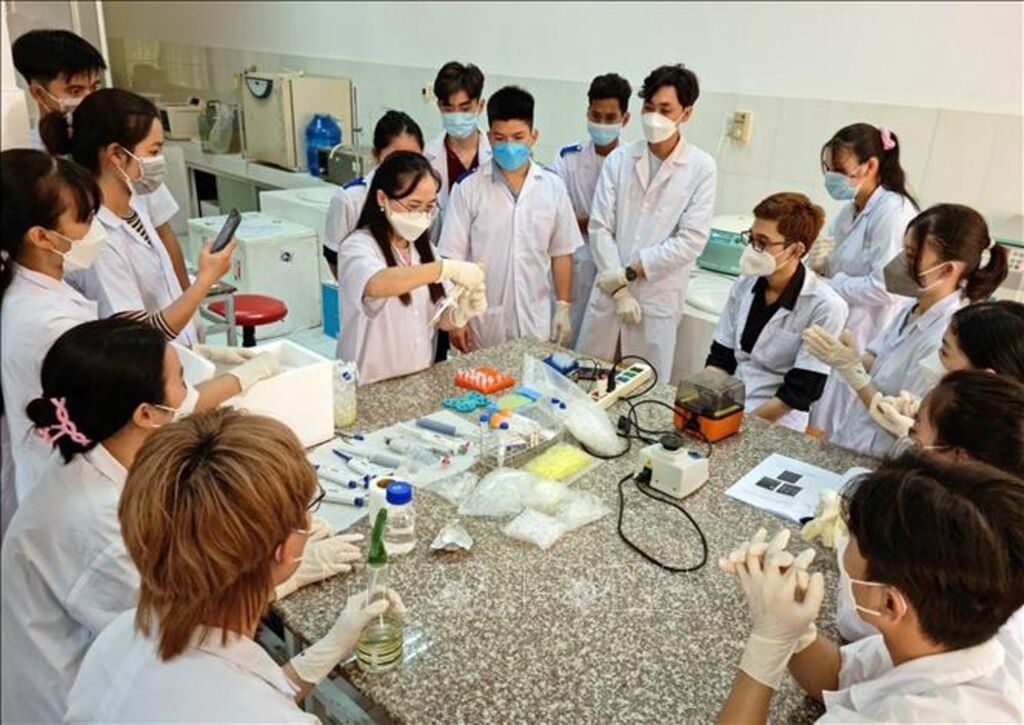
The objective of the Project is to train high-quality human resources at the undergraduate, master's, and doctoral levels, as well as provide short-term internships in the Russian Federation, China, Eastern European countries, and former Soviet Union countries; prioritizing training in fields where these countries have strengths.
During the period 2026-2035, it is projected that approximately 1,500 candidates will be sent to study abroad each year under both Agreement and Non-Agreement scholarship programs. The projected number of students studying in the Russian Federation is 1,000 per year; the total number in other countries is 500 per year. The number of students sent to study abroad may change depending on the scholarship quotas provided by foreign countries, actual training needs, and the state budget's capacity to balance resources.
Target audience
Vietnamese citizens applying for study abroad programs must meet the criteria set by each country. Those who have already met the conditions for receiving scholarships from foreign governments under agreements or outside of agreements will be considered for supplementary funding from the Vietnamese government if they fall under the following categories (those who do not meet the conditions for receiving supplementary scholarships from Vietnam will be eligible to study with scholarships provided by foreign countries):
Regarding university-level training:
For scholarship programs with 100 or more places available:
First-year university students in Vietnam with good academic results at the high school level who belong to one of the following groups: ethnic minorities; poor households; children of martyrs; residing in mountainous or island areas; children of diplomatic staff working at Vietnamese representative offices in that country (in the case of first-year students studying abroad, their high school academic results must be 8.0 or higher on a 10-point scale or equivalent).
High school students and first-year university students in Vietnam who win prizes in provincial, city, and national-level (organized by the Ministry of Education and Training ) or international (selected by the Ministry of Education and Training) competitions, or win official prizes in competitions in the fields of art and sports (recognized by the Ministry of Culture, Sports and Tourism) are eligible. Specifically for candidates studying in the Russian Federation, this includes those who win prizes in the Russian Language Olympiad organized by the Russian Ministry of Science and Higher Education or the Russian Science and Culture Center in Hanoi; and students majoring in Russian language who are eligible for a one-year Russian language program.
First-year university students in Vietnam with good academic results in high school are nominated by ministries, departments, localities, and state-owned enterprises to develop human resources for these ministries, departments, localities, and state-owned enterprises, with the aim of returning to work there after graduation.
First-year university students from schools belonging to the armed forces (police, military).
For scholarship programs with fewer than 100 places: In addition to the candidates mentioned in point a) above, there are also eligible candidates who are first-year university students in Vietnam with good academic results at the high school level.
Regarding master's and doctoral level training, the target group includes:
Officials, civil servants, public employees, and workers in state agencies, state-owned enterprises, and educational institutions.
University graduates with excellent academic results or master's degree graduates with a GPA of 8.0 or higher on a 10-point scale or equivalent are eligible to continue their studies at a higher level.
The candidates are nominated by ministries, departments, localities, and state-owned enterprises to develop human resources for these ministries, departments, localities, and state-owned enterprises, and to be offered employment after graduation.
Regarding short-term internships: The target group includes officials, civil servants, employees, and workers in state agencies, enterprises, and educational institutions.
Field of study, training methods
Regarding fields of study, the plan aims to train human resources in all sectors and professions that Vietnam needs, with priority given to sending personnel to fields related to national defense, security, high technology, artificial intelligence, cloud computing, quantum computing, blockchain, energy technology, advanced materials, rare earth technology, ocean and subsurface technology, aerospace technology, semiconductor industry, energy, nuclear technology, railways, biotechnology, medicine and pharmacy, law, etc., as stipulated in projects and programs approved by competent authorities.
Training method: full-time study abroad at reputable training institutions in the Russian Federation, China, Eastern European countries, and former Soviet Union countries.
The decision stipulates that the funding for the Project includes: Funding from other countries for training Vietnamese citizens under and outside of agreements; funding from the Vietnamese state budget, including expenses for training Vietnamese citizens abroad and for project management in accordance with the law; and socialized funding to support human resource training abroad (financial resources from higher education institutions; sponsorships and support from domestic and foreign businesses, organizations, and individuals; and other legally mobilized sources).
The management and use of funds for the implementation of the Project shall comply with the provisions of the law on state budget and other relevant legal regulations.
The period for implementing the overseas study recruitment program under this scheme is from 2026 to 2035.
This decision takes effect from the date of signing (December 10, 2025); it repeals the Prime Minister's directives in Official Letter No. 2792/VPCP-QHQT dated September 21, 2021, from the Government Office regarding regulations on candidate selection for countries of the Russian Federation, China, Eastern European countries, and former Soviet Union countries under the Agreement.
Source: https://baotintuc.vn/thoi-su/phe-duyet-de-an-dao-tao-nhan-luc-chat-luong-cao-o-nga-trung-quoc-cac-nuoc-dong-au-va-cac-nuoc-thuoc-lien-xo-cu-20251210194958573.htm

![[Photo] Prime Minister Pham Minh Chinh holds a phone call with the CEO of Russia's Rosatom Corporation.](/_next/image?url=https%3A%2F%2Fvphoto.vietnam.vn%2Fthumb%2F1200x675%2Fvietnam%2Fresource%2FIMAGE%2F2025%2F12%2F11%2F1765464552365_dsc-5295-jpg.webp&w=3840&q=75)


![[Photo] Closing Ceremony of the 10th Session of the 15th National Assembly](/_next/image?url=https%3A%2F%2Fvphoto.vietnam.vn%2Fthumb%2F1200x675%2Fvietnam%2Fresource%2FIMAGE%2F2025%2F12%2F11%2F1765448959967_image-1437-jpg.webp&w=3840&q=75)




































![[OFFICIAL] MISA GROUP ANNOUNCES ITS PIONEERING BRAND POSITIONING IN BUILDING AGENTIC AI FOR BUSINESSES, HOUSEHOLDS, AND THE GOVERNMENT](https://vphoto.vietnam.vn/thumb/402x226/vietnam/resource/IMAGE/2025/12/11/1765444754256_agentic-ai_postfb-scaled.png)









































Comment (0)