


Asset and income control is one of the important components of anti-corruption work, implemented in Vietnam and many countries. After the Law on Anti-Corruption 2018 and Decree 130/2020/ND-CP on asset and income control of people with positions and powers in agencies, organizations and units were issued, Vietnam has had a legal framework for asset and income control.
According to Article 11 of Decree 130/2020/ND-CP, the disclosure of the declaration of assets and income of the person with the obligation to declare is carried out in two main forms: public posting or public disclosure at meetings in the agency, organization or unit where that person works.
In the form of posting, the declaration is posted publicly at the headquarters of the agency, organization, state-owned enterprise or affiliated unit. The posting location must ensure safety and convenience for monitoring and reading information. The posting period is stipulated as 15 days, calculated from the date the declaration is handed over to the asset and income control agency. The posting must be recorded, clearly stating the list of declarations, with the signature of the head of the unit and the representative of the trade union organization.
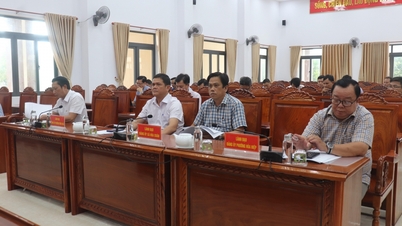
For the public form at meetings, the declaration is presented in meetings attended by cadres, civil servants, and public employees at each management level. The meeting can only be held when at least 2/3 of the summoned people are present. The chairperson or the assigned person will read the declaration of each individual. Any comments, questions or explanations related to the declaration content (if any) must be recorded in the minutes, with the signature of the chairperson and the union representative.
The declaration must be made public within 5 days at the latest from the date the agency or unit completes the handover of the declaration to the asset and income control agency.
These regulations aim to ensure transparency, objectivity and internal monitoring capabilities during the declaration process, helping people and agencies to access and monitor, while contributing to improving the accountability of people with positions and powers.
In fact, in recent times, some localities have discovered and handled cases of dishonest declaration of assets and income.
In September 2023, Mr. So Minh Huong, Deputy Secretary of the Party Committee and Chairman of the People's Committee of Ca Lui Commune, Son Hoa District, Phu Yen Province (old), was warned by the Party for dishonestly declaring his personal assets and income, and at the same time, allowing his wife to lend money against regulations.
By 2024, the Inspectorate of Hai Duong province (old) issued a conclusion on verifying the assets and income of Mr. NMN, Principal of Quang Trung High School. According to Conclusion No. 229/KL-TTr, Mr. NMN had made dishonest declarations and unclearly explained the source of the increased assets, violating the law.
From the inspection results, the Department of Education and Training of Hai Duong province (old) organized a review and disciplined Mr. NMN in the form of a warning.


The regulations are very clear, so how do localities declare and publish the above asset declaration?
According to Mr. Hoang Ba Nam, Secretary of the Party Committee of Ha Long Ward (Quang Ninh Province), the declaration of assets of officials and civil servants is strictly implemented by the locality in accordance with Party regulations and the law. However, to be effective, he said, it is necessary to raise awareness and clearly define the responsibilities of leaders in directing and controlling.
“At the ward and commune levels, the advisory bodies including the Party Committee Inspection Committee and the Department of Culture and Society need to coordinate closely. Officials have the right perception, but if they make wrong declarations or misunderstand the regulations, they can easily make mistakes,” said Mr. Nam.
He said that in order to make declarations effectively, it is necessary to establish a working group to review declarations, request corrections when declarations are incomplete or lack information, and provide specific instructions to declarants. Publicity must be in accordance with regulations, for example, posting at the agency for a certain period of time so that officials and people know, contributing to preventing corruption.
In Ha Long ward, asset declaration is usually done after the year-end review, around November. In case of rotation, promotion of cadres or preparation for congresses, the declaration is supplemented.
Mr. Nam said that the declaration was then publicly posted on a bulletin board in an easily visible area in the unit's headquarters for 15 days. "During the posting period, if there are comments from subordinates or citizens, the person whose name is on the declaration must explain," Mr. Nam said. The declaration results were reported to the Inspection Committee for the Party bloc and the Department of Home Affairs for the government bloc.
According to Mr. Nam, the locality has not had any cases disciplined for false declarations, but there have been a few cases that had to be re-declared or supplemented after being appraised by higher authorities. The reason for the cases that had to be re-declared or supplemented was mostly due to the incorrect understanding of the officials, such as incomplete income updates in the payroll.
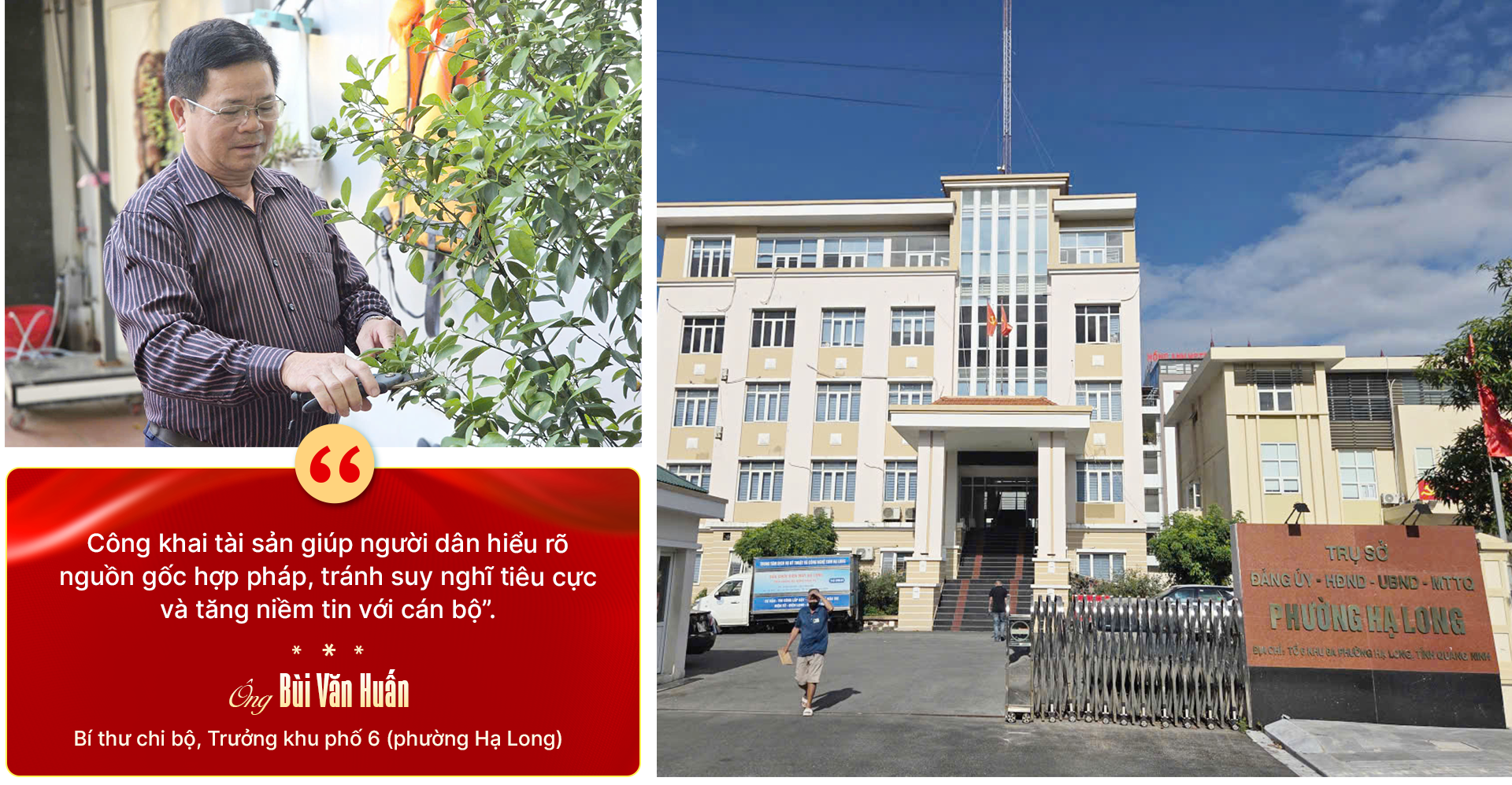
From a grassroots perspective, Mr. Bui Van Huan, Party Cell Secretary, Head of Ward 6 (Ha Long Ward), said that the policy of declaring assets of officials is necessary and supported by the people.
“Disclosing assets helps people understand where officials’ assets come from legally, avoiding negative thoughts. When officials declare honestly and clearly, they will strengthen people’s trust,” Mr. Huan said.
According to him, during the time the declaration is posted at the agency or party cell, people can access and grasp basic information. In Ward 6, the publicity helps to eliminate false public opinion and create social consensus.
Mr. Huan said that in the locality, there had been a case where people were gossiping about an official’s assets. After the declaration was published, the origin of the assets became clear, public opinion calmed down, creating consensus within the agency and the people.
Local residents also agree. Ms. Hoang Thi Ha, 63 years old, group 10, Hong Ha 6 area (Ha Long ward), said that every year the locality publicly posts the asset declaration of officials for 15 days, usually in mid-November.
“We are allowed to watch and monitor. This is the right thing to do, helping people know, discuss, and check. Thereby, strengthening trust in the leadership of the Party and the State,” said Ms. Ha.
Similarly, in Hai Phong city, Mr. Nguyen Vy, Secretary of the Kinh Mon Ward Party Committee, said that every year, based on Decree 130/2020/ND-CP and guidance from the Government Inspectorate, the Ward Party Committee issues a plan to implement the declaration of assets and income for cadres, civil servants and public employees who are required to declare.

The declaration is carried out seriously, in accordance with the form, and on time. The subjects of declaration include cadres, civil servants, and public employees under the management of the Party Committee Standing Committee, members of the Inspection Committee, accountants, and cadres planned and expected to be appointed to leadership positions.
Mr. Vy said that the declaration is made from November and submitted to the Party Building Committee before December 31 every year. After receiving it, the Party Committee assigns an inspection of the form and content, comparing it with the previous year to detect any changes.
“If there is any doubt about the honesty, the Party Committee will assign the Inspection Committee to verify and clarify and conclude according to regulations. Up to now, no violations have been detected, but there are some declarations that need to be supplemented and explained more clearly,” he said.
Once completed, the declaration is made public in two ways: announced at agency and party cell meetings and publicly posted at the agency's headquarters for at least 15 days. Localities implement both methods simultaneously to ensure democracy and transparency.
According to him, public declarations help officials and civil servants self-examine, self-correct, and raise their sense of integrity. At the same time, they are a mechanism for the collective and the people to monitor and detect early signs of irregularities.
“This is also a way to protect the prestige and honor of officials when the assets are legal and the origin is clear. To avoid formality, it is necessary to publicize according to regulations, have a record, have a specific posting time, and encourage people to reflect honestly,” Mr. Vy said.
Besides choosing to announce the asset declaration by posting it at the agency like the two units above, some localities also choose to announce it at meetings of key officials.

Mr. Nguyen Xuan Cuong, Chairman of the People's Committee of Tan Ky Commune (Hai Phong), said that the locality will announce the asset declaration of the subjects required to declare according to regulations by announcing at meetings.
In fact, Decree 130 does not stipulate that organizations and units must widely announce the time of publication of asset declarations. Therefore, although the declaration is publicly posted at the agency according to regulations, few people know to come and see and monitor.
Ms. Hoang Thi Lan (65 years old, in Kinh Mon ward, Hai Phong) shared: "We did not know about this and did not see the ward widely announce the time to post this asset declaration to come and see. In my opinion, there should be regulations to announce the time to post the asset declaration of officials so that we, the people, can know and come and see."
Regarding this issue, Dr. Nguyen Thi Ngoc Linh, Lecturer at the National Academy of Public Administration, said: The public disclosure of asset declarations - an important channel for social supervision - has not been implemented effectively.
“Many places just post it for the sake of it, without any notice, so no one knows to look at it. Officials and civil servants in the agency also do not know the declared data of their colleagues,” Ms. Linh said.

According to Dr. Dinh Van Minh, former Director of the Institute of Inspection Science, Director of the Legal Department (Government Inspectorate), agencies and organizations have fully disclosed asset declarations at the workplace as prescribed.
However, according to Mr. Minh, it is necessary to expand the form of public disclosure appropriately so that people can access information on the asset declarations of officials, thereby effectively monitoring and controlling the assets and income of those who are obligated to declare.
“In reality, more than 97% of asset declarations are submitted on time and fully as required. However, the problem lies in whether the declaration is truthful or not,” Dr. Dinh Van Minh commented.
Mr. Minh said that many declarations are just formalities and do not reflect the true assets and income. “Many cases were discovered after incidents, such as thefts or when investigating corruption and bribery cases... showing that the declarations were not truthful,” he said.
According to Mr. Minh, the system of regulations on controlling assets and income is quite complete, but the process of examining and verifying the truthfulness of declarations is still a weak link. Inspection agencies do not have specialized expertise, and human resources are scattered with many other tasks, leading to low inspection efficiency.
“The assessment of honesty currently depends largely on the awareness and goodwill of the declarant. There are cases of false declaration due to not understanding the regulations, but there are also people who intentionally conceal their assets,” Mr. Minh added.

From this reality, Mr. Minh said that it is necessary to tighten the institution and improve the capacity of the asset control agency, at the same time clearly define the responsibilities of each level, avoiding overlap between the inspection agency and the Party inspection agency.
Regarding the solution, Mr. Minh said that with millions of people subject to declaration, it is impossible to verify all of them, so it is necessary to choose the focus and key points. Verification should focus on cases with signs of abnormality, being denounced, or having sudden increase in assets.
He also emphasized the importance of data connection between agencies such as banks, tax, land, securities... because corrupt assets are often scattered in many places. "Digital technology and personal identification will make the investigation easier, instead of having to send documents everywhere like before," he said.
However, according to Mr. Minh, the public disclosure of asset declarations must go hand in hand with ensuring the safety of the declarant. “No country publicly discloses the assets of officials online. Public disclosure needs to have conditions so that people can monitor while still protecting their privacy and asset safety,” he said.
He said that, along with cleaning up the database, there should be clear sanctions for dishonest declarations. “When declarants know that their lies will be discovered and severely punished, the declaration becomes a real tool to control power,” Dr. Dinh Van Minh emphasized.
(More to come).
Source: https://dantri.com.vn/thoi-su/de-ke-khai-tai-san-cua-can-bo-khong-hinh-thuc-ky-1-can-niem-yet-ban-khai-20251030062223382.htm
![[Photo] General Secretary To Lam attends the Vietnam-UK High-Level Economic Conference](https://vphoto.vietnam.vn/thumb/1200x675/vietnam/resource/IMAGE/2025/10/30/1761825773922_anh-1-3371-jpg.webp)
![[Photo] National Assembly Chairman Tran Thanh Man receives foreign ambassadors who came to say goodbye](https://vphoto.vietnam.vn/thumb/1200x675/vietnam/resource/IMAGE/2025/10/30/1761820977744_ndo_br_1-jpg.webp)
![[Photo] General Secretary To Lam meets former British Prime Minister Tony Blair](https://vphoto.vietnam.vn/thumb/1200x675/vietnam/resource/IMAGE/2025/10/30/1761821573624_tbt-tl1-jpg.webp)

![[Photo] Touching scene of thousands of people saving the embankment from the raging water](https://vphoto.vietnam.vn/thumb/1200x675/vietnam/resource/IMAGE/2025/10/30/1761825173837_ndo_br_ho-de-3-jpg.webp)



















![[Photo] Standing member of the Secretariat Tran Cam Tu visits and encourages people in the flooded areas of Da Nang](https://vphoto.vietnam.vn/thumb/1200x675/vietnam/resource/IMAGE/2025/10/30/1761808671991_bt4-jpg.webp)


































































Comment (0)