

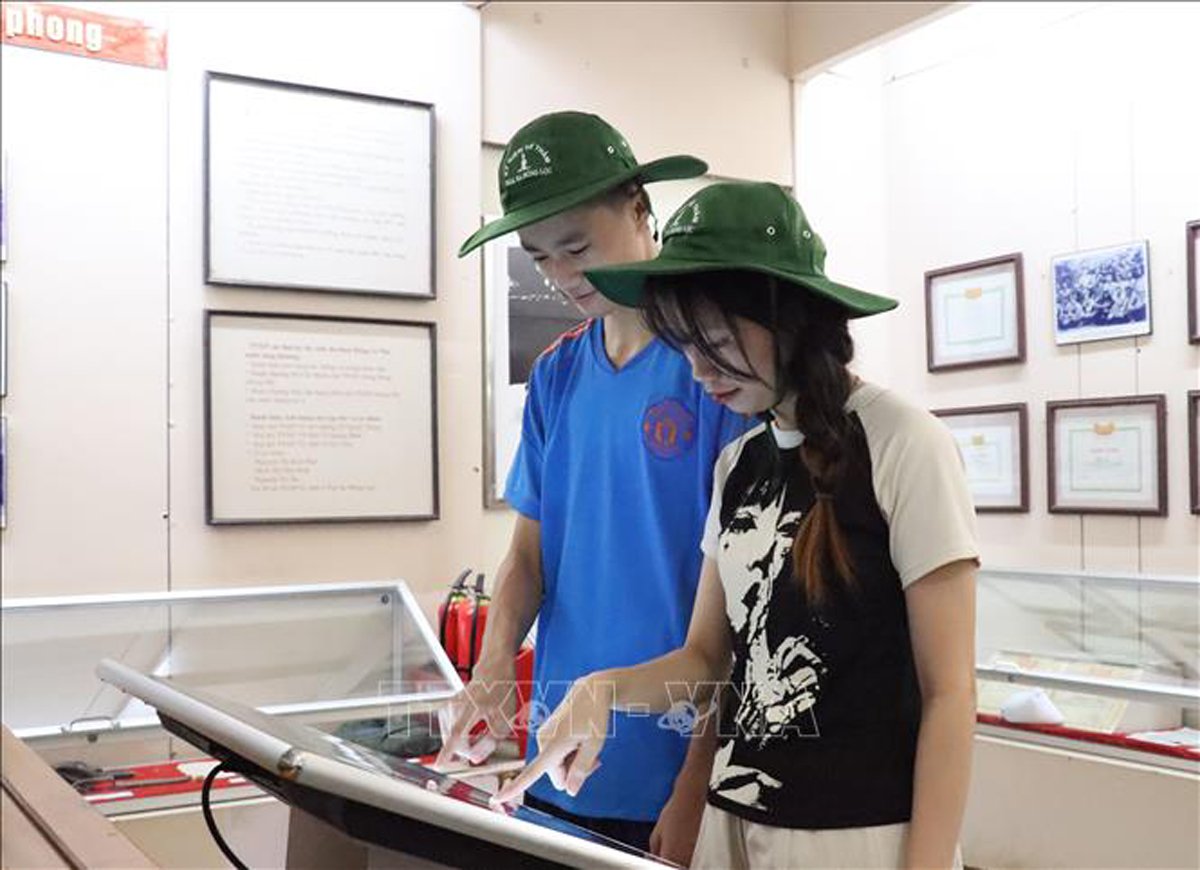
Applying technology to help tourists visit and learn about the Dong Loc Crossroads historical site ( Ha Tinh ).
Developing a smart tourism ecosystem.
According to experts, smart tourism is a tourism development model built on information and communication technology to enhance the experience and ensure the security and safety of tourists. The intelligent use of technology helps tourism activities become more modern, optimized, efficient, and convenient, meeting the diverse needs of tourists, businesses, and state tourism management agencies, aiming for sustainable development.
Analyzing the necessity of developing smart tourism linked to grasping and anticipating new tourism trends, including personalized and independent travel, Associate Professor Pham Hong Long (Faculty of Social Sciences and Humanities, Vietnam National University, Hanoi) argues that one of the tourism trends that will develop strongly in the coming time is individual and independent travel. More and more tourists are requesting customized, private itineraries, supported by tools such as AI, chatbots, and digital applications. In addition, many tourists, especially young tourists, often proactively seek information and design their own travel itineraries through digital platforms.
According to the Tourism Information Center (Vietnam National Tourism Administration), promoting the application of Industry 4.0 technologies to develop a smart tourism ecosystem, meeting the increasingly high demands of tourists in the digital age, and supporting effective connections between state tourism management agencies, businesses, and tourists is one of the important contents that the Vietnamese tourism industry and localities are actively implementing.
Currently, the Vietnam National Tourism Administration has developed and put into operation shared digital platforms that form the basis of the smart tourism ecosystem in the industry, including: the Vietnam Tourism Database System; tourism statistical reporting software from the central to local levels; the national tourism application "Vietnam Travel"; the Vietnam Card - Smart Tourism Card; a tourism management and business application; the Vietnam Tourism Yellow Pages; an "online - interconnected - multi-modal" electronic ticketing system; and a multimedia interpretation system.
Deputy Minister of Culture, Sports and Tourism Ho An Phong noted that digital transformation is paramount, inevitable, and objective for tourism. When applying digital technology, AI, and smart platforms, tourism will develop very quickly and sustainably; therefore, localities need to prioritize this solution to further enhance the value of their destinations.
Enhancing brand image and increasing destination competitiveness.
Developing smart tourism not only contributes to improving the effectiveness of tourism promotion through the increased application of modern digital technologies, but also enhances the attractiveness of tourism products, the quality of tourism services, and the visitor experience.
According to Le Truong Hien Hoa, Deputy Director of the Ho Chi Minh City Department of Tourism, developing smart tourism destinations is linked to building smart cities. Currently, over 360 outstanding tourism resources of the city have been updated on Google Earth and Google Map platforms. These products have also been listed on e-commerce platforms such as Shopee and Traveloka.
The city has developed the "Ho Chi Minh City 3D/360 Smart Interactive Tourist Map" (Map 3D/360) with a 3D/360 image system of over 100 characteristic attractive destinations such as cultural relics, museums, entertainment areas, conference centers, hotels, etc.
Through this interactive tourist map, visitors anywhere can access https://map3d.visithcmc.vn/ to experience tourist destinations through realistic and vivid 3D/360 images and videos, thereby making informed choices about suitable destinations for sightseeing and experiences.
Ho Chi Minh City is researching the construction of a Smart Tourism Operations Center (IOC); building a virtual tour guide system based on virtual reality and augmented reality, contributing to creating diverse experiences, enhancing the attractiveness of destinations, affirming the vibrant tourism brand of the city, and achieving the goal of attracting 53.5 million tourists in 2025.
Similarly, focusing on the application of technology and enhancing access to and provision of information for tourists is the solution chosen by Binh Duong tourism (which has many destinations suitable for eco-tourism, entertainment, and historical site exploration that attract tourists on weekends, holidays, and Tet).
According to Bui Huu Toan, Director of the Department of Culture, Sports and Tourism of Binh Duong province, the province has launched the website dulichbinhduong.org.vn. This website provides tourists with information on tours, travel companies, accommodation options, and a list of famous historical sites and tourist attractions in the province in 360-degree images. The Binh Duong tourism industry has also encoded QR codes for many articles, tourism programs, and tourism products and services to promote tourism to visitors, and promoted tourism through social networks such as Facebook and Zalo.
In the Mekong Delta, An Giang province is one of the localities actively undergoing digital transformation and gradually developing smart tourism. The province has launched the An Giang Smart Tourism Portal at https://checkinangiang.vn. Simultaneously, the "Check-in An Giang" mobile application has been deployed on Android and iOS operating systems.
These two platforms integrate various tourism databases such as attractions, travel companies, hotels, restaurants, shopping malls, and sports facilities, as well as providing tourists with information related to transportation, health, and security.
The An Giang Smart Tourism Portal also integrates virtual reality technology and multimedia content such as images, videos, 360-degree cameras, and digital maps, helping tourists easily search for information, plan trips, and connect stakeholders in the tourism industry, enhancing the visitor experience in An Giang.
According to the leaders of the Provincial Trade and Investment Promotion Center, the An Giang Smart Tourism Portal and the smart tourism application on mobile devices are highly appreciated for integrating many modern functions, including an intelligent virtual assistant that quickly and accurately responds to information of interest to tourists, while creating interaction between tourists, businesses, and state management agencies. At the same time, the applications also support tourists in creating suitable itineraries based on information they provide, such as expected arrival time, preferences, and means of transportation… contributing to the rapid progress of An Giang tourism, attracting over 9 million tourists in 2024.
Recently, a smart tourism product on a digital platform (VR360) about the Oc Eo-Ba The Archaeological Site (which preserves many important traces of the Oc Eo civilization, which flourished in Southern Vietnam from the 1st to the 7th centuries) was also launched. This contributes to spreading the value of the site in the process of building a nomination dossier for the Oc Eo-Ba The Archaeological Site as a World Cultural Heritage site, and also contributes to increasing the attractiveness of An Giang province to tourists in the future.
Source: https://baohoabinh.com.vn/276/200907/Du-lich-thong-minh-khang-dinh-vi-the-diem-den.htm
![[Photo] Solemn bathing ceremony and Buddha procession in Hue](https://vphoto.vietnam.vn/thumb/1200x675/vietnam/resource/IMAGE/2026/05/31/1780228263543_1-jpg.webp)

![[Photo] The General Secretary, President and his wife begin their state visit to the Philippines.](https://vphoto.vietnam.vn/thumb/1200x675/vietnam/resource/IMAGE/2026/05/31/1780230559452_anh-man-hinh-2026-05-31-luc-19-28-11.png)
![[Photo] Admire the coral "masterpiece" amidst the million-year-old heritage of Dak Lak province.](https://vphoto.vietnam.vn/thumb/1200x675/vietnam/resource/IMAGE/2026/05/31/1780221235105_anh-man-hinh-2026-05-31-luc-16-53-27.png)










![[Video] Sunset at Lap An Lagoon – Where the sun sets over the fishing nets](https://vphoto.vietnam.vn/thumb/340x192/vietnam/resource/IMAGE/2026/05/31/1780192137701_beach-landscape-sea-water-nature-grass-745871-pxhere-com.jpeg)



































![[Photo] Admire the coral "masterpiece" amidst the million-year-old heritage of Dak Lak province.](https://vphoto.vietnam.vn/thumb/402x226/vietnam/resource/IMAGE/2026/05/31/1780221235105_anh-man-hinh-2026-05-31-luc-16-53-27.png)
































Comment (0)