


On December 1, 2025, Deputy Prime Minister Nguyen Chi Dung signed Decision No. 2629/QD-TTg of the Prime Minister approving the Digital Government Development Program.
The general goal by 2030 is that Vietnam will complete the construction of a digital government , forming a smart government operating on the basis of big data and artificial intelligence.
The Decision clearly states the viewpoint of the Digital Government Development Program (Program) is to develop inclusive and widespread digital services based on the principle of taking people and businesses as the center, subjects and objects of service, and co-creating digital services. Taking users as the center with a unified service ecosystem, leaving no one behind.
Comprehensive digital transformation in state agencies, ensuring all consulting, work processing, management, internal administration, leadership, direction and operation activities are based on real-time data; management based on results. Inheriting existing results, ensuring unity, synchronization, connectivity, data sharing, and no duplication in the entire political system from central to local levels, suitable for two-level local governments.
Decentralize and decentralize strongly on digital platforms. Develop digital infrastructure and digital technology in a synchronous, modern, secure, safe, efficient manner, avoiding waste. Form large-scale data centers, according to green standards, closely following energy planning. Build and perfect national digital platforms and shared digital platforms of industries and fields in the direction of centralized, unified development, shared nationwide; ensure to avoid duplication and ensure synchronous connection and interconnection. These digital platforms will be invested, built and deployed synchronously and consistently by the central government down to the grassroots level (including provincial and communal levels).
Promote the development of open data, enhance transparency, accountability and innovation. Develop data to become a strategic resource, the foundation of digital government. Prioritize the construction and development of national databases, specialized databases and shared databases to serve the work of directing, operating, providing public services, monitoring, forecasting and policy making. The construction of databases must ensure the principles of "correctness, sufficiency, cleanliness, liveness, unity and shared use".
Combining internal resources and taking advantage of external resources, encouraging domestic digital technology enterprises to participate in developing new digital applications and services in the form of public-private partnership (PPP) is a breakthrough model and approach in developing a national digital platform to serve digital government in the new period; proactively cooperating internationally, learning from international experiences and standards in developing digital government.
Smart and automated operations based on prioritizing artificial intelligence applications (AI First). Deploying AI in providing online public services throughout the process to ensure efficiency, proactiveness, transparency and personalized user experience. At the same time, enhancing AI applications to smarten business processes, make operations transparent and optimize resources in the decision-making and operation processes of state agencies.
The program sets a general goal that by 2030, Vietnam will complete the construction of a digital government, forming a smart government operating on the basis of big data and artificial intelligence, towards a proactive, predictive, user-centric governance model. The basic activities of state agencies are carried out on centralized, unified and interconnected digital platforms between levels and sectors, creating a synchronous and modern digital ecosystem; at the same time, ensuring network security, protecting personal data and maintaining national digital sovereignty. AI becomes a core tool in public administration, providing public services and supporting policy decision-making, contributing to improving operational efficiency and the experience of people and businesses.
One of the specific objectives of the Program is to provide inclusive, intelligent digital services:
2025-2027 period: 100% of full-process online public services on total eligible administrative procedures; 100% of information, papers, and documents in administrative procedures related to production and business activities are provided only once to state administrative agencies; 95% of people and businesses are satisfied when using online public services.
In the period of 2028-2030, 99% of people and businesses are satisfied when using online public services; 50% of essential online public services are deployed proactively, supported by AI to "personalize", notify or suggest actions according to important milestones in life; 100% of state agencies provide standard open data; 100% of records and results of administrative procedure settlement are digitized; 80% of information and data that have been digitized in administrative procedure settlement and public services are exploited and reused.
Phase 2025-2027: 100% of national digital platforms, shared digital platforms of sectors and fields serving the digital government are completed and put into unified use from the central to local levels as planned; 100% of work records at ministerial, provincial and communal levels are processed in the electronic environment (except for work records within the scope of state secrets) and use personal digital signatures to handle work; 100% of reporting regimes of agencies are implemented on the Reporting Information System;
100% of tasks assigned by the Government and the Prime Minister to ministries, branches and localities are monitored, supervised and evaluated in the electronic environment; 100% of ministries, branches and localities reach level 3 of data management maturity; 100% of cadres, civil servants and public employees are trained in basic digital skills; 50% of cadres in charge of information technology and digital transformation of ministries, branches and localities are trained to obtain basic data management certificates.
2028-2030 period: 100% of ministries, branches and localities reach level 4 and 90% reach level 5 of data management maturity; 100% of information systems are connected and share data via data sharing services; 100% of agencies and organizations use at least 01 AI application to serve direction and operation; 25% of the leadership team of each agency and organization has expertise and experience in science, technology and digital transformation suitable to the requirements of the task;
100% of IT and digital transformation specialists of ministries, branches and localities are trained to obtain basic data management certificates; 100% of information systems serving the development of digital Government must have their cybersecurity proposal documents approved at each level before being put into operation and use; and be periodically inspected and assessed for cybersecurity.
To achieve the above goals, the Program sets out 9 tasks and solutions including: 1- Perfecting institutions; 2- Developing digital data; 3- Developing applications and digital platforms for digital government; 4- Developing digital government infrastructure; 5- Ensuring network security; 6- Developing digital human resources; 7- International cooperation; 8- Ensuring funding; 9- Measuring, monitoring and evaluating implementation.
Regarding digital data development, the Program focuses on digitizing data and exploiting data reuse to reduce and simplify administrative procedures, focusing on the fields of justice, education, health, and land.
Digitize 100% of administrative procedure records and results; complete the construction, upgrading, and development of national databases and specialized databases to ensure "correct, sufficient, clean, unified, and shared" data; connect and share data to serve the implementation of administrative procedures and the provision of public services.
Develop and promulgate a plan for publicizing open data at the national level and at each ministry, branch, and locality, including a list of priority open data, a publicization roadmap, access methods, update responsibilities, and criteria for assessing the level of use and reuse of open data. The provision of open data is carried out in accordance with current technical standards and legal regulations.
Develop and promulgate specific mechanisms and policies for ministries, branches and localities to proactively standardize, open, share and put qualified data on the Data Platform, promote the formation and development of the data market, associated with a transparent mechanism on ownership, exploitation rights, data commercialization and value distribution from data.
Regarding the development of digital government infrastructure, the Program will deploy the construction and development of digital infrastructure to serve the digital government according to Decision No. 1132/QD-TTg dated October 9, 2024 of the Prime Minister approving the Digital Infrastructure Strategy to 2025 and orientation to 2030.
Establishing storage and computing infrastructure that meets international and green standards. Developing large-scale data center clusters according to green standards, connecting and sharing to form a network of data center clusters to promote the big data industry, including the establishment of at least 03 national data center clusters according to the provisions of Resolution No. 175/NQ-CP dated October 30, 2023 of the Government approving the National Data Center Project.
Building a National Data Center and a unified, high-performance cloud computing platform to provide computing resources, centralized storage, backup, and ensure the highest network security, information security, and data safety for information systems of ministries, branches, localities, and the entire political system.
Developing network infrastructure to meet the needs of deploying digital government in ministries, branches and localities by prioritizing service rental, connection and effective use of specialized data transmission networks of Party and State agencies. Developing and perfecting the specialized digital signature authentication system for public use for all state agencies.
Upgrade, manage and operate the National Online Meeting Platform smoothly, safely and securely from central to local levels, meeting the requirements for unified use throughout the political system.
Regarding digital human resource development, the Program will develop and provide training materials, popularize digital skills, and guide people in using digital services of state agencies for various subjects on the basis of popular digital education.
Arrange specialized human resources for information technology and digital transformation; substantially and effectively implement the "Digital Education for All" movement and the activities of community digital technology groups.
Develop and implement specialized and regular training, fostering and technical support programs for commune and ward-level officials, focusing on skills in operating shared platforms and skills in supporting people in using digital services.
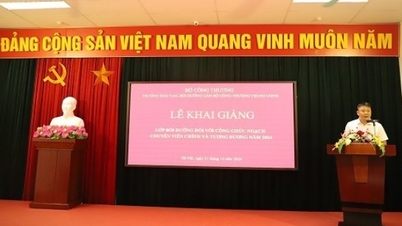
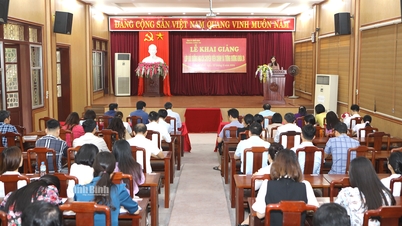
Review and update the competency framework and IT skill standards integrating digital skills for state officials, civil servants, and public employees. Include training content on digital skills and AI in state management training programs for specialists, senior specialists, senior specialists, or equivalent levels.
Source: https://baovanhoa.vn/nhip-song-so/dua-ai-vao-chuong-trinh-dao-tao-quan-ly-nha-nuoc-ngach-chuyen-vien-185011.html
![[Photo] Prime Minister Pham Minh Chinh receives President of Cuba's Latin American News Agency](/_next/image?url=https%3A%2F%2Fvphoto.vietnam.vn%2Fthumb%2F1200x675%2Fvietnam%2Fresource%2FIMAGE%2F2025%2F12%2F01%2F1764569497815_dsc-2890-jpg.webp&w=3840&q=75)





























































































Comment (0)