

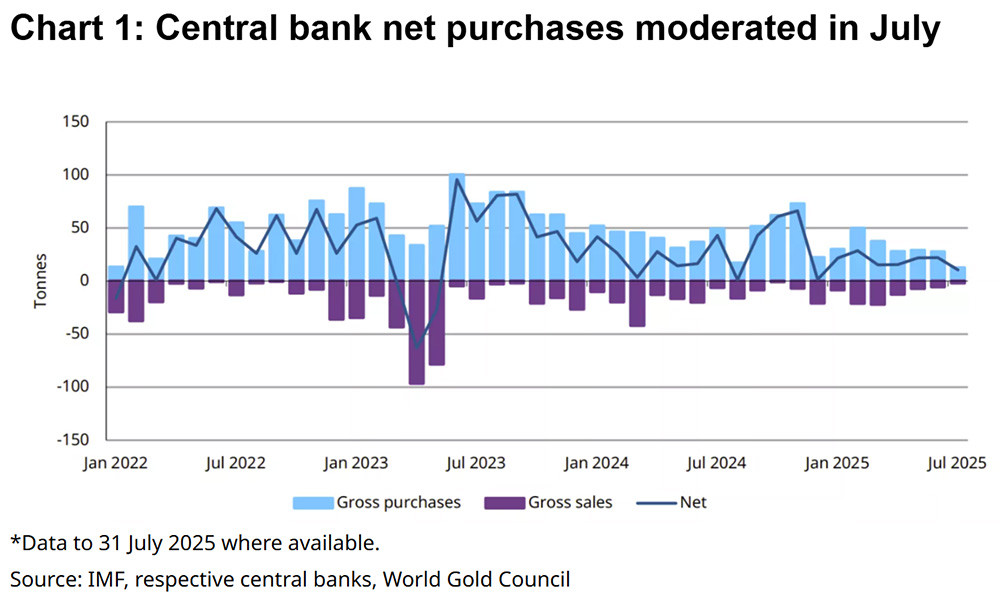
According to a report by the World Gold Council (WGC), global central banks made net purchases of 10 tonnes of gold in July. While this figure is significantly lower than in previous months, it still confirms the stable demand from major financial institutions, particularly in emerging markets.
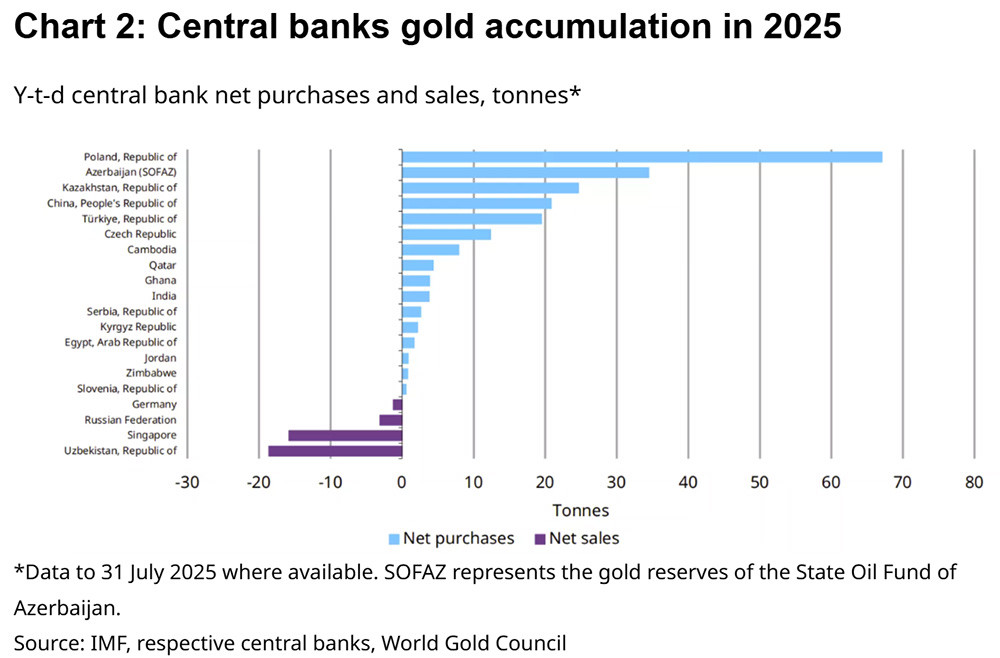
Specifically, the National Bank of Kazakhstan added 3 tons, bringing its total gold purchases since the beginning of the year to 25 tons, ranking third on the list of banks with the highest gold purchases.
The Central Bank of Türkiye, the People's Bank of China, and the Czech National Bank each purchased an additional 2 tons, continuing their steady buying spree.
Turkey has been a net buyer of gold for 26 consecutive months since June 2023. The Czech Republic has been buying gold for 29 consecutive months since March 2023. The People's Bank of China continued its streak of gold purchases for the ninth consecutive month, with total purchases during this period reaching 36 tonnes.
The National Bank of Poland remains the largest net buyer of gold in 2025, with 67 tonnes since the beginning of the year, despite having made virtually no further purchases of the precious metal since May.
In another notable development, the Central Bank of Uganda announced a 2-3 year pilot program to purchase gold domestically from artisanal miners. This initiative aims to build official reserves and reduce reliance on traditional foreign exchange assets, following the bank's announcement of beginning purchases of domestically produced gold.
Marissa Salim, Senior Research Lead at WGC, assessed that, despite the slowdown in net purchases, central banks are still maintaining a net buying position even at the current high price levels.
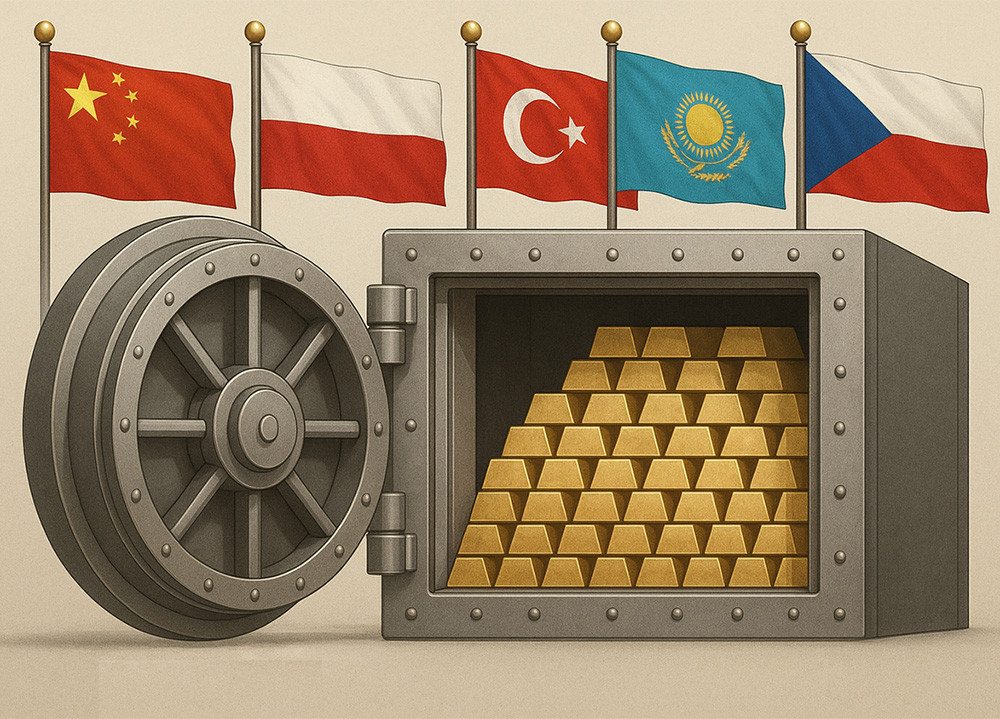
Global central banks continue to add gold to their reserves, a strategic move aimed at diversifying assets and protecting national economies from the unpredictable volatility of global financial markets.
Gold is considered an effective hedge against risk, especially in the context of rising inflation, geopolitical tensions, and the instability of the US dollar.
Holding gold helps mitigate risks when traditional assets like government bonds or foreign currencies depreciate. Furthermore, accumulating this precious metal strengthens confidence in the national currency and demonstrates a country's economic strength.
Central banks have made net purchases of over 1,000 tonnes of gold for three consecutive years (from 2022 to 2024), a pace of buying unprecedented since the 1970s. This demand is more than double the annual average from 2010 to 2021.
Gold prices are expected to rise sharply.
The gold market is experiencing a strong upward trend, with gold prices setting new records amid weak US economic data, increasing expectations of looser monetary policy from the Federal Reserve (Fed).
In the latest report, the number of non-agricultural jobs increased by only 22,000, far below the 75,000 forecast by economists. This figure indicates a surprisingly and significantly slowed pace of hiring.
The unemployment rate rose to 4.3%, compared with 4.2% the previous month. While this increase was within expectations, it still confirms the loosening trend in the labor market.
The report also raised concerns because the employment data for the previous two months had been revised downward. Specifically, the June figures showed a decrease of 14,000 jobs, while the July figures were only slightly revised upwards. In total, the number of jobs in these two months was 21,000 lower than initially reported. These figures reinforce expectations that the Fed will soon cut interest rates to support the economy.
As the likelihood of the Fed cutting interest rates increases, the US dollar tends to weaken. Lower interest rates also reduce the opportunity cost of holding gold, making the precious metal more attractive to investors.
Many major banks and financial institutions have raised their gold price forecasts. Some experts have even set targets of up to $4,000 per ounce in the near future if current trends continue.
Commerzbank and UBS both believe that a price range of $3,600 to $3,700 per ounce is entirely achievable by the end of this year.
Aakash Doshi, an expert at State Street Investment Management, predicts that gold prices could reach $4,000 per ounce in the next 3-6 months if the US economy falls into a state of stagflation.
Source: https://vietnamnet.vn/gia-vang-cao-ky-luc-ong-lon-ngan-hang-cat-ket-them-10-tan-vang-2439745.html

![[Photo] Prime Minister Pham Minh Chinh receives the Governor of Tochigi Province (Japan)](/_next/image?url=https%3A%2F%2Fvphoto.vietnam.vn%2Fthumb%2F1200x675%2Fvietnam%2Fresource%2FIMAGE%2F2025%2F12%2F16%2F1765892133176_dsc-8082-6425-jpg.webp&w=3840&q=75)
![[Live] 2025 Community Action Awards Gala](/_next/image?url=https%3A%2F%2Fvphoto.vietnam.vn%2Fthumb%2F1200x675%2Fvietnam%2Fresource%2FIMAGE%2F2025%2F12%2F16%2F1765899631650_ndo_tr_z7334013144784-9f9fe10a6d63584c85aff40f2957c250-jpg.webp&w=3840&q=75)
![[Image] Leaked images ahead of the 2025 Community Action Awards gala.](/_next/image?url=https%3A%2F%2Fvphoto.vietnam.vn%2Fthumb%2F1200x675%2Fvietnam%2Fresource%2FIMAGE%2F2025%2F12%2F16%2F1765882828720_ndo_br_thiet-ke-chua-co-ten-45-png.webp&w=3840&q=75)

![[Photo] Prime Minister Pham Minh Chinh receives Lao Minister of Education and Sports Thongsalith Mangnormek](/_next/image?url=https%3A%2F%2Fvphoto.vietnam.vn%2Fthumb%2F1200x675%2Fvietnam%2Fresource%2FIMAGE%2F2025%2F12%2F16%2F1765876834721_dsc-7519-jpg.webp&w=3840&q=75)



































































































Comment (0)