

 |
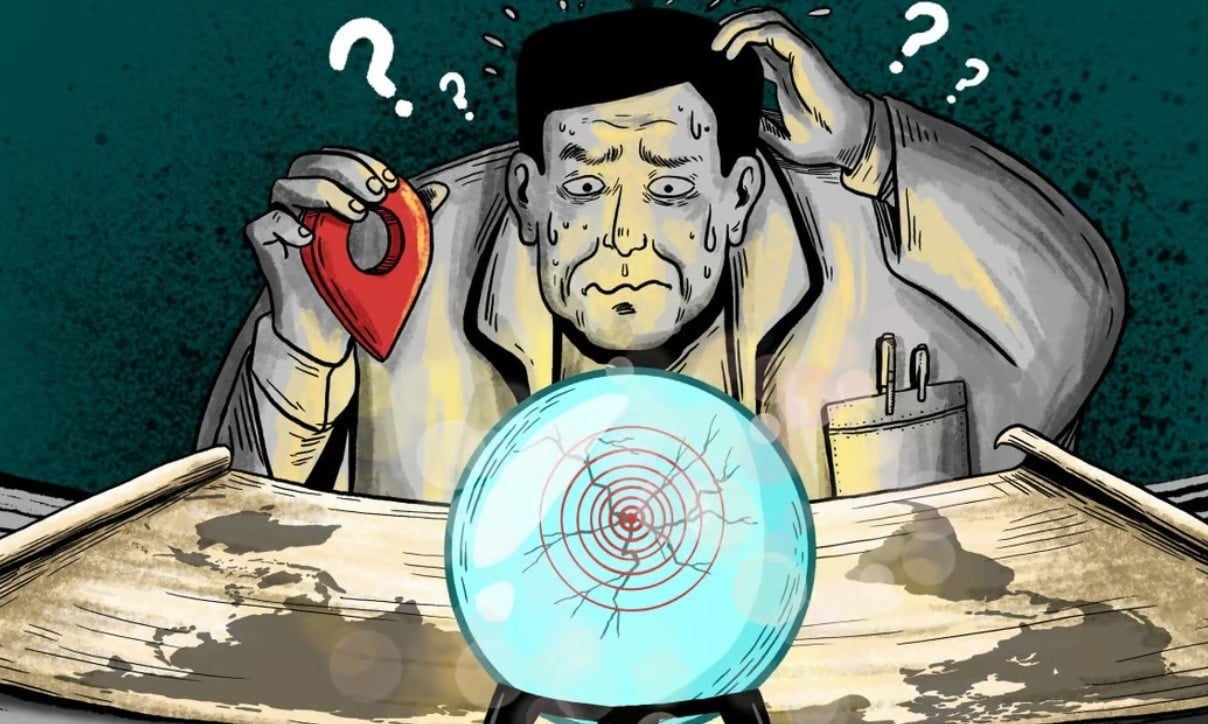
| Chinese scientists are researching and developing tools to accurately predict upcoming large-scale earthquakes around the world . (Source: SCMP) |
Approximately 84 hours before the 7.2 magnitude earthquake struck off the coast of the Alaska Peninsula on July 16th, a group of researchers in China predicted an impending earthquake, but were unable to pinpoint the exact time and location.
Now, the team hopes to further expand its research network to provide more accurate earthquake predictions.
A big step forward
Zhang Maosheng, a professor and dean at Xian Jiaotong University in Shaanxi Province and a researcher at China's Ministry of Natural Resources, received a notification about the appearance of unusual data a few days earlier.
Currently, his team is still unable to predict all the information, including intensity, location, and timing, but they believe that discoveries after 10 years of monitoring earthquake data could bring them closer to this goal in the future.
In an article published in the Northwest China Journal of Geology in June, the research team said they had spent more than a decade measuring the early warning signs of an earthquake.
Using a highly accurate gravity meter, the team has collected data from dozens of earthquakes since 2010, including the devastating earthquake that ravaged Türkiye and Syria on February 6th.
This paper introduces a method for monitoring the Earth's gravitational field at low frequencies, which could be a potential indicator for predicting impending or imminent high-intensity earthquakes.
According to the U.S. Geological Survey (USGS), "warning signs" of a large-scale earthquake can be unusual events such as a series of smaller earthquakes or unusual animal activity.
By monitoring changes in dynamic gravity, the research team stumbled upon a reliable indicator and a potential four-phase mechanism signaling impending earthquakes in the near future.
In particular, during the second phase, or the “locked-in energy storage” phase – which typically occurs between 1 and 15 days before an earthquake – dynamic gravity anomalies are manifested through gravity peaks.
The research team observed the anomalies using a gravitational gauge, a tool that measures changes in the Earth's absolute gravitational force.
Scientists have developed a special dynamic gravity meter to measure anomalies based on fluid movement. This tool is considered more accurate in predicting short-term earthquakes, while also being more cost-effective.
Anomalous readings from this instrument were observed 83 hours before the 7.4 magnitude earthquake in Sulawesi, Indonesia, in September 2018 and 116 hours before the 7.2 magnitude earthquake in Tajikistan in February 2023.
The research team said they consistently observed signs of major earthquakes several days before they occurred, and according to Professor Zhang Maosheng, for earthquakes with a magnitude above 7 on the Richter scale, the accuracy was "up to 100%".
Important scientific discovery
Earthquake prediction has been a focus of attention for Chinese scientists since the 1950s, with concentrated practical research in the 1970s. Predicting earthquakes has significantly reduced casualties.
However, failures in predicting large-scale earthquakes have discouraged scientists in many countries.
According to Professor Liu Huaqing from Northwestern Polytechnic University in Xi'an, Shaanxi Province, many scientists in countries like the United States and Japan do not believe earthquakes can be predicted, but "Chinese scientists disagree with this view."
The research team began independently observing dynamic gravity data after noticing a correlation between anomalous readings and earthquakes.
In the article, the group shared chat logs, including messages sent five days before the earthquake in Tajikistan. They read unusual results and predicted a large-scale earthquake could occur within the next three days.
Notably, the Turkish-Syrian earthquake disaster earlier this year was also one of the 11 earthquakes observed by the research team. They observed two anomalous gravitational peaks occurring in quick succession.
"We had never observed anything like this before. That day, after the initial earthquake of magnitude 7.8, there was a subsequent earthquake of magnitude 7.5," Professor Zhang Maosheng recounted, adding that the research team had been unable to predict two earthquakes in quick succession.
Professor Zhang Maosheng suggests that further observation is needed to find a link between earthquakes and peak gravity indices, as anomalies in dynamic gravity often occur continuously for a period of time before an earthquake.
The expert added that the ability to predict earthquakes within a range of 1 to 15 days is "very accurate" and far surpasses the achievements made in earthquake prediction research by scientists worldwide today.
The biggest challenge the research team is facing is using the information gathered from the measuring instruments to determine the precise time and location of earthquakes. In addition, the coverage of the devices is quite limited, as the research team has currently only established four sites in Xi'an.
The team's goal is to collaborate with researchers and countries to establish gravimeters around the world to create a comprehensive network for data collection.
"If it receives attention from scientists worldwide and its effectiveness is proven in many places, this will be a very important scientific discovery for earthquake prediction," said Professor Yue Zhongqi, a geologist at the University of Hong Kong (China).
Source
![[Photo] Prime Minister Pham Minh Chinh receives Lao Minister of Education and Sports Thongsalith Mangnormek](/_next/image?url=https%3A%2F%2Fvphoto.vietnam.vn%2Fthumb%2F1200x675%2Fvietnam%2Fresource%2FIMAGE%2F2025%2F12%2F16%2F1765876834721_dsc-7519-jpg.webp&w=3840&q=75)

![[Image] Leaked images ahead of the 2025 Community Action Awards gala.](/_next/image?url=https%3A%2F%2Fvphoto.vietnam.vn%2Fthumb%2F1200x675%2Fvietnam%2Fresource%2FIMAGE%2F2025%2F12%2F16%2F1765882828720_ndo_br_thiet-ke-chua-co-ten-45-png.webp&w=3840&q=75)
![[Live] 2025 Community Action Awards Gala](/_next/image?url=https%3A%2F%2Fvphoto.vietnam.vn%2Fthumb%2F1200x675%2Fvietnam%2Fresource%2FIMAGE%2F2025%2F12%2F16%2F1765899631650_ndo_tr_z7334013144784-9f9fe10a6d63584c85aff40f2957c250-jpg.webp&w=3840&q=75)

![[Photo] Prime Minister Pham Minh Chinh receives the Governor of Tochigi Province (Japan)](/_next/image?url=https%3A%2F%2Fvphoto.vietnam.vn%2Fthumb%2F1200x675%2Fvietnam%2Fresource%2FIMAGE%2F2025%2F12%2F16%2F1765892133176_dsc-8082-6425-jpg.webp&w=3840&q=75)





















































![[Photo] Prime Minister Pham Minh Chinh attends the Vietnam Economic Forum 2025](https://vphoto.vietnam.vn/thumb/402x226/vietnam/resource/IMAGE/2025/12/16/1765893035503_ndo_br_dsc-8043-jpg.webp)
































Comment (0)