

Experts warn that AI is a powerful tool, but like a double-edged sword. The overwhelming economic benefits that AI brings come with serious ethical and data security risks, requiring responsible oversight and unwavering determination from top leadership.
AI is a valuable partner, but it also brings risks.
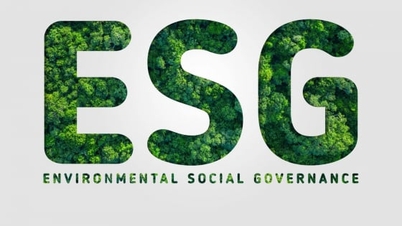
AI plays a crucial role, profoundly impacting all three pillars of ESG, helping businesses shift from traditional governance models based on intuition to data-driven operations. AI is also key to automating ESG data collection and reporting, analyzing millions of variables, and making timely decisions in real time.
As a result, AI helps optimize operational efficiency, reduce energy consumption, and lower carbon emissions. However, the downsides of this technology are also significant.

AI plays a key role, having a strong impact on all three pillars of ESG (Photo: Reuters).
The deployment of AI is consuming resources at an alarming rate. Training large AI models can consume enormous amounts of electricity. It is estimated that AI and Blockchain data centers could consume the equivalent amount of electricity as the entire country of Japan by 2026.
According to Dr. Dinh Viet Sang, training a large AI model can emit five times the amount of carbon equivalent to the average lifespan of a car. The training process for an advanced model like GPT-3 can consume approximately 700,000 liters of clean water per training session.
Clearly, for AI to become a savior for the planet, businesses must strike a balance between technological power and environmental responsibility.
One of the biggest risks of AI, particularly concerning the Social (S) pillar of ESG, is ethical and bias issues. AI bias, such as racial or color bias, stems directly from the quality of the input data.
AI models learn from internet data, and if the training data is biased, the AI will absorb and amplify these biases. This is especially dangerous in critical processes like recruitment, where AI is used to screen thousands of job applications in a single second.
If the data provided contains racial or gender bias, the AI system could ignore the voices of minority groups and make unfair hiring decisions, undermining the goals of gender equality and diversity in the workforce within ESG.
To address this issue, experts must apply rigorous technical measures. Mr. Vu Thanh Thang, Director of Artificial Intelligence at CAIO, emphasized the need to ensure that the input data is unbiased, diverse, and complete. Afterward, testing must be conducted using various tests to see if the model reveals any bias.

Mr. Vu Thanh Thang - Director of Artificial Intelligence at CAIO - Founder of SCS Cybersecurity Joint Stock Company, member of the Judging Panel of the ESG Vietnam Forum.
If so, businesses must supplement data to rebalance or eliminate that model. Even more advanced techniques like "Devil Semantic Generation" should be used to challenge AI itself, testing its logic and accuracy to prevent it from fabricating information.
Along with ethics, the security of personal data is another major risk when applying AI. Data is a business's most valuable asset. However, handling sensitive customer or employee information, if leaked, can lead to serious consequences such as fraud, loss of brand trust, and damage to the company's reputation.
Currently, Vietnam still lacks a clear legal framework for AI, making it difficult to assess "unethical" behavior or security breaches. This is a major bottleneck, especially considering that surveys show 90% of small and medium-sized enterprises (SMEs) in Vietnam do not have cybersecurity staff or systems in place.
This exposes them to the risk of cyberattacks, ransomware, and especially direct attacks on AI models – which are considered the "brains" running the business.
To address these risks, cybersecurity needs to be considered one of the four pillars, alongside IoT, AI, and Blockchain. Furthermore, this element must be designed from the outset when building ESG systems.
Establishing a framework for effective AI control.
With the national legal framework for AI being finalized, businesses need to proactively build a robust internal legal framework.
This framework needs to be based on existing state laws and decrees (such as the Cybersecurity Law and the Personal Data Protection Law) to clearly define what employees are and are not allowed to do with AI. For example, only approved AI tools should be used, and uploading sensitive company data to public platforms should be strictly prohibited.
Furthermore, adherence to intellectual property rights is also a core principle, limiting reliance on AI to protect human creativity and intellectual capital. Business leaders need to organize regular training sessions to raise employee awareness of ethical and security risks, thereby minimizing risks from unintentional actions.

Strong leadership is a crucial factor in creating consensus, helping businesses completely transform and differentiate themselves from competitors (Photo: CNBC).
Ms. Tran Phuong Nga, CEO of Thien Long Group, stated that the group has built an internal AI model based on an open platform, applying strict regulations on information security and intellectual property rights compliance to prevent legal risks and ensure that products are primarily created from human intelligence.
Although challenges related to cost, human resources, and security are real, experts agree that the biggest obstacle for Vietnamese businesses, especially SMEs, is not money but the will of their leaders.
Mr. Vu Thanh Thang argued that the essence of AI transformation is not "burning money" but rather investing to reap many times the profit. The question is whether the leaders truly understand the crucial role of AI and ESG, and whether they have the determination to prioritize these factors.
Strong leadership is a crucial factor in creating consensus, helping businesses undergo a complete transformation and differentiate themselves from competitors.
Leaders set the goals, while AI is merely an "intelligent partner" that assists in execution; it cannot replace humans in strategic and risky decisions. AI can help businesses increase revenue from 100 billion to 1 trillion without a corresponding increase in the number of employees. This only happens if leaders are determined to make the transformation.
To ensure success and responsibly manage the "double-edged sword" of AI, leadership needs commitment and a well-structured implementation plan, starting with data standardization. Success will come to organizations that know how to balance the power of technology with responsibility towards the planet.
On the afternoon of December 22nd, the ESG Vietnam 2025 forum, organized by Dan Tri Newspaper, will take place in Hanoi .
The forum provided in-depth analysis and a comprehensive perspective on the role of technology in ESG implementation.
Within the framework of the program, the Vietnam ESG Awards 2025 ceremony will be a highlight, honoring pioneering and exemplary organizations and businesses in promoting sustainable development.
With the theme " Science and Technology as a Driving Force for Sustainable Development," the event aims to contribute to laying the foundation for a sustainable and prosperous future for Vietnam.
Interested readers can register to attend the seminar with two participation packages: Standard and VVIP, with limited spaces available.
Upon successful registration, the organizers will send your participation ticket via email, for your convenience in checking in for the program on December 22nd.
The benefits of the Standard tier (worth 500,000 VND) include a good seat, access to seminar materials, and event gifts.
The benefits of the VVIP package (VND 2,000,000) include VIP seating, a private dinner with the speaker at Pullman Hanoi, exclusive gifts, a private check-in area, and seminar materials from the organizers. Due to limited seating, registration may close earlier if all seats are filled.
Source: https://dantri.com.vn/cong-nghe/dien-dan-esg-viet-nam-kiem-soat-con-dao-hai-luoi-ai-trong-esg-20251216105052546.htm

![[Photo] Prime Minister Pham Minh Chinh receives the Governor of Tochigi Province (Japan)](/_next/image?url=https%3A%2F%2Fvphoto.vietnam.vn%2Fthumb%2F1200x675%2Fvietnam%2Fresource%2FIMAGE%2F2025%2F12%2F16%2F1765892133176_dsc-8082-6425-jpg.webp&w=3840&q=75)

![[Live] 2025 Community Action Awards Gala](/_next/image?url=https%3A%2F%2Fvphoto.vietnam.vn%2Fthumb%2F1200x675%2Fvietnam%2Fresource%2FIMAGE%2F2025%2F12%2F16%2F1765899631650_ndo_tr_z7334013144784-9f9fe10a6d63584c85aff40f2957c250-jpg.webp&w=3840&q=75)
![[Image] Leaked images ahead of the 2025 Community Action Awards gala.](/_next/image?url=https%3A%2F%2Fvphoto.vietnam.vn%2Fthumb%2F1200x675%2Fvietnam%2Fresource%2FIMAGE%2F2025%2F12%2F16%2F1765882828720_ndo_br_thiet-ke-chua-co-ten-45-png.webp&w=3840&q=75)
![[Photo] Prime Minister Pham Minh Chinh receives Lao Minister of Education and Sports Thongsalith Mangnormek](/_next/image?url=https%3A%2F%2Fvphoto.vietnam.vn%2Fthumb%2F1200x675%2Fvietnam%2Fresource%2FIMAGE%2F2025%2F12%2F16%2F1765876834721_dsc-7519-jpg.webp&w=3840&q=75)





























































































Comment (0)