

According to estimates widely agreed upon by domestic and international experts, Vietnam needs a massive amount of capital to achieve its goals, projected at approximately US$1.4 trillion (US$280 billion/year) over the next five years. Meanwhile, financial resources for Vietnamese businesses still primarily rely on the banking system, with credit already at 134% of GDP. Other capital mobilization channels have not developed proportionally: the stock market (as of November 30, 2025) is only about 81.9% of GDP, significantly lower than the target of 100% of GDP; the bond market currently only reaches about 23.1% of GDP compared to the target of 47%...
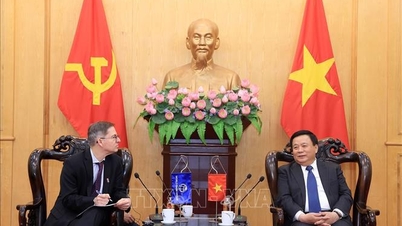
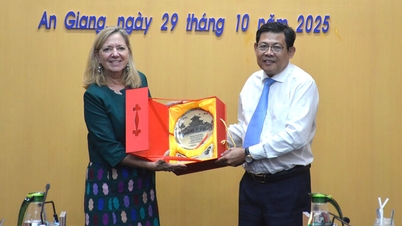
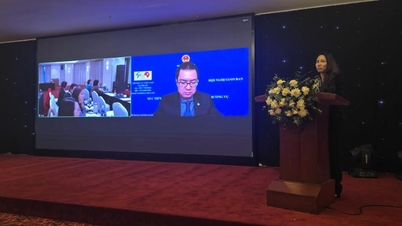
During a meeting with the Governor of the State Bank of Vietnam, Nguyen Thi Hong, at the end of November, the Vice President of the World Bank for East Asia and the Pacific , Felipe Jaramillo, warned that excessively rapid credit expansion, while asset quality and system reserves decline, could pose risks of macroeconomic instability and long-term consequences.
The World Bank leader's recommendation is quite similar to the opinions of many domestic experts, namely that pressure from bad debt, liquidity, and capital costs could return if credit continues to increase rapidly while the capital market has not developed proportionally. Shifting the investment structure, focusing more on production and business rather than speculative sectors, is an urgent requirement to ensure sustainable growth.
Sharing an international perspective, a representative from the International Monetary Fund noted that rapid credit growth in the past was often accompanied by bad debts and pressure on banks' balance sheets, especially in the context of banks having to comply with international standards such as Basel III. On the other hand, if double-digit growth targets are achieved but inflation is high, that growth figure will lose much of its meaning, and people will certainly not fully benefit from the growth.
To address these entirely legitimate concerns, international experience has shown that the crucial factor is not just mobilizing sufficient capital, but also allocating it appropriately, using it efficiently, and creating the highest possible added value by increasing the proportion of development investment spending, focusing on strategic infrastructure, inter-regional infrastructure, digital infrastructure, energy, and green transformation… The efficiency of capital utilization must become a consistent criterion in both public and private investment.
Besides fiscal policy, the capital market needs to be developed to become a pillar for mobilizing medium and long-term resources, gradually reducing dependence on bank credit. To achieve this, it is necessary to develop the stock market, bond market, and international capital flows in a coordinated manner, creating a balanced, competitive, and mutually supportive capital structure; at the same time, it is necessary to strongly develop non-deposit lending institutions such as leasing companies and consumer finance companies.
If close and effective coordination between fiscal and monetary policies is identified as a key factor in maintaining macroeconomic stability, controlling inflation, and supporting high growth, then institutional reform and building a transparent and stable legal environment are considered fundamental and decisive solutions to retain financial resources and attract long-term strategic investors to Vietnam and establish a strong foothold.
Source: https://www.sggp.org.vn/kiem-soat-tot-rui-ro-de-vung-vang-tang-truong-post829089.html
![[Live] 2025 Community Action Awards Gala](/_next/image?url=https%3A%2F%2Fvphoto.vietnam.vn%2Fthumb%2F1200x675%2Fvietnam%2Fresource%2FIMAGE%2F2025%2F12%2F16%2F1765899631650_ndo_tr_z7334013144784-9f9fe10a6d63584c85aff40f2957c250-jpg.webp&w=3840&q=75)

![[Image] Leaked images ahead of the 2025 Community Action Awards gala.](/_next/image?url=https%3A%2F%2Fvphoto.vietnam.vn%2Fthumb%2F1200x675%2Fvietnam%2Fresource%2FIMAGE%2F2025%2F12%2F16%2F1765882828720_ndo_br_thiet-ke-chua-co-ten-45-png.webp&w=3840&q=75)

![[Photo] Prime Minister Pham Minh Chinh receives Lao Minister of Education and Sports Thongsalith Mangnormek](/_next/image?url=https%3A%2F%2Fvphoto.vietnam.vn%2Fthumb%2F1200x675%2Fvietnam%2Fresource%2FIMAGE%2F2025%2F12%2F16%2F1765876834721_dsc-7519-jpg.webp&w=3840&q=75)
![[Photo] Prime Minister Pham Minh Chinh receives the Governor of Tochigi Province (Japan)](/_next/image?url=https%3A%2F%2Fvphoto.vietnam.vn%2Fthumb%2F1200x675%2Fvietnam%2Fresource%2FIMAGE%2F2025%2F12%2F16%2F1765892133176_dsc-8082-6425-jpg.webp&w=3840&q=75)









































































Comment (0)