

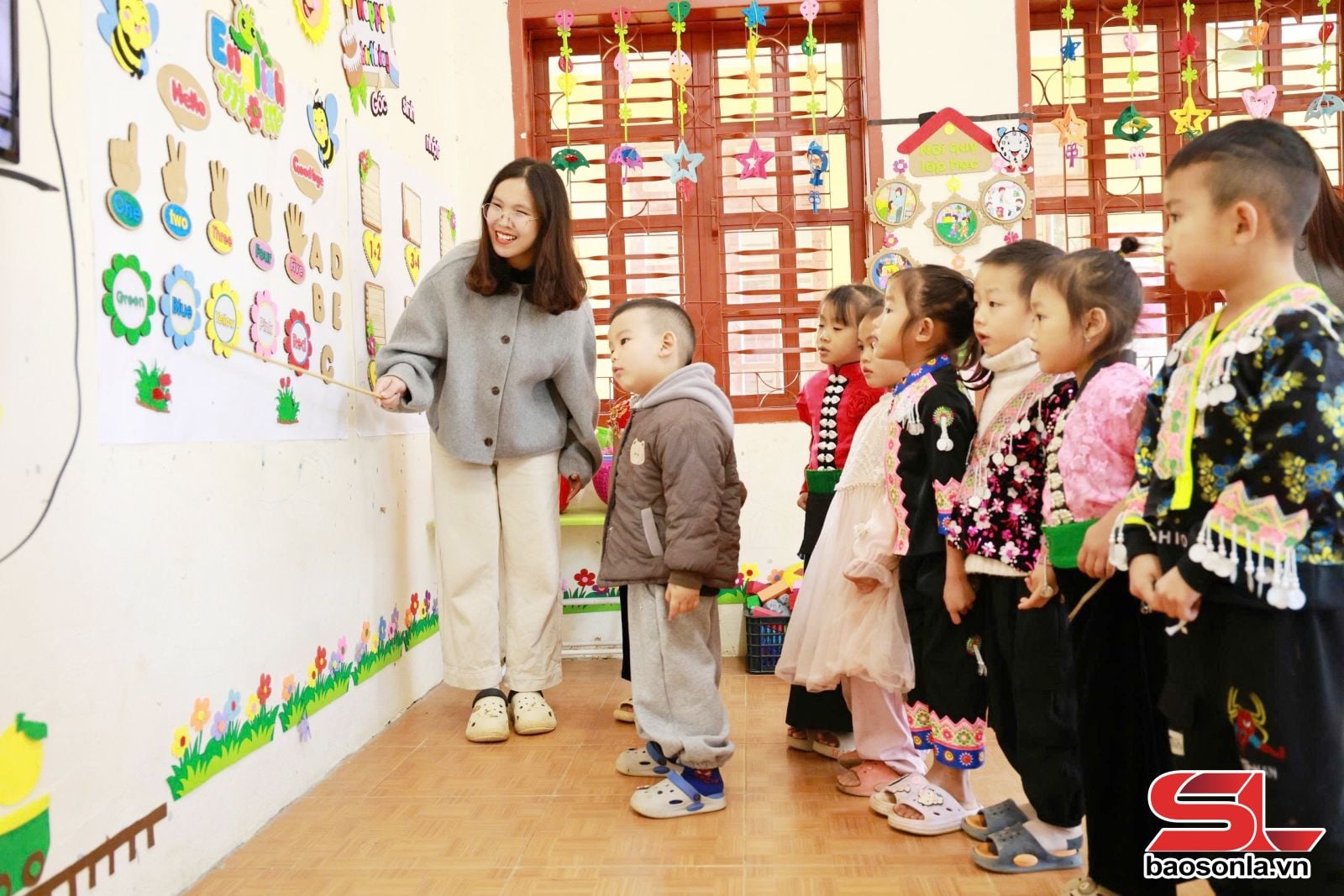
In the border commune of Muong Lan, the melody of the English song "What's your name?" fills the air, enlivening the atmosphere at the Na Khi village school branch of Hoa Phong Lan Kindergarten. Inside the classroom, ethnic minority students excitedly get acquainted with the new language. Through the melody and games, the children learn how to greet, introduce themselves, and practice basic communication skills.
The Na Khi school branch has 66 students, all children of the Mong, Khmu, and Thai ethnic minorities. This school year marks the second year these students have been learning and becoming familiar with English. Thanks to the enthusiastic guidance of the teacher in charge, the students have been able to memorize song lyrics, communicate with each other using simple words, and gradually approach the new language. Ms. Lo Thi Van, the English teacher, shared: At the school branch, there are two English lessons per week. The teachers approach and apply many teaching methods through songs, games, and visual aids to help children easily absorb and enjoy English lessons.
Hoa Phong Lan Kindergarten in Muong Lan commune has 925 children across 17 separate school locations. After more than a year of teaching English, the children are very enthusiastic, and the connection between teachers and students is more effective than before. Ms. Nguyen Thi Nu, the school principal, said: "The school hopes for more investment in facilities, especially in a team of specialized English teachers to make teaching foreign languages more effective for the children."
At Hoa Mai Kindergarten in Muong E commune, English language teaching has been implemented for over a year. The school has 5 campuses, 16 classes, and nearly 500 students, mainly children of the Mong ethnic minority. The school requires teachers to use online software and creatively add more simulation tools that are familiar to daily life to better illustrate lessons, helping children learn more quickly.
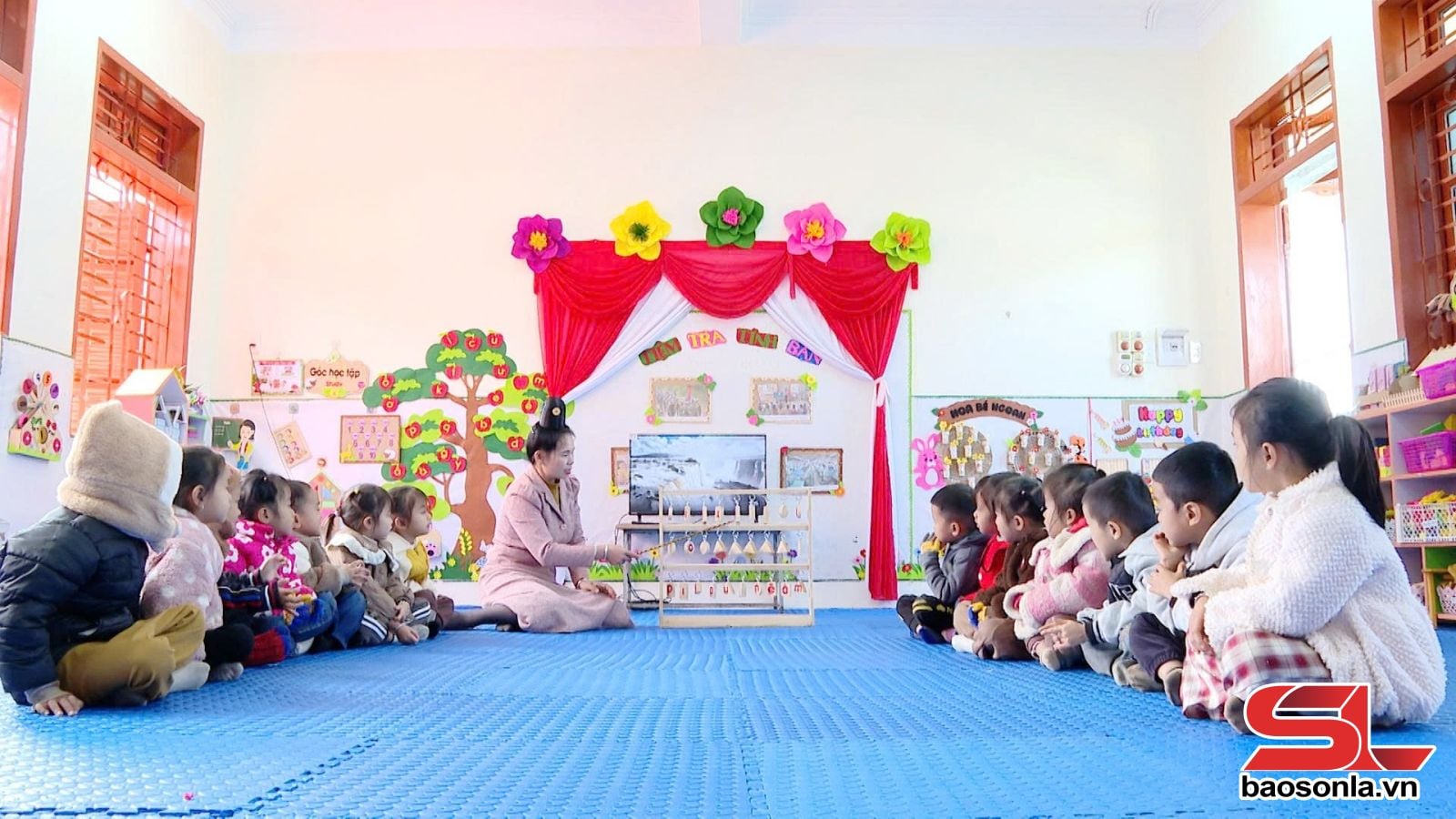
Ms. Lo Thi Thu, the English teacher at Hoa Mai Kindergarten in Muong E commune, said: "Most of the students here are from ethnic minority groups. The language barrier is the biggest challenge when we teach English to them. However, seeing the children enthusiastic and passionate in each lesson gives us more motivation to try to choose the most approachable and positive teaching methods so that the children can get acquainted with and absorb the new language naturally."
Despite being new to the subject, the children in the highlands showed enthusiasm for learning a foreign language and getting acquainted with the creative and interactive teaching methods of their teachers. Quàng Bảo Ngọc, a senior kindergarten student at Hoa Mai Kindergarten in Mường É commune, said: "I like the English songs the most. I learned English greetings with my teacher and friends, so I'm very happy."
Since 2024, 150 out of 227 preschools in the province have implemented the "Solutions for managing and improving the quality of English language activities in preschools ." Many schools in disadvantaged areas such as Bac Yen, Quynh Nhai, and Song Ma have organized English classes for children aged 3-5. The education sector aims to increase the percentage of preschool children introduced to English from 9.3% in the 2021-2022 school year to nearly 40% in the 2025-2026 school year. The Son La Department of Education and Training has issued a set of criteria for evaluating the management of English language activities in preschools, helping schools review and improve their management capacity and control the quality of education in practice.
The new model and innovative approaches are expected to help children in the mountainous areas of the province have the opportunity to access English, contributing to the implementation of the policy of making English the second language in schools during the 2025-2035 period.
Source: https://baosonla.vn/khoa-giao/giup-tre-em-vung-cao-som-tiep-can-tieng-anh-ZtOe0xGDg.html
![[Image] Leaked images ahead of the 2025 Community Action Awards gala.](/_next/image?url=https%3A%2F%2Fvphoto.vietnam.vn%2Fthumb%2F1200x675%2Fvietnam%2Fresource%2FIMAGE%2F2025%2F12%2F16%2F1765882828720_ndo_br_thiet-ke-chua-co-ten-45-png.webp&w=3840&q=75)
![[Live] 2025 Community Action Awards Gala](/_next/image?url=https%3A%2F%2Fvphoto.vietnam.vn%2Fthumb%2F1200x675%2Fvietnam%2Fresource%2FIMAGE%2F2025%2F12%2F16%2F1765899631650_ndo_tr_z7334013144784-9f9fe10a6d63584c85aff40f2957c250-jpg.webp&w=3840&q=75)
![[Photo] Prime Minister Pham Minh Chinh receives Lao Minister of Education and Sports Thongsalith Mangnormek](/_next/image?url=https%3A%2F%2Fvphoto.vietnam.vn%2Fthumb%2F1200x675%2Fvietnam%2Fresource%2FIMAGE%2F2025%2F12%2F16%2F1765876834721_dsc-7519-jpg.webp&w=3840&q=75)

![[Photo] Prime Minister Pham Minh Chinh receives the Governor of Tochigi Province (Japan)](/_next/image?url=https%3A%2F%2Fvphoto.vietnam.vn%2Fthumb%2F1200x675%2Fvietnam%2Fresource%2FIMAGE%2F2025%2F12%2F16%2F1765892133176_dsc-8082-6425-jpg.webp&w=3840&q=75)


































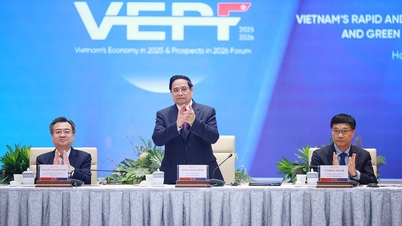
![[Photo] Prime Minister Pham Minh Chinh attends the Vietnam Economic Forum 2025](https://vphoto.vietnam.vn/thumb/402x226/vietnam/resource/IMAGE/2025/12/16/1765893035503_ndo_br_dsc-8043-jpg.webp)
























Comment (0)