

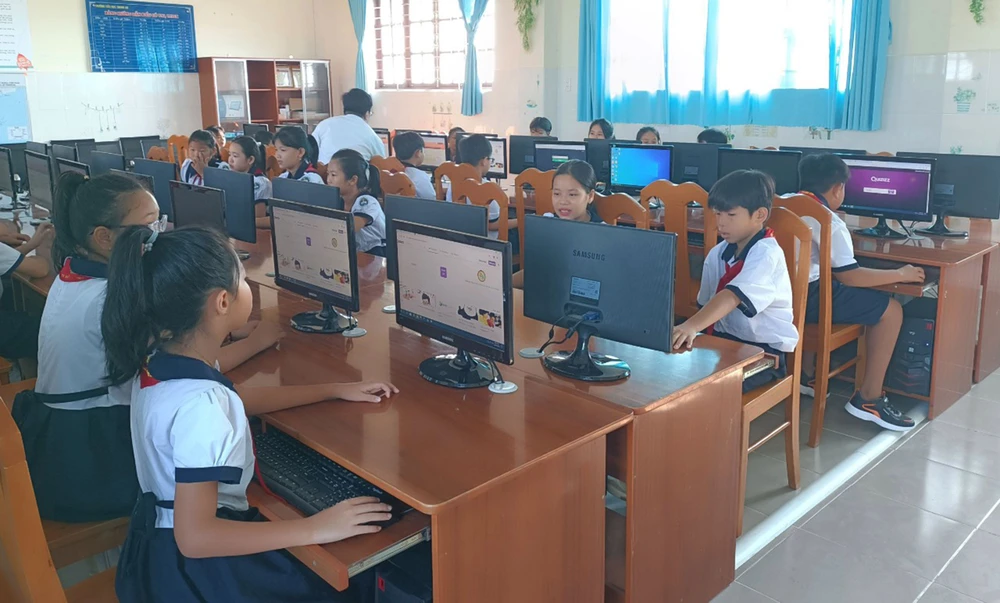
In the 2023-2024 academic year, Ho Chi Minh City's education and training sector strongly pursued digital transformation in management and innovation of teaching methods in schools. However, due to limitations in human resources and funding, the results have not met expectations.
Implement in stages.
According to statistics from the Ho Chi Minh City Department of Education and Training, by the end of the 2023-2024 school year, approximately 80% of schools in the city had implemented a digital learning resource repository. In primary schools alone, the shared digital learning resource bank contained a total of 22,838 lessons, including 5,068 level 1 resources (Word, PowerPoint, PDF files, etc.) and 17,770 level 2 resources (interactive lessons). Most schools have deployed digital platforms to promote online teaching and learning, synchronizing teaching results, tests, and assessments with real-world student and school data. Notably, this is the first school year that the education sector has piloted digital citizenship skills education for students in 44 primary schools in Thu Duc City and 21 districts, while also implementing a digital student record management system and electronic communication log.
Mr. Nguyen Thai Vinh Nguyen, Head of the Education and Training Department of Thu Duc City (Ho Chi Minh City), said that the use of digital student records and electronic gradebooks helps schools store, manage, and use student records more conveniently. In addition, this form of record helps teachers reduce the pressure of paperwork and record keeping, transparently manage students' academic and behavioral performance, and minimize problems related to altering academic results. However, during the implementation process, a portion of teachers have limited computer skills, resulting in less effective application of information technology, and the adoption of software lags behind requirements. Currently, most schools do not have dedicated IT staff due to recruitment difficulties. Furthermore, the development, evaluation, sharing, and updating of digital learning materials require significant financial investment to ensure quality and meet the learning and research needs of teachers and students.
Concurring with this view, the Head of the Education and Training Department of District 7, Dang Nguyen Thinh, expressed that investment and development in technology is easier in the non-public education system, while public schools face difficulties due to limitations in facilities and investment funds. To address the resource constraints, District 7 is implementing a project to establish a modern shared experimental practice center for 40 public educational institutions in the area using stimulus loan funds. This approach helps schools quickly access modern teaching and learning conditions in the context of limited funding.
Taking a different approach, Tran Hung Dao Primary School (District 1) successfully built a digital library model by breaking down the implementation plan into several stages. In the first stage, the school focused on basic items such as operating the library management software system and providing online resources for teachers and students to read at home or search online. In the next stage, teachers and students were provided with personal accounts to search for materials, participate in discussions, and share the books they had read. As resources became more abundant, the library expanded its function to become a place for professional development activities and support group work for students and teachers.
Focus on the human element.
Mr. Le Duy Tan, Head of the Secondary Education Department (Ho Chi Minh City Department of Education and Training), believes that human resources play a crucial role in implementing digital transformation because without operators, the technological infrastructure cannot be effectively utilized. When operators are present, it's necessary to avoid a situation where each school implements it differently, building grandiose learning resource libraries to chase achievements without considering the actual learning needs of students. Therefore, digital transformation needs to be controlled, not following a general template, but based on actual conditions and the capabilities of learners at each institution. From another perspective, according to Mr. Nguyen Bao Quoc, Deputy Director of the Ho Chi Minh City Department of Education and Training, schools should not wait until they have money and resources to implement it. Instead, they need a long-term investment strategy, dividing the implementation plan into many specific items over each school year to effectively exploit and utilize resources.
Leaders of the Education and Training Departments proposed that the Ho Chi Minh City Department of Education and Training issue guidelines on the development and implementation of a long-term financial plan to ensure stable funding for the implementation of digital student records, and simultaneously issue regulations on the use of digital signatures in school management and teaching activities. During implementation, localities need to proactively apply periodic backup and recovery measures to ensure data integrity and recovery, meeting the security and privacy requirements of students. Especially in the context of limited resources, digital transformation should be implemented gradually, one grade level per school year, to ensure effectiveness.
According to Nguyen Van Hieu, Director of the Ho Chi Minh City Department of Education and Training, in the 2024-2025 academic year, the education and training sector will focus on promoting digital transformation, aiming to implement the theme of the academic year: "Discipline, responsibility, innovation, and digital transformation to improve the quality of education and training in Ho Chi Minh City."
MINH QUAN
Source: https://www.sggp.org.vn/go-nut-that-chuyen-doi-so-giao-duc-post754702.html


![[Photo] General Secretary and President To Lam presides over a working session with the Central Policy and Strategy Committee on the development of the materials industry.](https://vphoto.vietnam.vn/thumb/1200x675/vietnam/resource/IMAGE/2026/05/21/1779359935432_a3-bnd-3129-1412-jpg.webp)

































































































Comment (0)