

Increasing the plant's capacity and exploiting backup groundwater sources are the city's immediate solutions to address the clean water shortage in many areas.
Currently, Hanoi 's clean water supply is short by 10,000 to 20,000 cubic meters per day, causing localized water shortages in many areas of Thanh Xuan and Nam Tu Liem districts, as well as Thanh Oai and Hoai Duc districts, for more than half a month.
The Hanoi Department of Construction predicts that localized water shortages in many areas will continue to recur. During the summer of 2024, Hanoi faces a risk of a daily water deficit of approximately 50,000 cubic meters, concentrated in the west and southwest.
The main reason is that many clean water supply projects are behind schedule, while the city is required to reduce groundwater extraction according to the plan.
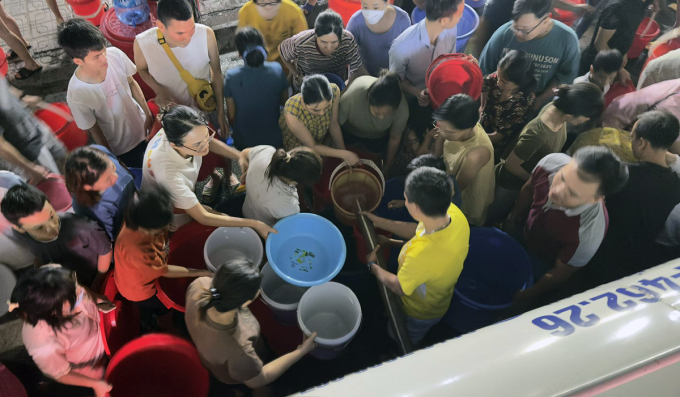
Residents of Thanh Ha urban area (Thanh Oai district) collect water from a water tanker on the evening of October 17th. Photo: Manh Luc
Currently, the designed capacity of the city's centralized water treatment plants is over 1.5 million m3, with actual production in 2023 reaching nearly 1.3 million m3 per day.
To ensure that water demand is met in 2024, the city requires the Duong River and Da River Water Supply Companies to prepare solutions to operate a reserve capacity that is 20% higher than the current level, subject to the time and technical conditions permitting.
A representative from the Duong River Surface Water Company stated that the plant is currently operating at nearly 100% of its Phase 1 capacity – 300,000 m3 per day. Regarding increasing capacity to compensate for the city's water shortage, the company representative said that according to the technical design standards, the plant can increase its capacity by an additional 20,000-30,000 m3 compared to the current average design capacity of 300,000 m3 per day. "However, increasing capacity can only be done with the permission of the management agency and within specific timeframes to ensure the safety of the system," the company representative added.
Mr. Nguyen Xuan Quy, General Director of Song Da Clean Water Investment Joint Stock Company, said that the company is currently operating the plant at its phase 1 capacity of 300,000 cubic meters per day. "Maintaining the current capacity ensures the safety and security of the water supply for the people of Hanoi," Mr. Quy said, adding that providing a larger water supply depends on phase 2 of the plant, which, upon completion, will increase the capacity to 600,000 cubic meters per day.
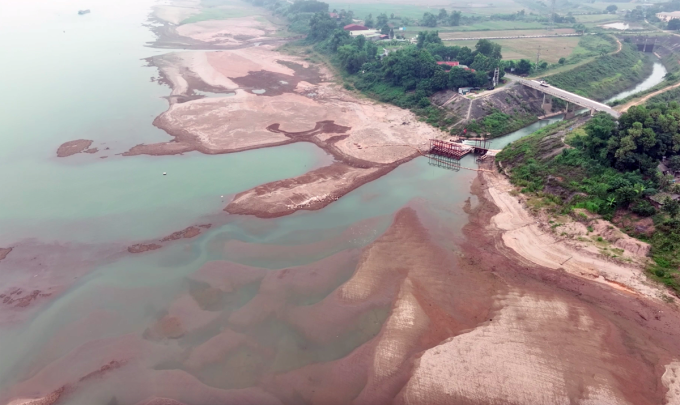
The water intake area of the Da River Surface Water Treatment Plant (Hop Thanh commune, Ky Son district, Hoa Binh province) is running low, photo taken on October 24. Photo: Hoang Phong
However, the progress of phase 2 is behind schedule. The reason is that during the investment preparation phase, the water level of the Da River dropped too low, causing difficulties in water supply. The company installed a temporary pumping station in 2020 and an emergency pumping station in 2023 to be able to draw raw water from the Da River into the canal leading to the production plant.
Based on the above situation, the company has researched and proposed adjusting the water intake gate from the Da River to approximately 1.5 km upstream from its original location. If the adjusted planning policy is approved soon, phase 2 of the Da River surface water treatment plant is expected to be completed and put into operation in 2025.
According to Mr. Le Van Du, Deputy Head of the Technical Infrastructure Department (Hanoi Department of Construction), the Da River surface water treatment plant reported that it can increase its capacity thanks to technical measures such as reducing the loss rate in the treatment line and recovering filter wash water... When the plant completes the sludge treatment project, its capacity can be increased to 315,000-320,000 m3 per day.
"In design, water treatment plants always have peak and off-peak safety factors. Companies must calculate and regulate, prioritizing the safety and quality of water supply, rather than increasing capacity at all costs," Mr. Du said.
Another potential source of water supply mentioned by the city is the commissioning of the Red River surface water treatment plant in Lien Hong commune, Dan Phuong district, in the first quarter of 2024. The plant, covering an area of over 20 hectares and with a capacity of 300,000 m3 per day, was initially planned for operation in the first quarter of 2021 but the project has been delayed twice.
In addition, the city is also allowing the exploitation of groundwater resources that were previously projected to decrease to meet the increased demand.
Mr. Le Van Du stated that the planning direction for groundwater treatment plants will gradually reduce their capacity as surface water treatment plants meet the needs of the people. When not in use, groundwater sources will be shut off and used as a backup source in case of emergency.
Currently, the groundwater source managed by Hanoi Water Supply Company has reduced groundwater extraction by approximately 200,000 m3 per day. However, to meet immediate needs while phase 2 of the Da River surface water treatment plant is not yet completed, the company will use that reserve source to compensate for the shortfall.
For areas at the end of the water supply line or in areas with high ground levels where water supply is difficult, the city directs units to develop detailed water supply plans for each area, such as supplementing with mobile booster pumps and operating water supply valves on a scheduled basis.
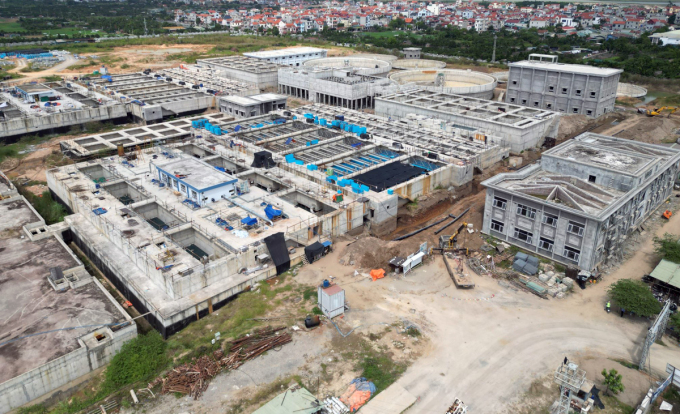
The Red River surface water treatment plant is nearly three years behind schedule. Photo: Hoang Phong
To ensure water supply for the coming years, the Department of Construction said it will expedite planned water supply projects such as: the second phase of the Da River surface water treatment plant; increasing the capacity of the Bac Thang Long plant; and researching the construction of the second phase of the Duong River water treatment plant... Only when these projects are completed will the clean water shortage throughout the city be resolved.
Currently, Hanoi's total water supply capacity is 1,530,000 m3 per day. This includes 770,000 m3 of groundwater and 750,000 m3 of surface water. The rural water supply network has a designed capacity of 300-1,000 m3 per day for each station.
Hanoi's population at the end of 2022 was 8.4 million, of which over 4.1 million (over 49%) lived in urban areas and nearly 4.3 million (almost 51%) lived in rural areas. Water demand in the inner city is 100-150 liters/day/person, while in rural areas it is 50-70 liters. The water supply coverage rate is 100% in urban areas and 85% in rural areas.
The city aims to ensure that by 2025, 100% of its population (urban, satellite, and rural) have access to clean water. Specifically, urban residents will have access to 125-160 liters of water per person per day, satellite residents to 100-125 liters, and rural residents to 105-110 liters per person per day.
Vo Hai
Source link
![[Photo] Solemn bathing ceremony and Buddha procession in Hue](https://vphoto.vietnam.vn/thumb/1200x675/vietnam/resource/IMAGE/2026/05/31/1780228263543_1-jpg.webp)
![[Photo] The General Secretary, President and his wife begin their state visit to the Philippines.](https://vphoto.vietnam.vn/thumb/1200x675/vietnam/resource/IMAGE/2026/05/31/1780230559452_anh-man-hinh-2026-05-31-luc-19-28-11.png)

![[Photo] Admire the coral "masterpiece" amidst the million-year-old heritage of Dak Lak province.](https://vphoto.vietnam.vn/thumb/1200x675/vietnam/resource/IMAGE/2026/05/31/1780221235105_anh-man-hinh-2026-05-31-luc-16-53-27.png)



















![[Video] Sunset at Lap An Lagoon – Where the sun sets over the fishing nets](https://vphoto.vietnam.vn/thumb/340x192/vietnam/resource/IMAGE/2026/05/31/1780192137701_beach-landscape-sea-water-nature-grass-745871-pxhere-com.jpeg)





































![[Photo] Admire the coral "masterpiece" amidst the million-year-old heritage of Dak Lak province.](https://vphoto.vietnam.vn/thumb/402x226/vietnam/resource/IMAGE/2026/05/31/1780221235105_anh-man-hinh-2026-05-31-luc-16-53-27.png)

































Comment (0)