

Da Lat – a city of vibrant flowers in all four seasons, a dreamy and enchanting land – is an endless source of inspiration for poetry, music, and art. To commemorate 130 years of Da Lat's formation and development (1893-2023), the Da Lat City People's Committee has just released a collection of 130 songs about Da Lat, published by Thanh Nien Publishing House.
 |
| A collection of 130 songs about Da Lat. |
Holding the book in their hands, readers are amazed by the meticulousness and inherent value of this music anthology. It seems that all the best songs about Da Lat, spanning both breadth and depth over more than a century, have been gathered and presented here. These are songs that immediately come to mind when mentioning Da Lat: "Who Goes to the Land of Cherry Blossoms" (Hoang Nguyen), "Da Lat Sunset" (Minh Ky - Da Cam), "Sad City" (Lam Phuong), "Mimosa" (Tran Kiet Tuong), "Da Lat Wind and Clouds" (Pham Trong Cau - Nguyen Luong Hieu), "Da Lat Winter" (The Hien), "Distant Street" (Le Quoc Thang), "Lake Surface" (Trong Thuy)...
130 songs express a range of emotions, in response to nature, the sky, the sun, wind, clouds, rain, hills, waterfalls, grass, trees, flowers… They are the heartfelt expressions of the author's love for Da Lat. Compiled and edited by musician Quynh Hop, the author shared: “Many musicians, brimming with emotion, have left behind musical works that resonate deeply with music lovers and accompany the city's development. Present in these songs is the beauty of nature, architecture, and people in this land of flowers, pine trees, lakes, waterfalls, and incredibly romantic and beautiful hillside towns.”
 |
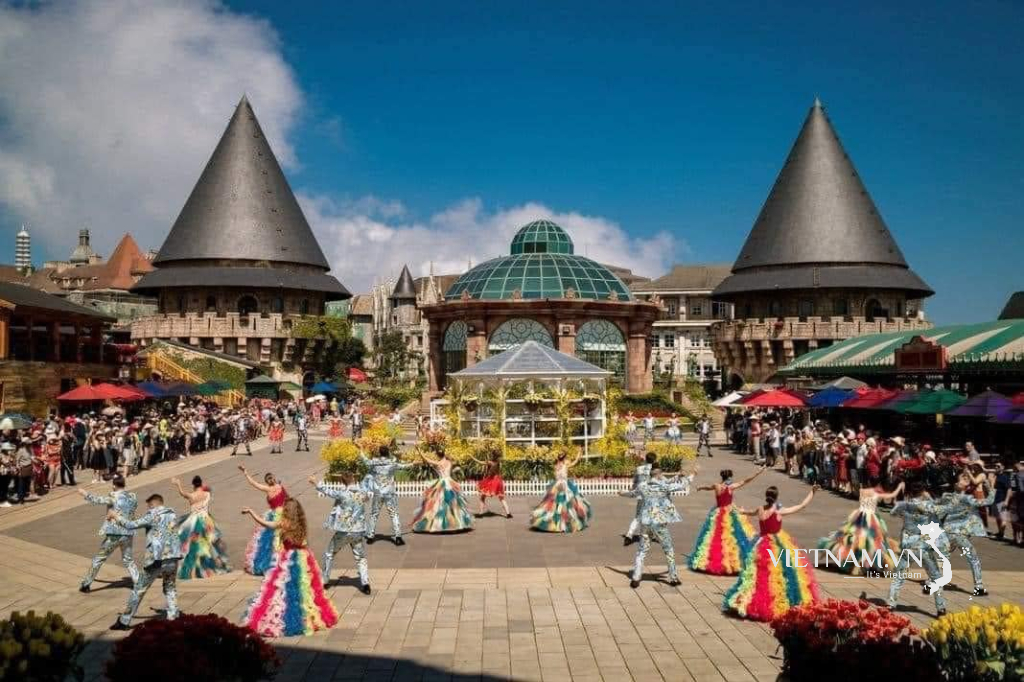
| Many art programs at Lam Vien Square, Da Lat. |
There, the range of human emotions in the face of beautiful nature, the human connections that have lasted for over a century, are reflected. The melodious, gentle, captivating, and overflowing music of Da Lat, originating from the tranquil cafes of the 20th century, gradually ascends to the grand stage of the vibrant, youthful, and expansive festivals of the early 21st century. Alongside the melancholic songs that were once deeply ingrained in the hearts of audiences, the anthology also contains very new works, never before performed or sung on any stage, composed during a writing camp themed "Da Lat: 130 Years of Formation and Development." Many of these songs have a contemporary feel, incorporating genres such as Pop, Pop Ballad, Hip-hop-Rap, and R&B, enriching Da Lat's music with a fresh and vibrant color. Many of the authors are very young, belonging to Generation Z. Through each musical note and lyric, we can see that the artist and art are also secretaries of the times.
The meticulousness of this anthology lies not only in its accurate musical scores, but also in its brief introductions to the authors, their works, the circumstances of their creation, and the emotions, lyrics, and musical ideas behind each song. The inclusion of complete information about the 130 authors—including their birth dates, hometowns, backgrounds, and current residences—allows readers to better understand and connect with their favorite songs, further enhancing the book's value.
With the song "Who Goes to the Land of Peach Blossoms" (music and lyrics by Hoang Nguyen), which is loved by many people in Da Lat, besides the sheet music with notes, melodies, and a portrait of the author, the public is also provided with the following information: "Composer Hoang Nguyen, real name Cao Tu Phuc, was born in 1932 in Quang Tri . He studied at Hue National High School and participated in the resistance against the French in the early 1950s in the battlefield of Zone 4, then left the mountains and forests for the misty city. Hoang Nguyen's trilogy of songs about Da Lat's peach blossoms, including 'Poem of Peach Blossoms,' 'Who Goes to the Land of Peach Blossoms,' and 'Peach Blossoms of Yesteryear,' are all written in C major with a slow tempo. The music describes the ethereal mist, the rolling hills and mountains associated with beautiful memories of youth in a city with Western beauty... You don't need to set foot in Da Lat to feel the dreamy, hazy beauty with mist, the colors of the flowers, the clouds, and feel as if you've wandered there." Entering paradise through the lyrics of "Who Goes to the Land of Cherry Blossoms?".
In the song "Da Lat Sunset" (music and lyrics: Minh Ky - Da Cam), alongside the familiar musical score that was once inscribed on the flower-lined streets of Ho Tung Mau slope, the collection also provides readers with valuable information: "Composer Minh Ky was born in 1930, his real name was Nguyen Phuc Vinh My, he was the 5th generation descendant of King Minh Mang, studied music in Quy Nhon from the age of 14, and composed his first song at the age of 19 (1949). In his 45-year life and career, the composer left behind hundreds of famous songs and is always considered one of the most representative composers of the 'golden age' music before 1975… When mentioning Da Lat, one cannot fail to mention composer Minh Ky with songs such as: 'Love Story by Than Tho Lake,' 'Da Lat Sunset,' 'Longing for the Cold Land.' Each composition leaves an indelible mark in the hearts of music lovers and those who love the city of a thousand flowers…"
The process of selecting and collecting images and information about 130 works by 130 authors, introducing the authors and the emotions behind their creation, was a lengthy and laborious one. The dedication, responsibility, and meticulous effort of the editors and selectors, musicians Quynh Hop and Ha Dinh Nguyen, are clearly evident in every page, earning the admiration of music lovers and avid readers. As musician Quynh Hop expressed: "This anthology is a beautiful panorama of Da Lat's music—both familiar and unfamiliar, tranquil and joyful, traditional and contemporary, simple and elegant… a colorful bouquet celebrating Da Lat's 130th anniversary and its recent recognition by UNESCO as a Creative City for Music."
It could be said that this anthology only represents a fraction of what the authors dedicated to Da Lat, as many authors who wrote entire collections of famous songs about Da Lat, such as Minh Ky and Hoang Nguyen, only selected one representative work. Therefore, upon closing the book, the greatest regret is that many beautiful songs about Da Lat, already deeply ingrained in the public's memory and known to everyone, were not included in this anthology, such as "Longing for the Cold Land" (Minh Ky), "Dreamy Da Lat" (Who Gave You Rosy Cheeks... Tu Huy), and "Da Lat, the Heroic City" (Ha Huy Hien).
Source


![[Photo] Announcement Ceremony of the Art Program “Light Concert – Welcoming the New Year 2026”](/_next/image?url=https%3A%2F%2Fvphoto.vietnam.vn%2Fthumb%2F1200x675%2Fvietnam%2Fresource%2FIMAGE%2F2026%2F01%2F27%2F1769514762857_le-cong-bo-ct-hoa-nhac-anh-sang-1772-9042-jpg.webp&w=3840&q=75)
![[Photo] Commemorating the unwavering friendship between Vietnam and Laos](/_next/image?url=https%3A%2F%2Fvphoto.vietnam.vn%2Fthumb%2F1200x675%2Fvietnam%2Fresource%2FIMAGE%2F2026%2F01%2F27%2F1769518372051_ndo_br_1-jpg.webp&w=3840&q=75)


![[Hightling] Conference on the Implementation of Tasks for 2026](/_next/image?url=https%3A%2F%2Fvphoto.vietnam.vn%2Fthumb%2F402x226%2Fvietnam%2Fresource%2FIMAGE%2F2026%2F01%2F27%2F1769477856197_dsc01637.jpeg&w=3840&q=75)


![OCOP during Tet season: [Part 2] Hoa Thanh incense village glows red.](/_next/image?url=https%3A%2F%2Fvphoto.vietnam.vn%2Fthumb%2F402x226%2Fvietnam%2Fresource%2FIMAGE%2F2026%2F01%2F27%2F1769480573807_505139049_683408031333867_2820052735775418136_n-180643_808-092229.jpeg&w=3840&q=75)
![OCOP during Tet season: [Part 1] Ba Den custard apples in their 'golden season'](/_next/image?url=https%3A%2F%2Fvphoto.vietnam.vn%2Fthumb%2F402x226%2Fvietnam%2Fresource%2FIMAGE%2F2026%2F01%2F26%2F1769417540049_03-174213_554-154843.jpeg&w=3840&q=75)




Comment (0)