

.jpg)
Taking a deep breath, filling my lungs with the scent of the highland soil and vegetation, I wondered: How has Kon Vơng Kia (also known as Konke village, Mang Den commune, former Kon Tum province) managed to withstand the tourism boom in Mang Den and preserve its pristine beauty like this?
pristine mountain region
The young teacher, Le Dan Ha, a former student of mine from the coastal city of Da Nang, occasionally came here to "seclude herself," leading me around the village like wandering children on a dreamy summer vacation.
In the morning, the small concrete road winding up and down through the village seemed to float through a thin mist. In the opposite direction, local people were carrying baskets into the mountains to gather firewood and wild vegetables.
The name Kon Vơng Kia only appeared recently, when Kon Plông district (formerly Kon Tum province) merged the three villages of Kon Vơng, Kon Kia, and Kon Péc into one.
The stunning terraced rice fields, painted by nature's artist, are a tapestry of vibrant yellow hues, interspersed with verdant pine hills. Amidst this golden hue of autumn, the Nước Long stream meanders, flowing from Kon Sử village to Kon Chốt, then rushing like a lover returning to Kon Vơng Kia. The stream provides water and fertile silt, nourishing the lush, blossoming rice paddies.
Against this picturesque backdrop, the three suspension bridges of Kon Doa, Y Bay, and Kon Pec stand out like delicate threads of silk, connecting villages and rice paddies to create a romantic mountain song.
The afternoon here descends quickly, so quickly that before you can even take a deep breath to regain your strength after climbing to the summit of Ngok Pơng hill, nestled amidst a dreamy pine forest, the sun hides behind the mountains, casting a hazy purple mist in the distance like an illusion.
Suddenly, I felt a pang of nostalgia for the afternoon in Tay Giang, Quang Nam province, with the towering Que Peak hidden in the mist amidst the clouds.
I remember the sunset casting its shadows over the communal house of Arớh village (formerly Lăng commune, now Tây Giang commune, Da Nang city), the voice of the village elder Bh'riu Pố telling stories of primeval times amidst the evening mist. I remember the bare feet dancing to the tâng tung da dá dance during the festival season.
And the planned visit to the vast cypress forest with Pơloong Plênh, a cultural officer from Tây Giang, remained unfinished because of the rain and muddy roads, forcing them to stand at the edge of the forest, looking in with regret.
Gentle and mysterious to entice customers to return.
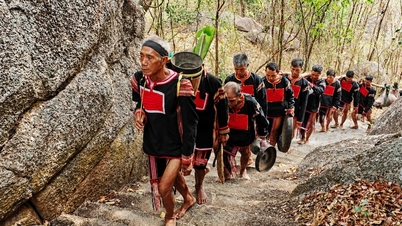
Even though I only spent two days in Kon Vong Kia, I felt that the Xe Dang people here live peacefully in their small houses nestled along the rice fields.
The village road was quiet, with only the occasional slow-moving farm vehicle, crawling along like a ladybug climbing a hill.
It seems that all the highland villages I passed through shared a common trait: they were gentle enough to make you want to stay longer, but also mysterious enough to entice you to return.
Gazing at the panoramic view of Kon Vơng Kia from the top of Ngok Pơng hill, nestled amidst a dreamy pine forest, I am reminded of the slow mornings at the ĐhRôồng community tourism village in Tà Lu commune, in the old Đông Giang region.
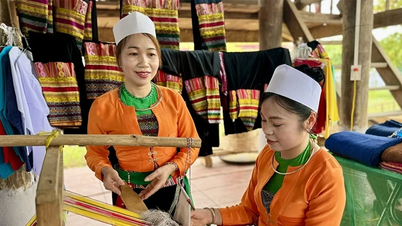
Here and there, glimpses of mountain girls sitting on verandas weaving cloth, their hands silently moving the shuttle in the pristine sunlight, casting soft streaks of light that melt away emotions that have long been hardened.
Once, when he saw me enjoying a type of plain rice cake made from upland rice, wrapped in dong leaves and shaped like buffalo horns, the village elder Cơlâu Nhím in Ghúc (Gừng) village, Prao town, now Đông Giang commune, smiled softly and said: “The rice is grown by the villagers, the cakes are wrapped by the villagers. They are cooked with firewood gathered from the forest. That's all, but each cake encapsulates the soul of the Cơ Tu people…”
Preserving the soul of the village
Kon Vơng Kia is one of the four community-based tourism villages of the former Kon Plông district, but the way the village develops seems slow but steady.
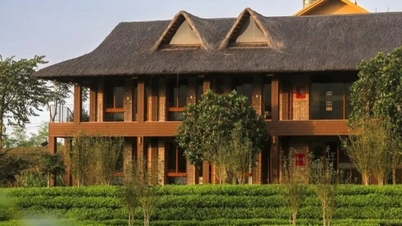
This was evident in the enthusiastic and proud way Mr. Hung, the village Party Secretary, spoke when we met him in the organic vegetable garden: "Since tourism started, the village has had 8 homestays for guests. 6 of them belong to villagers, and the rest are built by people from outside the area who bought land."
But everyone agreed to preserve traditional features, using materials like wood, tiles, bamboo, and rattan... Minimizing the use of corrugated iron and steel. Especially, avoiding violent plowing and leveling of mountains, hills, rivers, and streams…”
Moreover, Kon Vơng Kia has restored and organized three gong and traditional dance troupes, two adult troupes and one children's troupe, with a total of 88 members.
Teacher and writer Dinh Su Giang helps create scripts for the performances, while other philanthropists assist the gong ensemble in preserving the unique cultural beauty of the villagers day and night.
I suddenly remembered a recent field trip to survey the Co Tu culture by the Da Nang Folk Arts Association. We heard Pơloong Plênh, a very young cultural officer from Tay Giang, say that the centuries-old cypress forest located in the heart of the vast wilderness of the two communes of Tr'Hy and A Xan (formerly Tay Giang) was discovered in 2008 and officially announced in 2011.
To date, six tourist routes have been opened into the cypress forest, all adhering to the principle of "not touching the forest trees," including vines and trees that are not cypress.
The local people have preserved that forest as if it were sacred. Since its discovery, only one tree has been lost, due to falling over caused by storms…
The way those two ethnic groups preserve the soul of their villages sometimes makes me dream of returning to the highlands.
There, the Xê Đăng xoang dance is faintly heard, accompanied by the lingering sound of the Bơrét Cơ Tu flute drifting through the forest, flowing along the meandering A Vương river downstream.
The buffalo horn-shaped pastry gleams in the sunlight, dancing in the mystical story of Mother Forest. The pure, bare arms of the Co Tu girl rise above her head, the spirit of the mountain people soaring like the wings of the sacred T'ring bird, messenger of the Rice God, guiding the villagers to find a new path while preserving the mountain spirit that has existed for generations…
Source: https://baodanang.vn/hon-son-cuoc-3317159.html
![[Photo] Capturing the moment the tide recedes at Yen Binh Son rapids - a million-year-old scenic spot in Quang Ngai.](https://vphoto.vietnam.vn/thumb/1200x675/vietnam/resource/IMAGE/2026/05/19/1779175463885_yen9-1199-jpg.webp)
![[Photo] National Assembly Chairman Tran Thanh Man attends the groundbreaking ceremony for the National Highway 1A spatial axis project.](https://vphoto.vietnam.vn/thumb/1200x675/vietnam/resource/IMAGE/2026/05/19/1779161360398_ndo_br_bnd-1412-jpg.webp)








![[Livestream] Opening Ceremony of the Traditional Culture Festival of Ethnic Minorities in Thanh Hoa Province, 2026](https://vphoto.vietnam.vn/thumb/402x226/vietnam/resource/IMAGE/2026/05/19/1779198270040_livestream-khai-w1200t0-di2620d272d2183324t11920l1-banner-live-191.webp)






































![[Photo] General Secretary and President To Lam receives Indian Defense Minister Rajnath Singh](https://vphoto.vietnam.vn/thumb/402x226/vietnam/resource/IMAGE/2026/05/19/1779184046302_anh-man-hinh-2026-05-19-luc-16-46-58.png)




















Comment (0)