

(CPV) - Government Inspector General Doan Hong Phong proposed continuing to strengthen the fight against corruption and negative practices at the local and grassroots levels, overcoming petty corruption and the situation of "hot at the top, cold at the bottom".
On the morning of November 26th, the Inspector General of the Government , Doan Hong Phong, reported on the work of preventing and combating corruption in 2024.
Implement multiple solutions decisively and in a coordinated manner.
The Inspector General of the Government stated: In 2024, the work of preventing and combating corruption and negative phenomena was consistently directed by the Party and State leaders, especially the Central Steering Committee on Anti-Corruption and Negative Phenomena; ministries, sectors, localities, and agencies with anti-corruption and negative phenomenon prevention and control functions have implemented many solutions decisively and synchronously with very high political determination, achieving many important results, leaving a positive mark, spreading strongly in society, and receiving the support, response, and high appreciation of cadres, Party members, and the people, enhancing Vietnam's position and prestige in the international arena.
The implementation of anti-corruption measures is demonstrated through the following results: transparency in the organization and operation of agencies, organizations, and units; the development and implementation of norms, standards, and regulations; the implementation of codes of conduct for officials and those in positions of authority; the implementation of job rotation; the implementation of administrative reform and the application of science and technology in management; the implementation of the plan to promote cashless payments; the implementation of regulations on asset and income control; and the handling of responsibility of heads of organizations when corruption occurs.
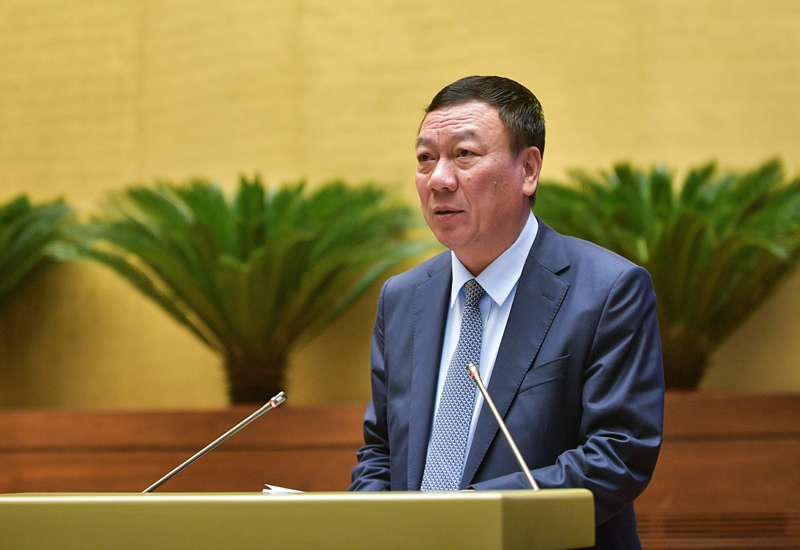 |
| Inspector General of the Government, Doan Hong Phong. (Photo: Archival) |
In 2024, inspections uncovered numerous violations, leading to recommendations for administrative sanctions against 7,629 organizations and 8,714 individuals; 372 cases were transferred to investigative agencies for handling according to their jurisdiction. Through the resolution of complaints and denunciations, recommendations were made to take action against 392 individuals; 25 cases were transferred to investigative agencies for handling according to their jurisdiction.
However, the Inspector General of the Government acknowledged that: Addressing loopholes and inadequacies in mechanisms, policies, and laws is still slow compared to practical requirements; some anti-corruption measures have not been comprehensively implemented; the situation of shirking responsibility, avoiding accountability, and delaying action has not been rectified; apprehending fugitives who have fled abroad remains difficult; and the value of assets to be recovered in corruption and negative cases remains substantial...
Referring to the key tasks for 2025, the Inspector General of the Government, Doan Hong Phong, stated that the focus will be on enhancing the responsibility and role of the heads of agencies, organizations, units, and localities. This includes strengthening administrative discipline and order, and resolutely addressing and rectifying the situation of sluggish work, avoidance, shirking responsibility, and fear of making mistakes among officials and Party members.
Along with that, we must continue to strengthen and comprehensively improve the institutional framework for preventing and combating corruption; continue to strengthen inspection, examination, and auditing work, focusing on areas prone to corruption and negative practices. We must expedite the verification, investigation, prosecution, and trial of serious, complex, and socially significant corruption and negative cases.
The Inspector General of the Government proposed continuing to strengthen the fight against corruption and embezzlement at the local and grassroots levels, overcoming petty corruption and the situation of "enthusiasm at the top, apathy at the bottom".
At the same time, we propose that the National Assembly and the Standing Committee of the National Assembly continue to direct the review, amendment, and supplementation of loopholes, inadequacies, contradictions, and obstacles that easily create conditions for corruption and negative practices in legal documents...
Corruption and malpractice in some areas remain serious and are becoming increasingly complex.
Reviewing the report on this matter, the Chair of the Judicial Committee, Le Thi Nga, stated: The Judicial Committee recognizes that in 2024, the fight against corruption continued to be intensified, achieving many comprehensive results at both the central and local levels; corruption continued to be curbed and prevented. This further affirms the increasing effectiveness and decisiveness of the fight against corruption; making a significant contribution to purifying the system, tightening discipline and order, and promoting the socio-economic development of the country.
Regarding the assessment of the corruption situation, the Judicial Committee basically agrees with the Government's report on the corruption situation, and also notes that in 2024, the fight against corruption continued to be intensified, more decisive and effective at both the central and local levels; many new policies and regulations on combating corruption were issued, disseminated, and seriously implemented. However, the situation of corruption and negative practices in some areas remains serious and complex, with major violations emerging in some fields such as: planning, construction, energy, bidding, public asset management, land management and use, resource and mineral exploitation... Harassment and negative practices in the administrative and public service sectors still occur.
The Chairman of the Judicial Committee pointed out that recent corruption and negative practices demonstrate lax management and a lack of responsibility on the part of many collectives and individuals, especially leaders in state management in some areas. The inspection and supervision of the exercise of power by those in positions of authority has not received adequate attention. The problem of officials and civil servants shirking responsibility, lacking competence, and being afraid to act is still slow to be overcome. Many shortcomings and limitations in anti-corruption work have been clearly identified for many years, but effective solutions have yet to be found.
"The Government should summarize, evaluate, and fully identify the limitations and causes in order to accurately predict the corruption situation; on that basis, clearly identify the main causes and propose breakthrough solutions for effective prevention and control," the Chairman of the Judicial Committee stated.
In 2024, investigative agencies within the People's Public Security Force handled 1,538 cases involving 3,897 defendants accused of corruption. Prosecution was recommended in 856 cases involving 2,686 defendants. The Criminal Investigation Agency of the Ministry of National Defense investigated 23 cases involving 70 defendants; prosecution was recommended in 11 cases involving 57 defendants. The People's Procuratorates at all levels have handled 1,186 cases involving 3,869 defendants, and have resolved 1,006 cases involving 3,242 defendants; the People's Courts at all levels have handled 1,154 cases with 3,201 defendants in first instance trials concerning corruption crimes; and have tried 917 cases with 2,418 defendants. The total number of criminal cases related to corruption and economic crimes requiring enforcement is 12,877, of which 10,944 are eligible for enforcement, and 9,211 have been completed. The State Audit Office has recommended financial adjustments totaling 48,670.38 billion VND. |
Source: https://dangcongsan.vn/thoi-su/tong-thanh-tra-chinh-phu-khac-phuc-te-tham-nhung-vat-684359.html



Comment (0)