

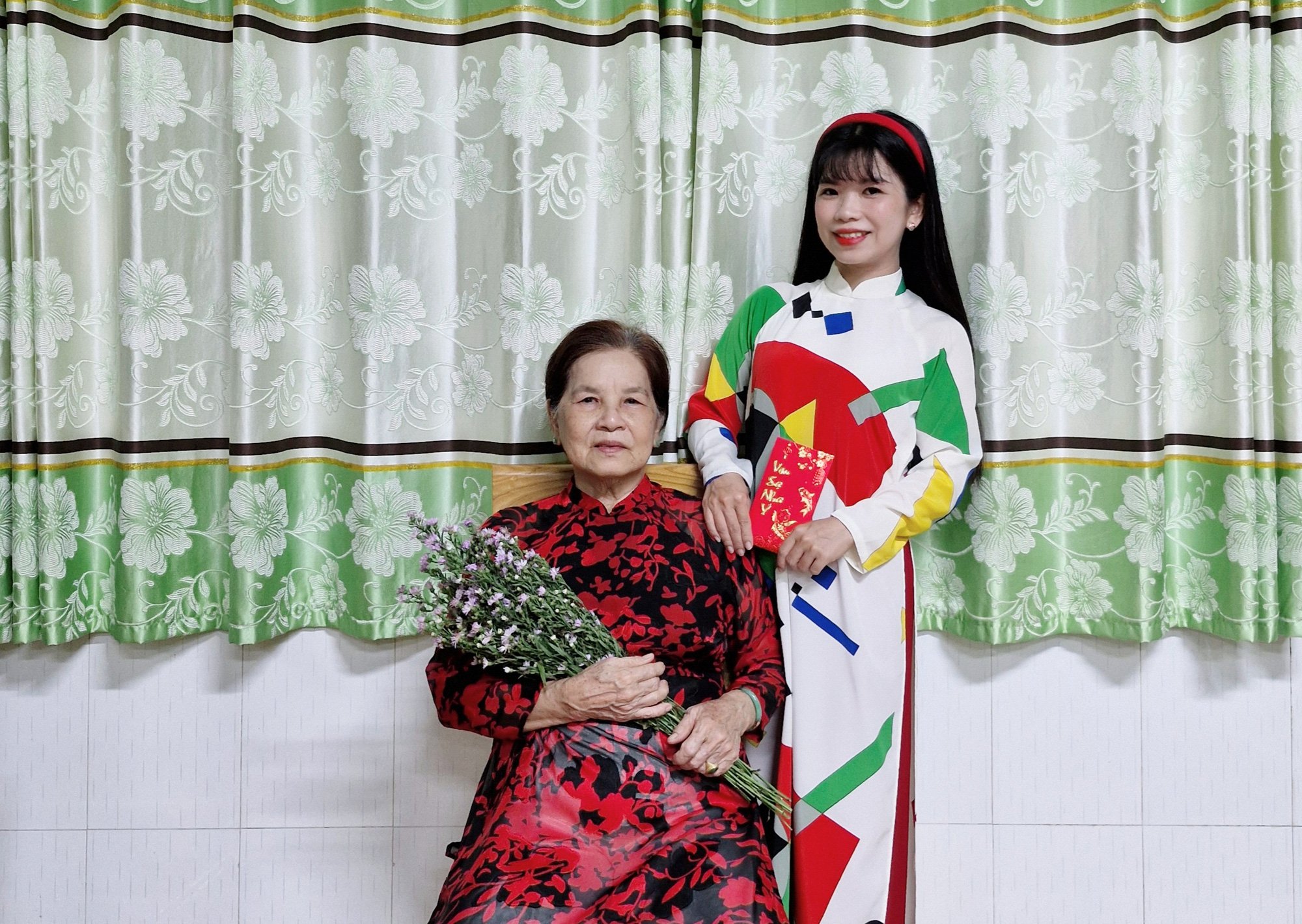
Taking photos with mom during Tet 2024
This year's Tet holiday is special for me. Before Tet, while cleaning the house, I accidentally found my mother's old ao dai (traditional Vietnamese dress) lying quietly in a small drawer.
The white dress, printed with red, blue, and yellow geometric patterns, looked brand new, just as I remembered those Tet holidays, like the old photo of my mother that I used to look at in the family photo album. The dress evoked so many emotions in me about a time of hardship.
That's the shirt my mother bought me thirty years ago. Back then, my hometown was a poor village, with dirt roads and a few thatched houses scattered in the distance amidst vast fields and waterways.
Back then, not many people owned a traditional Vietnamese dress (áo dài). Women probably only wore it on the most important day of their lives – their wedding day. And my mother was no exception; her first áo dài was made from a piece of fabric my grandmother gave her on her engagement day.
My mother said this was a tradition: on the day of the engagement ceremony, among the gifts the groom's family brings to the bride's family, there must be a piece of fabric to give to the bride so she can have a new traditional dress made for her wedding day.
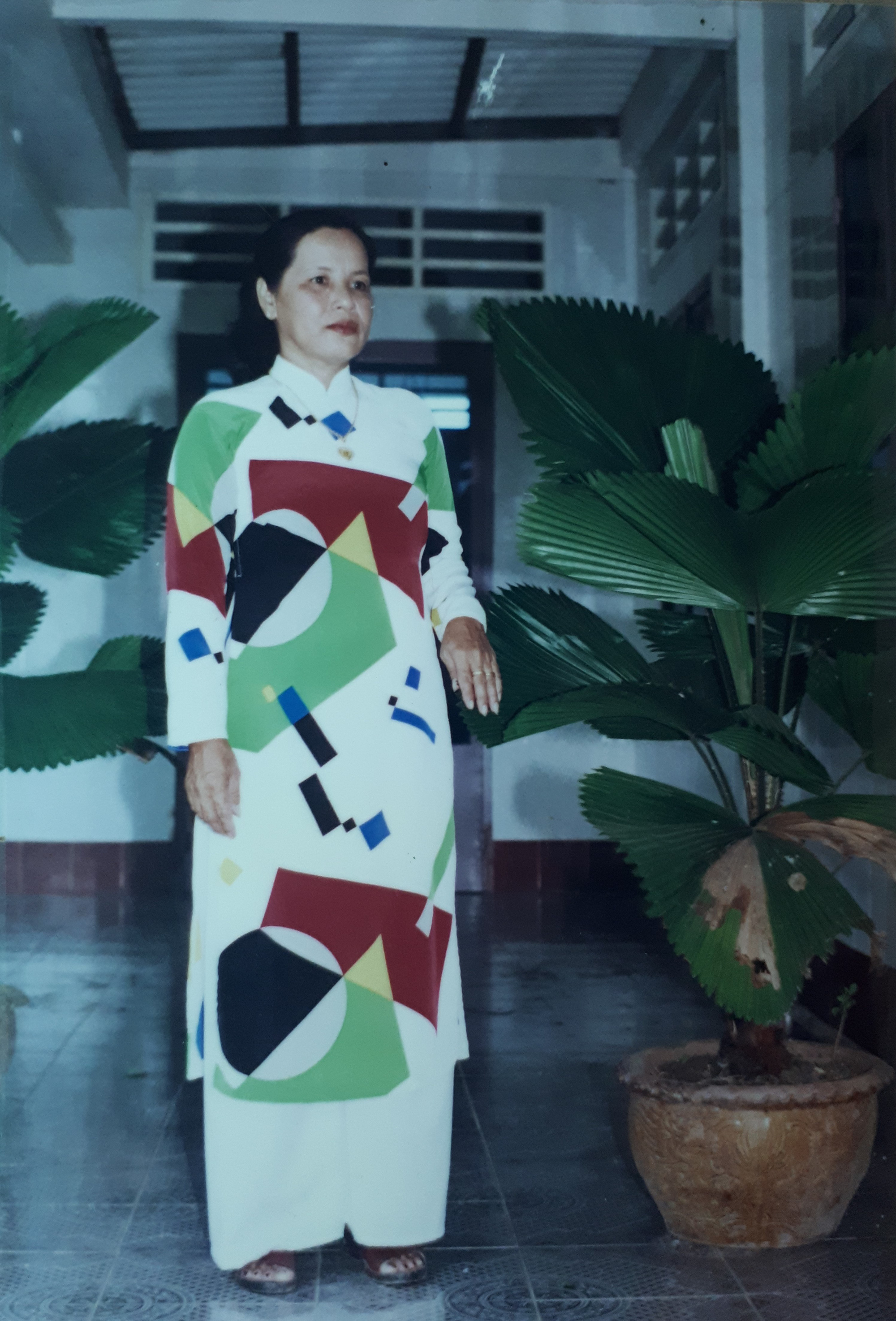
My mother wore an ao dai in 1994 at the photo studio.
In January 1974, wearing a lotus-pink ao dai (traditional Vietnamese dress), my mother became a new bride, following my father to Long Dien Dong. This land of salty water and acidic soil relied solely on a single harvest year-round, depending on the rains. In years of good harvests and high prices, they could manage until the next season. But if pest infestations, diseases, or crop failures occurred, my parents had to scramble to find food, clothing, and education for their children.
Then, it wasn't until Tet in 1994, when her youthful beauty had faded and she was already the mother of three children, that she once again had the opportunity to wear an ao dai (at this time, thanks to a friend's introduction, she worked as a cook for the canteen of a shrimp processing plant in Gia Rai).
Throughout those twenty years, many times when going to the Tet market, my mother would gaze longingly at the new fabrics hanging on the stalls, lost in thought. But then, new clothes for her children, the sweets and treats for Tet... and countless other things quickly dispelled her thoughts about a new ao dai (traditional Vietnamese dress) each spring.
But the second ao dai (traditional Vietnamese dress) my mother ever wore wasn't a truly new one; it wasn't tailored to her measurements. It was bought from a pile of secondhand clothes dumped on the roadside in front of Ho Phong market for twenty-five thousand dong, on the day before Tet when she went to the market to buy food to cook for the workers.
I asked my mother why she didn't buy new clothes instead of secondhand ones, and she said it was because... she was too stingy with money. Her monthly salary was only a little over three hundred thousand dong, and if she bought the fabric and paid for tailoring, one outfit would cost seventy or eighty thousand dong. She saved that money to send back home to my sisters and me.
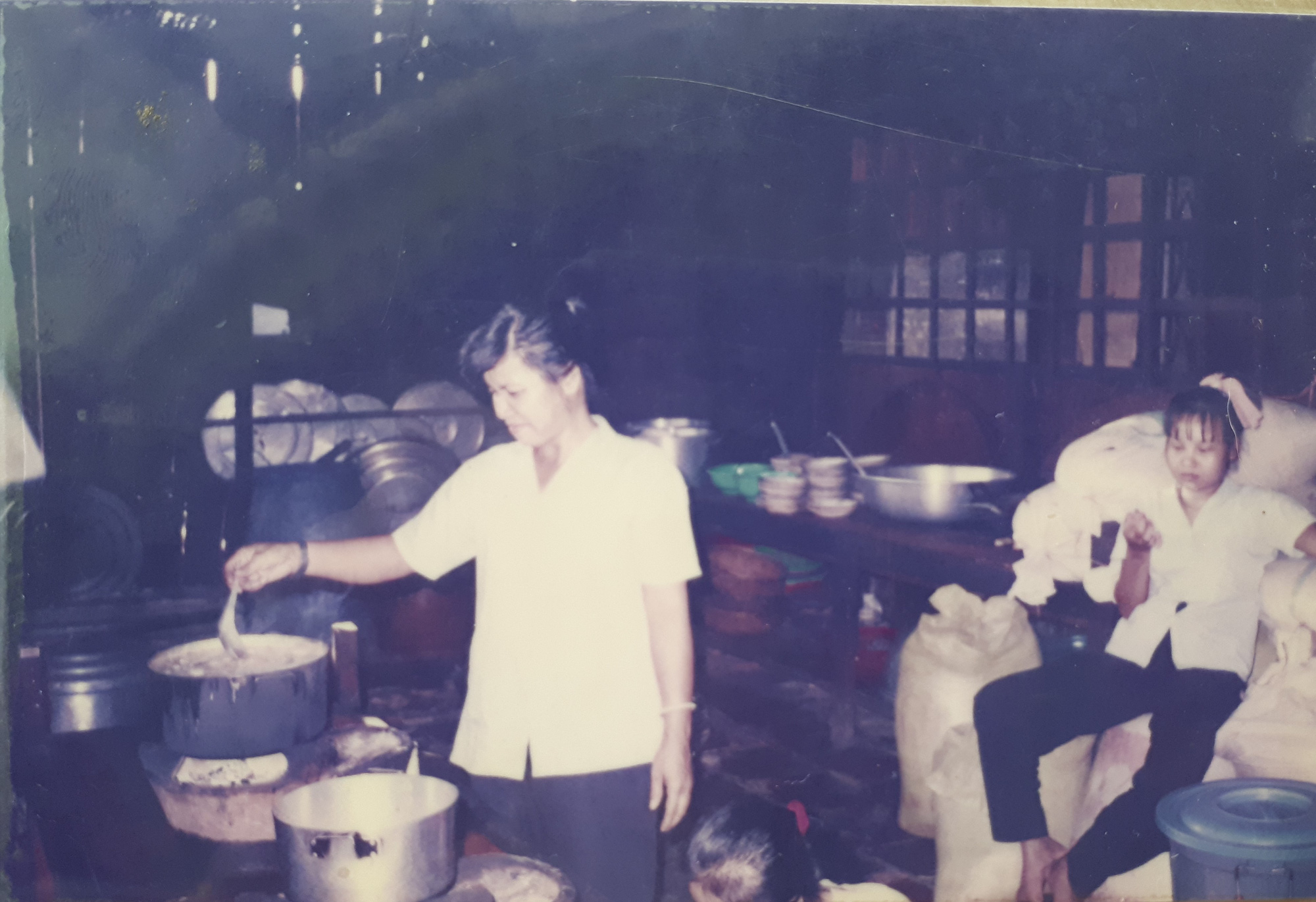
My mother works in the kitchen at the shrimp processing plant.
Back then, my mother's workplace was nearly twenty kilometers from my house. Compared to today's convenient transportation, it seems very close. But thirty years ago, the river crossing, the dusty dirt roads, and the mindset of a five or six-year-old child like me, having to be away from my mother, made it a very long distance.
Back then, every time I heard the distant sound of a ferry's engine, I would run to the road, watching for the ferry, hoping it would dock so my mother could come home. And I hoped even more that every summer, my father would pack my clothes into his old-fashioned briefcase and take me to the factory to stay with my mother until I started school.
Sometimes, my father and I would take a ferry at dawn to Lang Tron market, then from Lang Tron market we would take a rickshaw down to Ngoc Nang to where my mother worked. Other times, when the sun was shining and the road was dry, my father would borrow my uncle Hai's bicycle and clatter along the winding dirt road to get there. The heat and dust were behind us, and in front of me was my father's sweat-drenched back, his eager anticipation of seeing my mother again after so many days apart.
The memories of my childhood, filled with days of missing my mother, have stayed with me ever since. So when I see the traditional Vietnamese dress, it's like it comes alive again, overflowing with love and a poignant feeling.
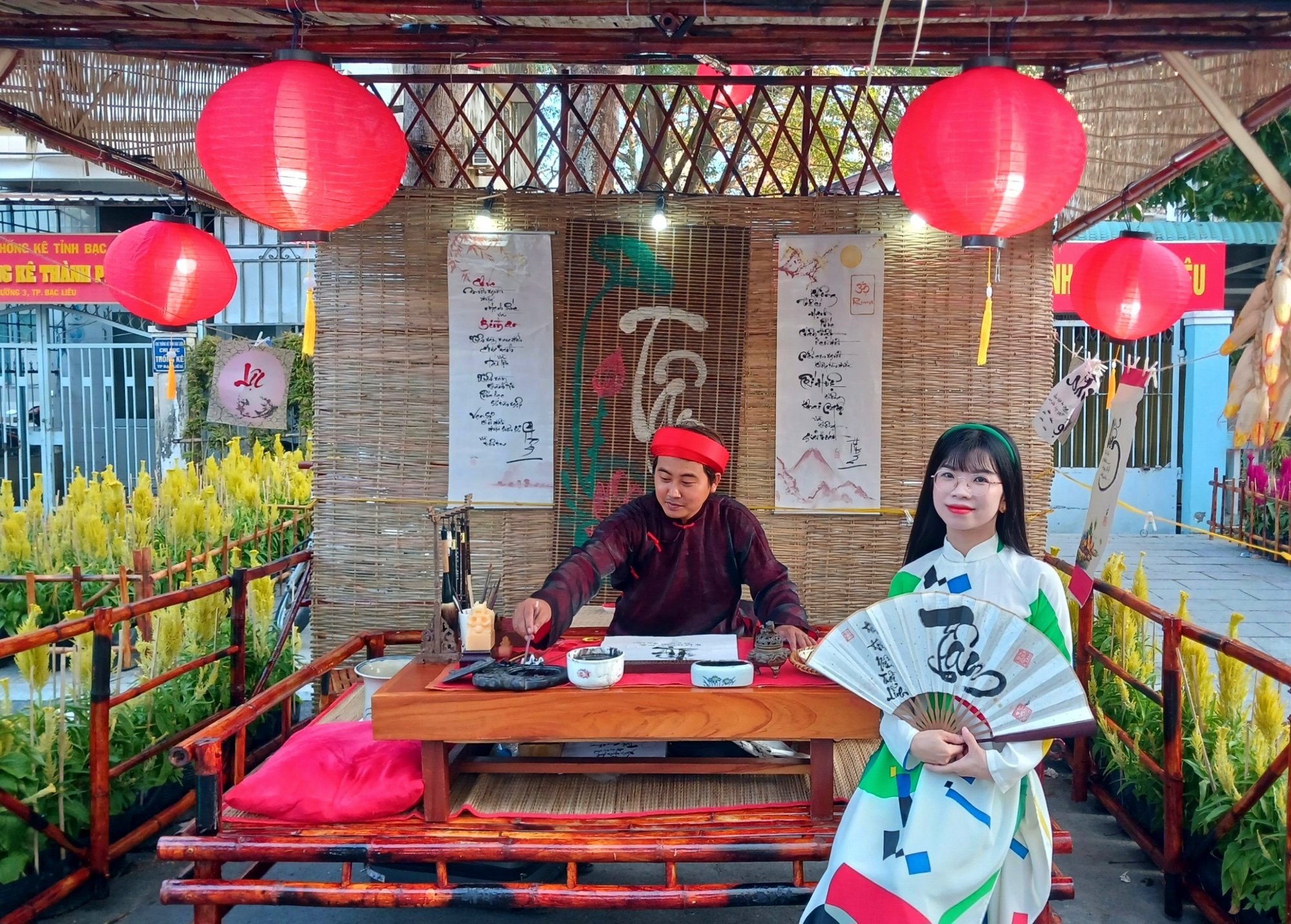
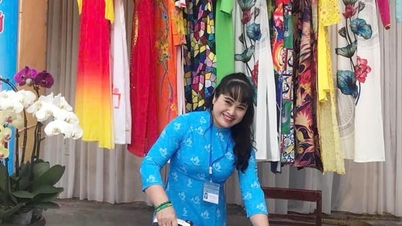
Wearing my mother's ao dai (traditional Vietnamese dress) for a spring outing.
I brought my mother's ao dai (traditional Vietnamese dress) with me to the city, wearing it to stroll through the spring market and along many flower-lined streets during Tet (Vietnamese New Year). I've always been self-conscious about my appearance, but this time was different. Amidst so many brightly colored ao dai and the graceful figures of beautiful young women, for the first time, I felt my most beautiful and unique self.
Because I know I'm not just wearing an ordinary old dress, but am being embraced by sacred memories, by the recollections of a time when there was an abundance of boundless, sky-high love from my parents.
The "My Tet Moment" contest has closed for submissions.
Running from January 25th to February 24th, the "My Tet Moments" contest is an opportunity for readers to share beautiful moments and unforgettable experiences from Tet with family and friends.
The organizing committee has received nearly 600 entries from readers over the past month. More than 50 entries have been selected and are being published on Tuoi Tre Online . We sincerely thank our readers for submitting entries and following the contest during the Lunar New Year of the Year of the Dragon this year.
Several more articles will be published in the near future.
The awards ceremony and closing event are scheduled to take place in March 2024. The prize structure includes 1 first prize (15 million VND in cash and gifts), 2 second prizes (7 million VND and gifts), and 3 third prizes (5 million VND and gifts).
The program is sponsored by HDBank .

Source


































































Comment (0)