

Recently, according to feedback from many fertilizer manufacturing businesses, Law 71/2014/QH13 (Law 71), enacted in 2014, stipulates that fertilizers are exempt from VAT. After 10 years, not only fertilizer businesses are suffering losses, but farmers are also affected because they have to buy fertilizers at prices 5-8% higher due to businesses having to account for a portion of the non-deductible tax as a production cost.
On the afternoon of June 24th, the National Assembly discussed the draft Law on Value Added Tax (VAT) (amended) in the plenary session. Notably, Point b, Clause 2, Article 9 of the draft law stipulates that fertilizers are subject to VAT at a rate of 5% instead of being "exempt from VAT" as currently stipulated. This provision attracted significant attention and debate among National Assembly deputies. The majority disagreed with applying a 5% VAT rate to fertilizers, arguing that it would create further difficulties for farmers.
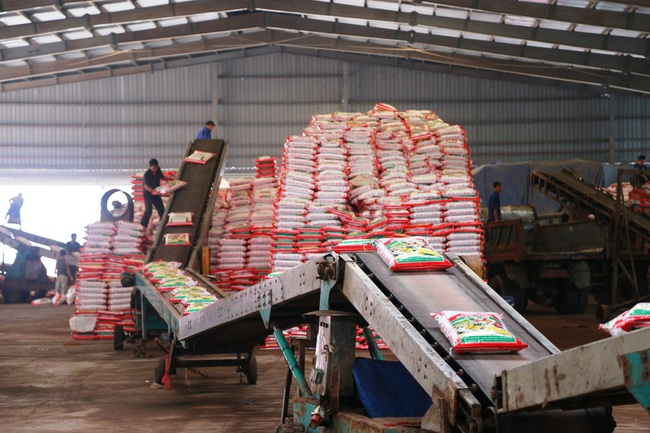
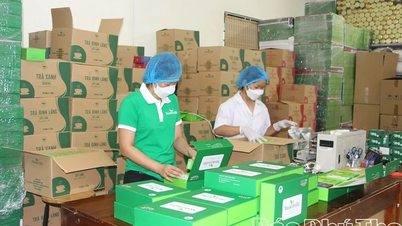
Fertilizer production at Lam Thao Superphosphate and Chemical Joint Stock Company. Photo: Thien Huong
On the afternoon of June 28th, at a press conference of the Ministry of Agriculture and Rural Development, Mr. Nguyen Quy Duong, Deputy Director of the Plant Protection Department, stated that the debate over whether fertilizers should be subject to a 5% VAT rate or not, and whether they should be exempt from VAT, has been a "hot topic" for the past three years.
Mr. Duong stated that the purpose of exempting fertilizers from the 5% tax under Law 71 of 2014 was to bring domestic fertilizer prices in line with imported fertilizer prices. However, in practice, this has had a "counterproductive effect," particularly impacting domestic fertilizer manufacturers.
Currently, the agricultural sector uses approximately 10 million tons of fertilizer annually, with inorganic fertilizers accounting for 75%. Vietnam imports 3-4 million tons annually, while the production capacity of domestic enterprises reaches nearly 30 million tons per year. Recently, the Plant Protection Department has advised the Ministry of Agriculture and Rural Development to request the Ministry of Finance to support the inclusion of fertilizers in the Value Added Tax (VAT) scheme at a rate of 5% to encourage domestic fertilizer production.
"It's also impossible to say that imposing a 5% VAT tax would increase the price of domestic fertilizers, because currently, the proposal is only to tax imported fertilizers," Mr. Duong said.
Source: https://danviet.vn/dua-hay-khong-dua-phan-bon-vao-dien-ap-thue-gtgt-5-lanh-dao-cuc-bao-ve-thuc-vat-noi-gi-20240628174308737.htm

![[Photo] National Assembly Chairman Tran Thanh Man successfully concludes his participation in IPU-152](https://vphoto.vietnam.vn/thumb/1200x675/vietnam/resource/IMAGE/2026/04/18/1776502638199_vna-potal-chu-tich-quoc-hoi-ket-thuc-tot-dep-chuong-trinh-tham-du-ipu-152-8709975-jpg.webp)



























































Comment (0)