

Farmers are excited
Entering the 2024-2025 crop year, coffee growing areas applying the emission reduction model in Lam Dong are showing outstanding efficiency. Not only reducing investment costs, farmers also improve the quality of agricultural products, restore soil and enhance ecological health. This is a direction in line with the green agriculture trend, meeting new requirements from international export markets.

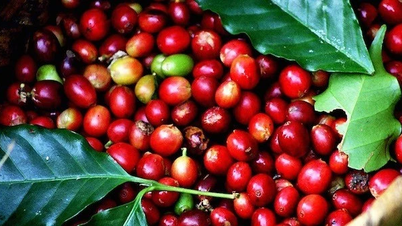
Entering the 2024-2025 crop year, coffee growing areas applying the emission reduction model in Lam Dong are showing outstanding efficiency. Not only reducing investment costs, farmers also improve the quality of agricultural products, restore soil and enhance ecological health. Photo: Pham Hoai.
Mr. K'Rong Brech's family in Nam Nung commune has nearly 1.7 hectares of coffee and has switched to an organic model to reduce emissions for more than 5 years. Previously, he used a large amount of inorganic fertilizer for each crop, which increased costs and hardened the soil. Since applying the new process, he has reduced chemical fertilizers by 50%, increased the use of composted manure and maintained a natural grass carpet to retain moisture. In addition, he intercropped some types of trees such as macadamia and pepper in the coffee garden to both provide shade and absorb CO2.
This season, his coffee garden's yield is expected to reach 3.5 - 4 tons/ha. "The new method was a bit difficult at first because I was not used to it, but the results were obvious. The soil was looser, the plants were healthier and the costs were significantly reduced," he shared with K'Rong Brech.
In Quang Phu commune, Ms. H'Mri's family has about 2 hectares of coffee intercropped with durian and avocado trees for shade. Thanks to reduced dependence on chemicals, reduced pesticides and returning to manual weeding combined with natural grass, her family's production costs have decreased by more than 50% compared to before. The yield is still 4 - 4.5 tons/ha, the income from 1 hectare is maintained at over 450 million VND per year. "A few years ago, only a few households in the village followed the instructions of agricultural extension officers, now almost everyone knows how to take care of landscape coffee, keeping the environment cleaner," Ms. H'Mri added.
Since 2023, Lam Dong province has widely deployed sustainable coffee production projects towards emission reduction, implemented by the Provincial Agricultural Extension Center in coordination with the Central Highlands Agricultural and Forestry Science and Technology Institute. Many other projects are sponsored by JDE Company, IDH Organization and consulted by TMT Consulting Company. These models are operating in many communes such as Di Linh, Nam Ban - Lam Ha, Nam Ha, Nam Nung, Quang Phu, Quang Son... helping people access farming processes that meet the criteria of green growth and sustainable development.

Since 2023, Lam Dong province has widely implemented sustainable coffee production projects towards emission reduction, implemented by the Provincial Agricultural Extension Center in coordination with the Central Highlands Agricultural and Forestry Science and Technology Institute with high efficiency. Photo: Phuong Chi.
Reduce costs, increase quality and meet market standards
According to Mr. Lang The Thanh, Director of Thanh Thai Fair Agriculture Cooperative (Nam Nung commune), the quality of farmers' coffee products is the decisive factor in the cooperative's post-harvest value. "If farmers' coffee meets standards, the cooperative can supply qualified products to domestic and foreign partners. The emission-reducing farming model helps coffee beans to be more uniform, meet technical standards and increase traceability," he affirmed.
Mr. Nguyen Van Chuong, Director of Lam Dong Agricultural Extension Center, said that the emission reduction coffee model brings many obvious benefits. Intercropping shade trees and maintaining natural vegetation ensures water retention, limits erosion and improves soil structure. “People change farming methods, practice standard technical processes, thereby saving irrigation water, reducing fertilizer and increasing productivity,” Mr. Chuong emphasized.
Mr. Chuong also said that many coffee programs and projects with environmental and social standards certification such as Rainforest Alliance, UTZ, Fair Trade, Organic... have been widely transferred, helping farmers use inputs responsibly and access high-end markets.

The low-emission coffee model brings many obvious benefits. Intercropping shade trees and maintaining natural vegetation increases CO2 absorption, ensures water retention, limits erosion and improves soil structure. Photo: Pham Hoai.
Urgent solutions in the context of climate change
According to Mr. Le Quoc Thanh, Director of the National Agricultural Extension Center, the abuse of chemical fertilizers, pesticides and herbicides for many years has caused soil degradation, water pollution and greenhouse gas emissions. Implementing sustainable coffee farming models and reducing emissions is an urgent solution. It not only protects soil and water but also contributes to protecting the health of coffee growers and the surrounding community.
"The method of reducing toxic chemicals, increasing tree cover and maintaining a diverse ecosystem will help coffee gardens develop more sustainably, have fewer pests and diseases and stabilize long-term productivity," Mr. Thanh affirmed.
With great potential and a clear green transformation orientation, the low-emission coffee farming model is increasingly proving its practical effectiveness. From individual farmers to cooperatives, from individual coffee gardens to supply chains, all are shifting towards a more sustainable, safer direction and meeting strict international standards.
Currently, Lam Dong province has more than 327,000 hectares of coffee, of which over 310,000 hectares are in the business period. Total output is estimated at over 1 million tons per year. The whole province currently has nearly 119,000 hectares of coffee that have been granted sustainable production certificates such as VietGAP, 4C, UTZ... The annual coffee export value is estimated at 450 - 500 million USD, of which the EU market alone accounts for about 45 - 50%.
Source: https://nongnghiepmoitruong.vn/loi-ich-kep-tu-mo-hinh-canh-tac-ca-phe-giam-phat-thai-d787330.html


![[Photo] Prime Minister Pham Minh Chinh receives President of Cuba's Latin American News Agency](/_next/image?url=https%3A%2F%2Fvphoto.vietnam.vn%2Fthumb%2F1200x675%2Fvietnam%2Fresource%2FIMAGE%2F2025%2F12%2F01%2F1764569497815_dsc-2890-jpg.webp&w=3840&q=75)































































Comment (0)