

(VHQN) - On a peaceful summer afternoon, the little girl lay in a hammock strung between two tamarind trees laden with green fruit. Her mother lay at the opposite end, one leg stretched out for the child to hold tightly, the other dangling loosely to the ground, rocking the hammock gently: "Lullaby, my child, sleep soundly / Watching you grow up, to be a wise person."

I tried to tell myself I had to stay awake and chat with my mother, her sweet lullabies carried on the cool breeze, lulling me into peaceful dreams. Those were the rare summer days when my mother sang me to sleep.
Then, suddenly waking up at noon, I rushed around looking for my mother, only to find that the familiar scent had been carried away by the wind. My mother had left home with her carrying pole, going to the city to collect every last penny to support the whole family.
Perhaps lullabies were born at the same time as children, imbued with the boundless love of grandmothers and mothers, which is why they are so sweet and poignant.
The first life lesson I learned at the age of four was acceptance. No matter how much I missed my mother, no matter how much loss and fear of abandonment I felt, I had to accept that she couldn't always be by my side.
The demands of making a living forced our parents to temporarily leave us. And as we grow up, there will come a time when we, as their children, need to spread our wings and bid farewell to our parents.
The only thing that guided me through those uncertain days of learning to play and sleep alone was the heartfelt lullaby my mother gently sang to me as she rocked me in the cradle one afternoon: "Once a tiny baby / Now you've grown so big / With your father's food, your mother's clothes, your teacher's lessons / How can I ever repay all those days of longing?"
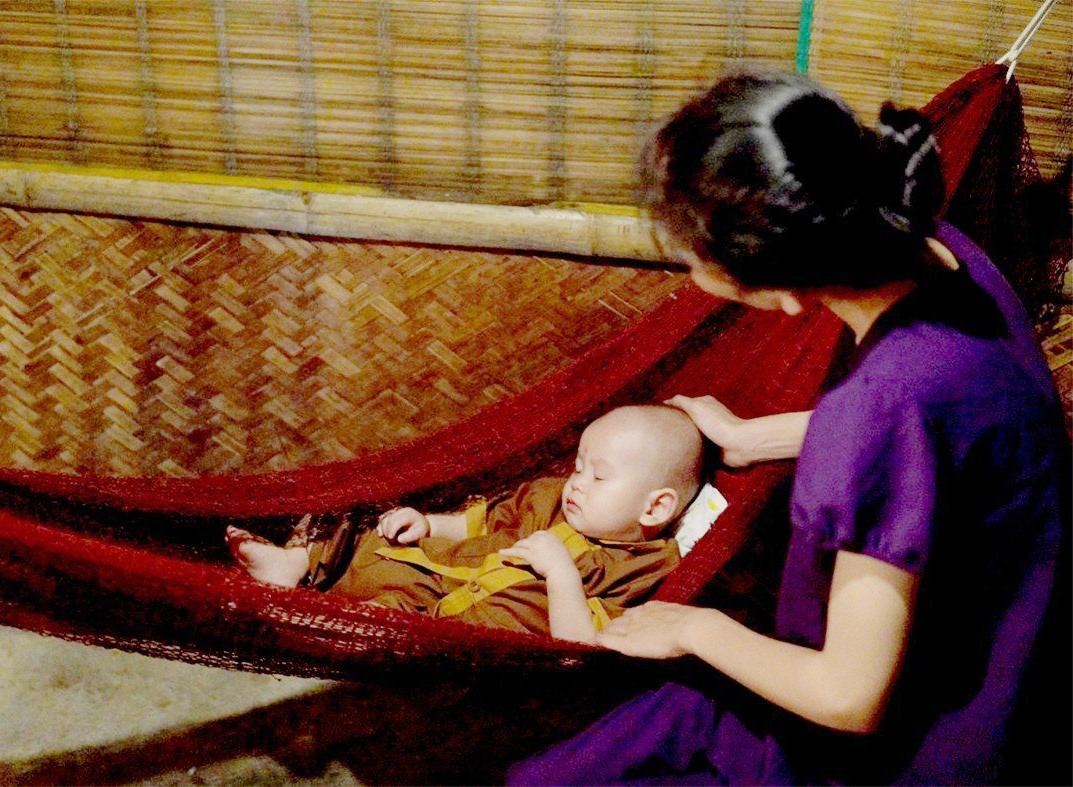
Some have claimed that any Vietnamese woman will automatically know how to sing lullabies when she gives birth. Perhaps lullabies were born at the same time as children, imbued with the boundless love of mothers and grandmothers, which is why they are so sweet and poignant.
In our early years, before we understood anything, lullabies carried the scent of the first person to hold us, lullabies wrapped in the gentle voice of each mother, lullabies bearing the familiar image of our village.
In my midday dream, I see kites soaring in the wind, the thin figures of farmers carrying the sun across the fields, the gentle sound of flutes guiding buffaloes home, and storks herding the sunset over the village bamboo groves…
When I was a little older, the joyful lullabies mingled with the playful running of children. I was also one of those children playing hopscotch on the porch, humming and mimicking my mother's lullabies: "Girls should take care of household chores / With graceful figures and gentle manners / When eating, when speaking, they should be composed / When sitting, when standing, they should be dignified and elegant."
Lullabies are more than just lullabies. They are the teachings of our ancestors, nurturing the soul and shaping character. These folk songs convey love for the countryside, contain heartfelt family sentiments, share perspectives on life, and offer guidance on interpersonal relationships.
Therefore, even though I sometimes lacked my mother's touch, I could still grow up proudly thanks to the sweet lullaby deeply ingrained in my subconscious: " Every evening I remember every evening / I remember the leftover rice, I remember the pot of tea / I remember riding on horseback and getting off the carriage / I remember the bowl of tea, I remember the pot of sugar ."
The lullaby of those days, sung while rocking in the cradle, has accompanied me throughout my life, supporting each step and encompassing all the memories and affections of my roots. During my time away from home, amidst the unfamiliar crowds of the city, that very lullaby reminded me that back home, my mother was waiting day and night: “ My son, your father fears your mother’s departure / The river is deep and the water is high, the boat cannot take you / We wait day after day / Our eyes are weary from waiting, but you haven’t returned yet …”
As children, we all wished to grow up quickly so we could roam freely and enjoy ourselves. But as we grow older, we yearn intensely for those childhood summer afternoons, lulled by our grandmothers and mothers with their loving lullabies. And we long to return, even if only in fleeting dreams.
I don't have a musical talent, nor do I have a treasure trove of folk songs and ballads in my head like my mother did. But I've always believed that when my child is born, lullabies will naturally follow.
I will lull my child to sleep as a way to find my mother, to find the me of the old days. "Oh, oh, if only the wooden bridge were nailed together," lull my child to sleep, or rather, to lull my own heart with endless longing and memories throughout my life.
Source


![[Image] Close-up view of the interchange connecting the two expressways and Long Thanh Airport.](https://vphoto.vietnam.vn/thumb/1200x675/vietnam/resource/IMAGE/2026/05/25/1779703378210_ndo_br_z7863716673926-224453a31600126cce10622af6290afd-4549-jpg.webp)


















































































Comment (0)