

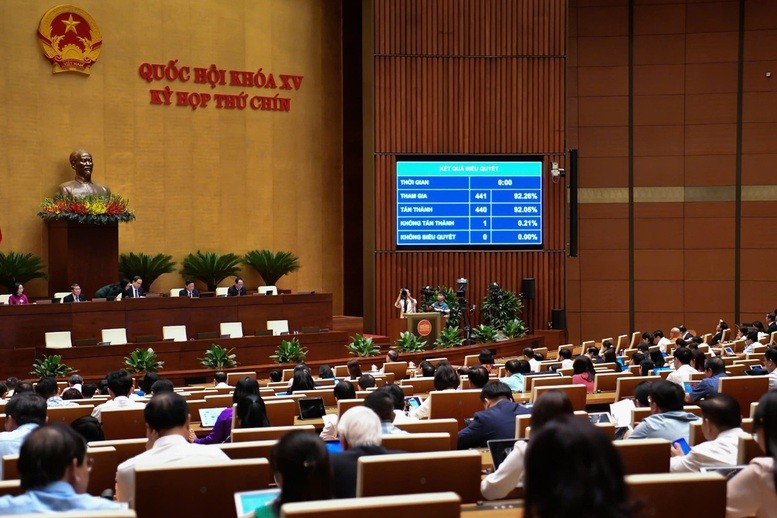
The National Assembly voted to approve a Resolution on tuition fee exemption and support for preschool children, primary and secondary school students, and learners in general education programs at educational institutions within the national education system. (Photo: National Assembly)
This is a major step forward in social justice policy, marking a significant maturation of the political system in empowering all Vietnamese children to develop.
In less than a year, from the time the policy idea was initiated by General Secretary To Lam at the National Assembly session at the end of 2024, to the Politburo issuing the policy and the National Assembly passing the Resolution, this policy has become a reality. What accounts for such unprecedented speed of decision-making? And why does this policy hold special significance in the current process of national development?
A mindset focused on caring for the people from the grassroots level.
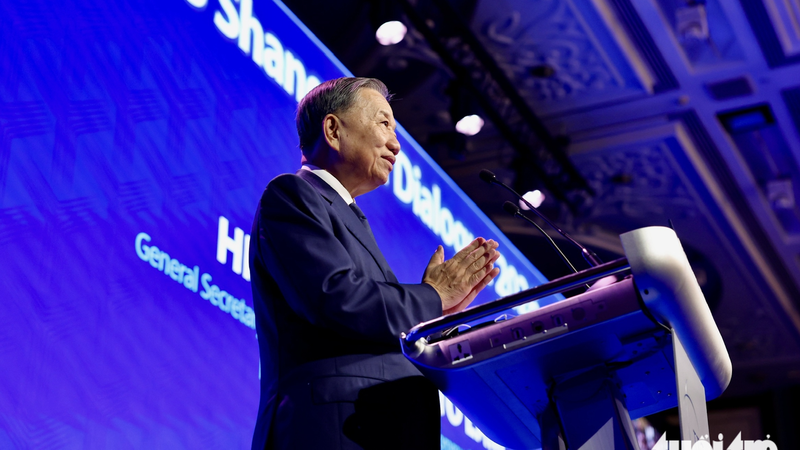
During a group discussion at the National Assembly at the end of 2024, General Secretary To Lam delivered a powerful, concise, and profound message: "Moving forward, the state will abolish tuition fees and support children of school age. Progress must be like that!" Without embellishment or formality, this is a call stemming from a strategic vision and a deep concern for the development of Vietnam's young generation.
That message placed education not only as a "top national priority," but as the primary responsibility of the State towards future generations. More importantly, the General Secretary not only raised the issue – he also instilled in it a will to act, so that the entire political system would join forces, transforming a humane aspiration into a policy reality.
When acting for the people is a command.
Following the General Secretary's speech, the Politburo convened and agreed on the policy at the end of February 2025. Just four months later, on June 26, 2025, the National Assembly officially passed the Resolution.
This is an unprecedented pace for a policy with nationwide scope, impacting nearly 20 million students and tens of millions of households. This speed is no accident. It reflects a political system reformed for efficiency, where orders from the top can quickly translate into seamless legislative and administrative action.
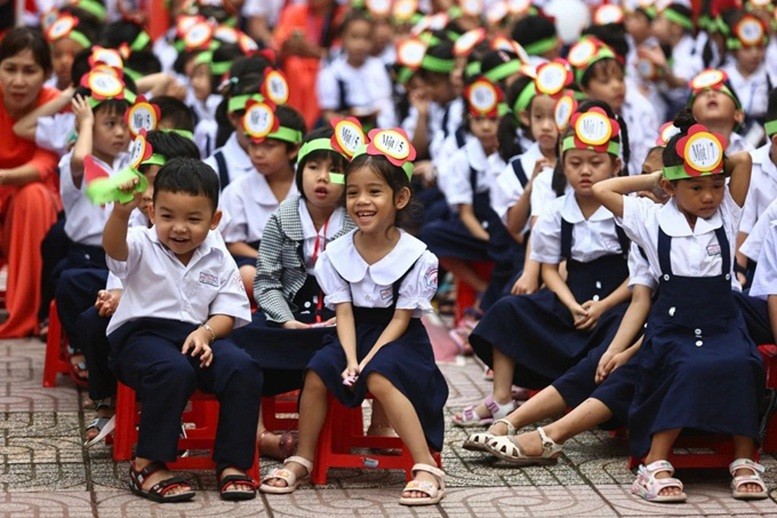
Tuition waivers and subsidies clearly demonstrate that investing in education is investing in sustainable development.
Thanks to the streamlined organizational structure, resources are available to implement policies.
The inevitable question is: where will the resources come from to implement such a comprehensive policy? In reality, the merger of intermediate agencies, streamlining of intermediate levels such as districts, salary reform, and expenditure contracting have created new fiscal space – thereby shifting the budget towards reducing administrative spending and increasing spending on human resources.
Prioritizing resources for education, especially for students and their families, represents a significant shift in thinking: cutting back where there is little added value, in order to invest in areas with long-term growth potential.
The immense significance of tuition fee exemption and support policies.
This policy of waiving and supporting tuition fees for high school students is not merely a financial measure, but a systemic and strategic development choice. Beneath its surface lie broader meanings, spanning education, society, public trust, and the nation's future.
First and foremost, in terms of education, this is a significant step towards truly achieving universal education. There will no longer be a situation where students have to drop out of school simply because they can't afford tuition – a seemingly small barrier that can disrupt a child's entire journey to adulthood.
As Prime Minister Pham Minh Chinh has repeatedly emphasized, it is necessary to ensure equal access to education for all, especially in remote areas, border regions, islands, ethnic minority areas, the poor, and vulnerable groups.
For students from ethnic minorities, remote areas, or those with disabilities – the most vulnerable groups – this policy opens a door to more equitable access to knowledge. At the same time, when students in private schools receive support equivalent to public school tuition fees, private schools are also able to reduce tuition fees, improve quality, and develop sustainably – thereby contributing to enriching and diversifying the national education system.
From a social perspective, this policy directly reduces the financial burden on millions of households, especially poor, near-poor, and unskilled laborers. In the context of a still challenging economy, this is timely support, helping families stabilize their lives and confidently invest in their children's future.
Furthermore, the policy contributes to narrowing the social gap between population groups, ensuring equal access to education regardless of whether it's a public or private school. In the long term, as education costs decrease, people's purchasing power increases, leading to a recovery in domestic consumption – a crucial driver for sustainable economic growth.
In terms of public trust, this policy is a vivid testament to a state that listens and acts. People not only see the policy being implemented quickly, but also feel that the government is truly placing the interests of their children at the center of policymaking. In a society with high expectations for institutional reform and improved quality of life, the state's proactive sharing of the burden of education is a strong signal: the government is close to the people, for the people, and acting for the people's future.
Finally, from a national strategic perspective, tuition fee waivers and subsidies clearly affirm that investing in education is investing in sustainable development. A knowledge-based society, a digital economy, a generation of global citizens – all begin with a fair and quality education. When every child has the right to school, the right to learn, and the right to development, that nation is building its competitiveness from the ground up – starting with its people.
Act for the future
Tuition fee exemption and support is not just a socio-economic policy. It is a long-term development choice, a step forward in thinking about the role of a proactive and people-oriented state. In that choice, we clearly see consensus from top to bottom, from leaders to legislative and executive bodies, and more broadly – from the people.
We are on the right track: using institutions to unlock resources; using resources to invest in people; and using people to build the future.
With this policy, we are not just waiving tuition fees. We are unleashing the potential of millions of students. We are empowering poor families with hope. We are sowing the best seeds for tomorrow.
A nation is only truly strong when every child – regardless of where they are born or what school they attend – has an equal opportunity to grow up with knowledge, confidence, and the support of an active government.
Source: https://baolaocai.vn/mien-hoc-phi-menh-lenh-vi-dan-vi-tuong-lai-post404039.html



![[Image] A brilliant symphony and explosive power in the skies of Da Nang.](https://vphoto.vietnam.vn/thumb/1200x675/vietnam/resource/IMAGE/2026/05/31/1780196945787_anh-man-hinh-2026-05-31-luc-10-08-51.png)

















![[Video] Sunset at Lap An Lagoon – Where the sun sets over the fishing nets](https://vphoto.vietnam.vn/thumb/340x192/vietnam/resource/IMAGE/2026/05/31/1780192137701_beach-landscape-sea-water-nature-grass-745871-pxhere-com.jpeg)


























































Comment (0)