

Many difficulties arose.
Thanh Hoa province was recognized by the Ministry of Education and Training as having achieved Level 2 literacy standards on December 31, 2021, and has maintained this standard until now.
According to Mr. Ta Hong Luu, Acting Director of the Department of Education and Training of Thanh Hoa province, the Party and the State have identified universal education and illiteracy eradication as crucial tasks; the system of Directives and Resolutions of the Party, the National Assembly, and Decrees of the Government provides a solid legal foundation for organizing and implementing this work.
In Thanh Hoa , this is also a matter that receives attention and guidance from local Party committees and authorities. The task of universal education and literacy eradication has been included in resolutions of Party committees at all levels, with specific programs and plans for implementation, which is an important basis for achieving the goals of universal education and literacy eradication.
Investment in infrastructure and teaching equipment has received attention. The number and quality of management staff and teachers are increased annually, better meeting the practical requirements of universal education and literacy programs.
The awareness of the majority of the population regarding the importance of universal education and literacy has been raised, creating conditions for maintaining, preserving, and improving the quality of results.
However, given its vast territory, large and scattered population, challenging terrain, transportation, climate, and socio-economic conditions, as well as low literacy levels—with over 1 million people from various ethnic groups in the mountainous region alone—implementing universal education and literacy programs in Thanh Hoa still faces many challenges.
According to Mr. Ta Hong Luu, although the facilities and teaching equipment of schools have been strengthened and supplemented, they only meet the average requirements. Funding for upgrading, replacing, and building new classrooms and equipment remains challenging. Mobilizing resources and investing in building facilities and equipment for schools, especially in mountainous areas with low literacy levels and difficult socio-economic conditions, and in communes with particularly difficult socio-economic conditions, is still limited and does not meet the requirements.
Prior to 2025, the management and teaching staff still faced structural and quality imbalances; the rotation and reassignment of staff and teachers disrupted the core workforce involved in universal education and literacy programs in various units, affecting these efforts to some extent. Localized shortages and surpluses persisted in many areas, including towns and cities. The secondment of teachers to community learning centers also faced difficulties, and school staffing levels were insufficient.
Funding for universal education and literacy programs is very limited, almost non-existent. Mobilizing illiterate people to attend literacy classes is difficult in some areas due to the vast mountainous terrain and the presence of many scattered villages and hamlets. The number of people aged 15-60 who are still illiterate at level 2 accounts for 0.67%, mainly those over 50 living scattered in particularly difficult areas, making class organization challenging. People in this age group are reluctant to attend school, difficult to persuade, and their ability to absorb knowledge is limited…
From July 1, 2025, with the implementation of a two-tiered local government system, administrative units have undergone changes and shifts in administrative boundaries. The entire province has been reduced from 27 districts, towns, and cities with 559 communes, wards, and townships to 166 communes/wards (the number of working points has increased from 27 to 166). The members in charge of directing and implementing universal education and literacy programs have also seen significant changes.
Mr. Ta Hong Luu also mentioned the difficulties of uneven resource allocation between mountainous and lowland areas. In mountainous regions and areas inhabited by ethnic minorities, opening combined classes or flexible class schedules for adults after relocation becomes even more difficult: longer distances, scattered class locations, and a shortage of part-time literacy instructors. Adults who have just completed literacy classes are likely to relapse into illiteracy if they lack ongoing activities (reading clubs, basic digital skills). In 2025, community activity centers will also have to be relocated to new areas, disrupting ongoing efforts.
Furthermore, there are difficulties due to significant fluctuations in aggregated data and records related to universal education and literacy; and changes in the aggregation tool from 3 levels to 2 levels (data is sorted and updated entirely). Practical requirements necessitate the development or use of a new system for aggregating universal education and literacy data from 2025 onwards.
At the commune and ward level, very few officials in the Culture and Social Affairs Department work in education, or have not had experience in universal education or literacy programs. At all levels, new steering committees, operating regulations, and plans for the 2025-2030 period must be established. The documentation and procedures for inspection, supervision, and recognition must be adjusted according to the regulations of the two-tiered government structure…
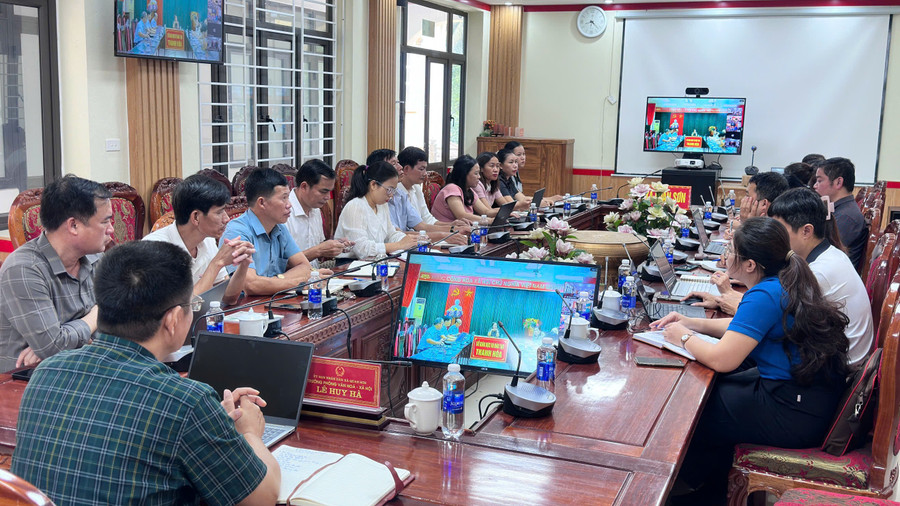
Strengthen management and promote initiatives to overcome difficulties.
In response to this situation, Mr. Ta Hong Luu stated that the Thanh Hoa Education Department has implemented comprehensive solutions to more effectively carry out universal education and literacy programs in the area.
The Department of Education and Training - the standing agency for universal education and illiteracy eradication - promptly sent a document to relevant agencies and units requesting their opinions on nominating individuals to participate in the provincial steering committee; and advised the Thanh Hoa Provincial People's Committee on the establishment of the Thanh Hoa Provincial Steering Committee for Universal Education and Illiteracy Eradication, for the period 2025-2030.
The Department of Education and Training also advised the Provincial Steering Committee to issue the Working Regulations of the Steering Committee for Universal Education and Literacy Eradication in Thanh Hoa Province, 2025-2030; the Plan for implementing universal education and literacy eradication in Thanh Hoa Province, 2025-2030; the Plan for implementing universal education and literacy eradication in Thanh Hoa Province in 2025; and guiding documents for implementing universal education and literacy eradication in 2025.
In particular, the initiatives "Integrated Data System for Universal Education and Literacy Eradication" at the two-tier government level (by Mr. Nguyen Sy Thuan - Principal of Quang Tien Secondary School, Sam Son Ward); the initiatives "Printing survey forms for each household from universal education and literacy eradication data" and "Printing Universal Education and Literacy Eradication Registers" (by Mr. Nguyen Minh Giang - Vice Principal of Yen Lac Secondary School, Yen Ninh Commune) have initially helped to fundamentally solve one of the four major educational challenges that Thanh Hoa province needs to address by 2025.
On a province-wide scale in Thanh Hoa and considering the products on the market, Mr. Nguyen Sy Thuan's initiative has helped save at least 3-4 billion VND per year; Mr. Nguyen Minh Giang's initiative saves educational institutions approximately 3 billion VND per year and reduces the time teachers spend on preparing forms and registers for universal education by 80%.
Another solution is to create a Zalo group for exchanging information and supporting communes, wards, and educational institutions. When issuing documents, a Word version would be sent to the group for easy access by commune and ward officials; at the same time, providing forms and documents issued at the local level; and guiding commune and ward officials on the steps and procedures for implementation.
Finally, online training sessions will be organized for commune officials, educational institution leaders, and teachers on universal education, literacy programs, and the use of data aggregation programs and the printing of universal education forms and registers.
Innovative and practical solutions are helping the Thanh Hoa Education sector gradually overcome difficulties, ensuring the maintenance and improvement of universal education quality, eradicating illiteracy, and moving towards the goal of sustainable and equitable education for all citizens.
Source: https://giaoducthoidai.vn/nang-cao-hieu-qua-xoa-mu-chu-voi-ung-dung-cong-nghe-doi-moi-quan-ly-post753611.html


![[Image] Close-up of the newly discovered "sacred road" at My Son Sanctuary](/_next/image?url=https%3A%2F%2Fvphoto.vietnam.vn%2Fthumb%2F1200x675%2Fvietnam%2Fresource%2FIMAGE%2F2025%2F12%2F13%2F1765587881240_ndo_br_ms5-jpg.webp&w=3840&q=75)

![[Infographic] Preventing students from making their own firecrackers: 7 things parents need to know](https://vphoto.vietnam.vn/thumb/402x226/vietnam/resource/IMAGE/2025/12/11/1765466656703_img_0320_20251211183542.jpeg)






































































Comment (0)