

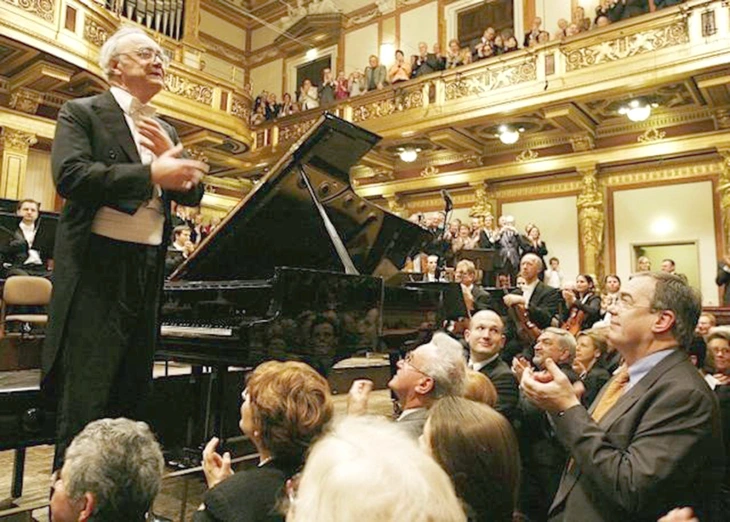
Austrian pianist Alfred Brendel passed away at the age of 94. This photo was taken during his last performance in Vienna in December 2008 - Photo: AFP
He is called the first pianist to record all of Beethoven's piano solos. But he himself says so.
He didn't record everything. He left out some pieces that he thought didn't need Beethoven's input; contemporaries or aspiring composers could have produced them.
Unearthing the funny stuff
Few people would dare to criticize Beethoven. But even fewer would dare to interpret Beethoven's works from his later years as "a collection of musical humor."
Brendel might remind us of Milan Kundera in music, because, like Kundera, he devoted a scholarly and intellectual interest to laughter, to nonsense, and to triviality.
In *The Betrayed Testaments*, Kundera argues that the emergence of the first novelists is linked to the invention of humor.
Brendel was no different; he always managed to uncover humor hidden within seemingly serious musical pieces in the otherwise solemn realm of classical music.
He saw in Haydn "a master of daring and surprise." He saw in Beethoven a lightheartedness and mischief.
For example, with Für Elise, Beethoven's lyrical, passionate bagatelle, which also contains quite a few dramatic passages, takes on a playful and witty quality under Brendel's touch.
But Brendel argues that Mozart's music, which we often consider the most frivolous and joyful, is not humorous at all.
In a lecture on the lack of seriousness in classical music, Brendel quoted a saying by Pliny the Younger: "I laugh, I joke, I play, I am a human being." This seemed to imply that if you learn to laugh, you will learn to joke, you will learn to play (piano), and you will become a truly human being.
Beethoven - Piano Sonata No. 32 - Alfred Brendel
The most hearty laughter
Brendel didn't play music until his last breath. Before turning 80, he said goodbye to music. When he said goodbye, he spoke about how concerts were becoming too much for him, but "I can still smile – not as much as before, but enough to survive."
His house displayed a painting of a pianist chuckling, surrounded by an audience listening intently and tensely. We often think of entering a theater as entering a sacred place, bringing with us all solemnity to respectfully bow before the music as if bowing before a deity, while the artist is a prophet preaching to us on behalf of the deity.
But perhaps that's not the case? Perhaps the artist, like Brendel, is actually secretly teasing and laughing at the music, while we are the ones who imagine everything in the theater to be so serious.
Alfred Brendel has passed away at the age of 94. Besides being a pianist, Alfred Brendel was also a brilliant essayist on art and a poet with his own unique style.
In a poem about the afterlife, Brendel imagines that after death, people can redeem themselves: "For example, Beethoven / could be redeemed on the other side / as a baker / throwing flour into the oven with a familiar rage."
He humorously compared the sonatas of musical masters to pretzels, and Bagatelles to poppy seed cakes.
And what about Brendel? Now that he's gone, how will he "redeem" himself? We don't know, but whatever he becomes other than a pianist, he'll surely do it with the most hearty laughter.
"To me, it seems pointless to try to save from oblivion musical works that are completely devoid of Beethoven's brilliance and originality," Alfred Brendel wrote in a lengthy essay on his interpretation of the German musical genius.
Source: https://tuoitre.vn/nghe-si-duong-cam-cua-tieng-cuoi-20250622093751193.htm


![[Image] National Assembly discusses the implementation of the socio-economic development plan.](https://vphoto.vietnam.vn/thumb/1200x675/vietnam/resource/IMAGE/2026/04/20/1776696707422_ndo_br_img-20260420-185419-jpg.webp)
![[Photo] General Secretary and President To Lam meets with National Assembly delegates from ethnic minorities.](https://vphoto.vietnam.vn/thumb/1200x675/vietnam/resource/IMAGE/2026/04/20/1776696701056_a1-bnd-8331-3342-jpg.webp)
























































































Comment (0)