

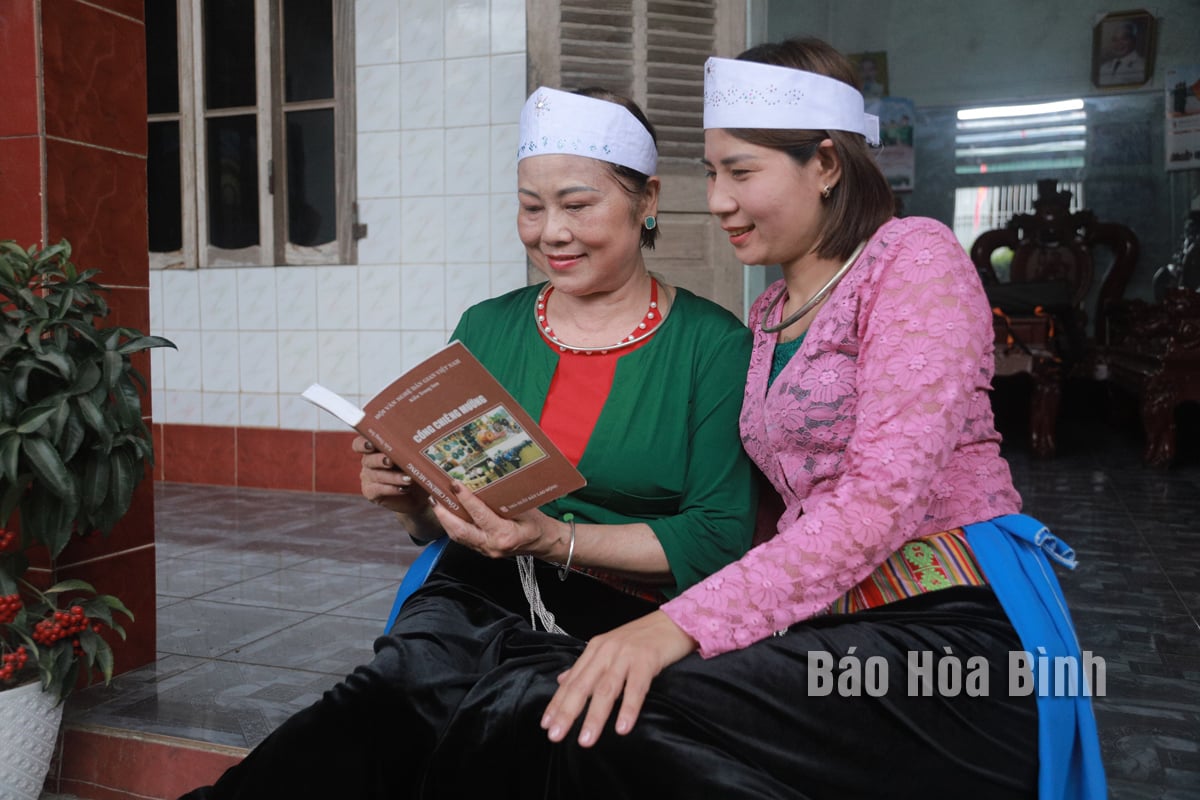
Ms. Dinh Thi Kieu Dung (left), from Bo area, Bo town (Kim Boi district), passes on the cultural values of the Muong people to the next generation.
Welcoming us to her house in a small alley, our first impression of Ms. Dung was her enthusiasm, youthfulness, and passion. In the living room were certificates, awards, and prizes in the field of culture. Ms. Dung confided: "Growing up, I often taught myself and recorded the folk songs and traditional melodies of my ancestors. My time working in the cultural sector has also been the years I've pursued my dream of breathing life into Muong culture, keeping it shining brightly. I often visit villages, meet with elders to collect ancient gong melodies and folk songs passed down from our forefathers. I always have a high sense of responsibility in studying and following the thoughts, ethics, and style of Ho Chi Minh to contribute a small part in preserving and promoting the national cultural identity in an era of integration where it tends to fade away."
Ms. Dung further shared that gongs are a part of the Muong soul, a "sacred treasure," and the sound of Muong gongs is the voice of the Muong soul, the voice of the mountains, forests, rivers, and streams harmonizing with the rhythm of the people's lives. In a gong performance, each gong has a different note. A gong set usually has 12 gongs, traditionally believed to represent the 12 months of the year, in order from the first gong to the twelfth gong. The first gong has the highest pitch, and the twelfth gong has the lowest pitch (also called the "khầm" gong). Each Muong region has different gong pieces, and many pieces share the same name but differ in performance and expression, such as: "Séc bùa," "Đi đường," "Lóng 2, 3, 9," etc. In many places, during festivals and New Year celebrations, gong ensembles often visit each family to offer New Year greetings and wishes for good fortune in the new year. In preserving and promoting the intangible cultural value of the Muong gong, Ms. Dung has taught gong music to cultural officials and grassroots arts and culture enthusiasts.
While working in the district's cultural sector, Ms. Dung was one of the most energetic and enthusiastic officials, excelling in her role as a community leader. With dedication, love for her profession, and respect for the cultural identity of the Muong ethnic group, especially Muong folk songs and gong music, she taught 14 gong ensembles with over 200 artisans in the district and surrounding areas. From 2004 to the present, the classes she opened have taught over 500 people how to play basic gong pieces and sing Muong folk songs. After retiring in 2016, she devoted much of her time to voluntarily opening classes to teach Muong gong music and folk songs to children aged 8-15. She believes that passing on cultural knowledge to the younger generation not only helps preserve ethnic identity but also creates a connection between generations.
During her teaching career, Ms. Dung selected promising students to nurture and train them to perform at cultural exchange events and local festivals. She also authored two books titled "Muong Folk Songs" and "The Art of Playing Gongs and Drums of the Muong Dong People" to preserve the beautiful cultural aspects of the Muong ethnic group for future generations.
Comrade Bui Van Dat, Vice Chairman of the People's Committee of Bo town, said: "Ms. Dinh Thi Kieu Dung is a shining example of actively propagating and mobilizing people in the residential area to effectively implement the Party's guidelines and policies, the State's laws, and build national unity. She is also one of the exemplary figures in studying and following the thoughts, ethics, and style of Ho Chi Minh. We hope she will continue to set a good example in researching, collecting, preserving, and conserving the cultural heritage of the Muong ethnic group. Through this, she will contribute to preserving and promoting the value of ethnic identity and contribute to the socio -economic development of the locality."
Duc Anh
Source: https://baohoabinh.com.vn/16/201781/Nguoi-giu-lua-van-hoa-Muong.htm


![[Image] Ho Chi Minh City simultaneously commences construction and breaks ground on 4 key projects.](/_next/image?url=https%3A%2F%2Fvphoto.vietnam.vn%2Fthumb%2F1200x675%2Fvietnam%2Fresource%2FIMAGE%2F2026%2F01%2F15%2F1768472922847_image.jpeg&w=3840&q=75)


Comment (0)