Ho Citadel (Vinh Loc district, Thanh Hoa province) is associated with a turbulent period in Vietnamese society, becoming a globally significant landmark, serving as both a center of power and a military fortress, demonstrating a masterful integration of architecture with cultural and natural landscapes.
Nearly 15 years after being recognized as a UNESCO World Heritage site (2011-2025), Thanh Hoa province has been gradually preserving and promoting the value of this heritage. Numerous excavations have been conducted here, uncovering valuable evidence that has greatly contributed to the restoration and preservation of this unique stone citadel.
Promoting the value of the Ho Dynasty Citadel Heritage Site.
Following UNESCO's recommendations and the commitment of the Thanh Hoa Provincial People's Committee, from 2011 to the present, the Ho Citadel World Heritage Conservation Center has collaborated with the Institute of Archaeology (Vietnam Academy of Social Sciences ) and the Vietnam Archaeological Association to intensify underground archaeological activities at the heritage site. With the goal of excavating a total area of 56,000 m², including 25,000 m² of the inner citadel area, 12,000 m² of the moat, 5,000 m² of the four citadel gates, and 14,000 m² of the Royal Road, scientists and historians have discovered and found much important evidence, helping to clarify the construction techniques of the Ho Citadel. This has greatly contributed to the protection and restoration of the heritage site, which is deteriorating in many areas.
The comprehensive research, excavation, and archaeological studies of the heritage site are gradually "unveiling" the material cultural traces of the Ho Dynasty Citadel from various periods that were buried underground.
The People's Committee of Thanh Hoa province is focusing resources and increasing investment to complete the excavation targets as planned. In particular, the province is paying special attention to the six steps of the excavation process: preparing the excavation site and equipment; manual excavation; restoring the excavation site; compiling excavation results and documenting artifacts; holding scientific workshops; systematizing excavation results and developing a scientific report to phase investment and ensure adherence to the approved plan.
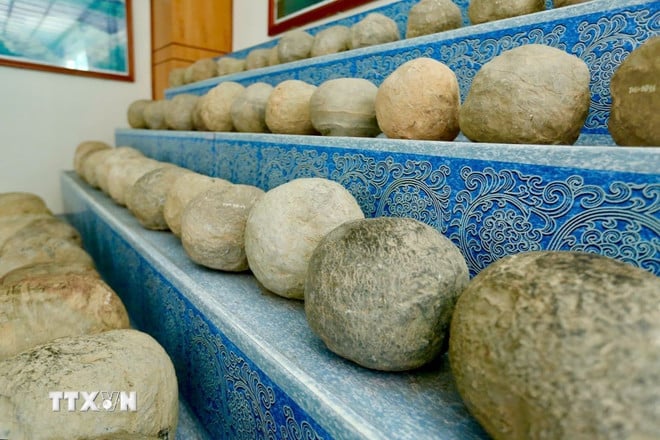
Hundreds of stone cannonballs of various sizes are on display at the artifact gallery of the Ho Dynasty Citadel World Heritage Conservation Center. (Photo: Hoa Mai/VNA)
To support management and conservation efforts, the Ho Citadel Heritage Conservation Center, in collaboration with the Vietnam Institute of Archaeology and international experts, is conducting surveys and developing a project to create a digital satellite map using a global information system (MAP GIS) for the heritage site. The province is focusing on developing a strategic archaeological map for the nominated and specially protected areas of the heritage site, including the Imperial Citadel, the Outer Citadel, the Southern Gate, and the Royal Road. Subsequent phases will focus on developing various types of maps to support heritage management in the buffer zone.
Mr. Nguyen Ba Linh, Director of the Ho Dynasty Citadel Heritage Conservation Center, said that the application of digital technology brings many benefits to the work of archiving, managing, researching, preserving, promoting the value of the heritage, and fostering sustainable tourism development at the Ho Dynasty Citadel. In addition, the mindset, awareness, and professional skills of tour guides are enhanced, bringing satisfaction to the public when visiting and experiencing tourism products at the heritage site.
A bright spot in tourism development.
In addition to continuing to invest in research, archaeology, and the protection and preservation of the heritage, promoting and showcasing the value of the Ho Dynasty Citadel to friends both domestically and internationally is a key task.
To exploit and promote the unique value of the heritage site and attract a large number of tourists, the Ho Citadel Heritage Conservation Center has continuously "renewed" itself with diverse tourism products linked to the inherent resources and distinctive characteristics of the land and people of Tay Do. This is also the way the Ho Citadel attracts tourists throughout all four seasons.
To bring heritage closer to the public, the Ho Dynasty Citadel Heritage Conservation Center has designed an outdoor exhibition space to showcase artifacts. Currently, the space displays and introduces a system of foundation stones and typical architectural materials discovered during excavations in the inner citadel area of the Ho Dynasty Citadel Heritage Site, serving scientific research and the needs of tourists.
The Ho Dynasty Citadel Heritage Conservation Center organizes many activities such as: displaying models of cannons and reforms of the Ho Dynasty; a cultural space showcasing agriculture in the Tay Do region; an exhibition space of the Ho Dynasty Citadel, history, legends, and archaeology; an exhibition space of citadel building stones as a new check-in point at the South Gate; organizing folk games and introducing unique local cuisine and OCOP products… With the development of 4 tour routes: Ho Dynasty Citadel - Returning to the Heritage Region; Ho Dynasty Citadel - Traditional Villages; Ho Dynasty Citadel - Spirituality in the Buffer Zone; Ho Dynasty Citadel - Historical Sites and Scenic Spots in the Buffer Zone, the center has incorporated nearby historical sites in the buffer zone into the heritage site's tour program, while also giving visitors a more comprehensive view of the land and people of the Tay Do - Ho Dynasty Citadel region.
Tourist Nguyen Kieu Lien (from Quang Ninh) said: "After returning after 5 years, I see that Ho Citadel has undergone many noticeable changes. The tourism products here are more diverse, not just limited to visiting the stone citadel as before. Tourists can experience many diverse cultural spaces through exhibits of artifacts and archaeological models related to the cultural characteristics of the heritage site. My children are very excited about the new experiences here."
A unique feature that affirms the value of Ho Citadel is its close connection with the lives of the local people. The Ho Citadel Heritage Conservation Center places special emphasis on heritage education for students through experiential learning programs linked to local history and culture. This is an effective approach to fostering patriotism and a sense of heritage preservation in the younger generation.
The center organizes numerous training courses to enhance tourism knowledge for people in the buffer zone, aiming to improve their awareness and skills in welcoming and behaving courteously towards tourists. This, in turn, creates synergy between heritage preservation and livelihood development for the local community.
Mr. Le Van Nam, Deputy Director of the Department of Culture, Sports and Tourism of Thanh Hoa province, said that the province always pays attention to allocating resources to invest in archaeological excavation and preservation, and preventing degradation at Ho Dynasty Citadel. The innovation and diversification of tour routes linked to the characteristics of the heritage site have contributed to fundamentally changing the perception of tourists and the local community when visiting. Tour routes are constantly being expanded and enhanced to include historical sites, scenic spots, and traditional villages within the heritage area.
Ho Citadel, a World Heritage Site, is located in Vinh Loc District, Thanh Hoa Province – also known as Tay Do (Western Capital) to distinguish it from Dong Do (Thang Long-Hanoi). This is one of the most unique stone architectural works in Vietnam and the world, built in 1397. It was once considered the capital and the socio-political and cultural center of Dai Ngu Kingdom under the Ho Dynasty. Nearly 15 years after being recognized by UNESCO, Ho Citadel has become an attractive tourist destination for both domestic and international visitors.
(VNA/Vietnam+)
Source: https://www.vietnamplus.vn/thanh-nha-ho-tu-di-san-thanh-diem-sang-du-lich-post1038199.vnp


![[Image] Close-up view of the interchange connecting the two expressways and Long Thanh Airport.](https://vphoto.vietnam.vn/thumb/1200x675/vietnam/resource/IMAGE/2026/05/25/1779703378210_ndo_br_z7863716673926-224453a31600126cce10622af6290afd-4549-jpg.webp)



![[Image] Hanoi's urban life under the challenge of a "scorching hot" environment](https://vphoto.vietnam.vn/thumb/1200x675/vietnam/resource/IMAGE/2026/05/25/1779706979265_nang-nong-t5-2026-minh-duy-7-4636-jpg.webp)








































































Comment (0)