According to Mr. Lai Duc Dai, Deputy Director of the Department of Culture, Sports and Tourism, this idea is increasingly receiving attention and promotion from the social community. Especially in recent years, when the concept of "cultural industry" has been clearly understood and defined - and people see it as an important trend/opportunity contributing to the economic and social development of all nations and peoples in the context of deep international integration.
Of course, integrating the gong heritage into the development of the "cultural industry" requires adequate investment. In Dak Lak , since the Central Highlands Gong Culture Space was recognized by UNESCO as a Masterpiece of Oral and Intangible Cultural Heritage of Humanity in November 2005, the local government and community have continuously strived to invest in promoting this heritage to its full potential.
According to the Department of Culture, Sports and Tourism, over the past 20 years (2005-2025), through the projects "Preserving and promoting the cultural value of gong music in Dak Lak province," the cultural sector has actively implemented many important core programs and contents in coordination with local authorities and relevant departments, such as: opening classes to teach gong playing and tuning to the younger generation; restoring traditional rituals and festivals; purchasing gongs to donate to villages and providing financial support to gong ensembles and community cultural centers for performances; organizing gong music festivals, seminars and cultural exchanges; compiling and collecting ancient gong pieces for preservation; printing books, tapes, and images about rituals and festivals associated with gong music performances to serve propaganda and education in the community…
According to Linh Nga Niê K'đăm, a researcher of Central Highlands culture, these programs and initiatives aim to quickly halt the problem of indifference, or even the "bleeding" of gong culture in the villages. More importantly, they have truly awakened the awareness and pride of the heritage owners regarding their new mission: Gong culture is both a heritage and a precious asset for today's descendants to inherit and develop as a strength to improve and enhance the overall economic and social life in each community.
You may also like  Preserving and promoting the value of the Cham people's pottery art heritage.On the morning of May 27th, Mr. Nguyen Long Bien, Member of the Standing Committee of the Provincial Party Committee and Permanent Vice Chairman of the People's Committee of Khanh Hoa province, chaired a meeting to hear a report on the results of the implementation of the National Action Program on the Protection and Promotion of the Intangible Cultural Heritage of Cham pottery making. Leaders from several relevant departments, agencies, and localities attended the meeting.  From village to museum: A journey of spreading the value of living heritage in Lao Cai.In response to International Museum Day 2026 with the theme “Museums Connecting a Divided World”, the Lao Cai Museum, in collaboration with the Center for Culture, Arts and Sports, is organizing a series of activities titled “Sowing Green on Cloud Peaks”. The program not only introduces the value of heritage and indigenous knowledge but also creates a space for community connection, spreading the message of environmental protection, climate change adaptation, and aiming towards the goal of developing Lao Cai province into a “Green, Harmonious, Distinctive, and Happy” place. |
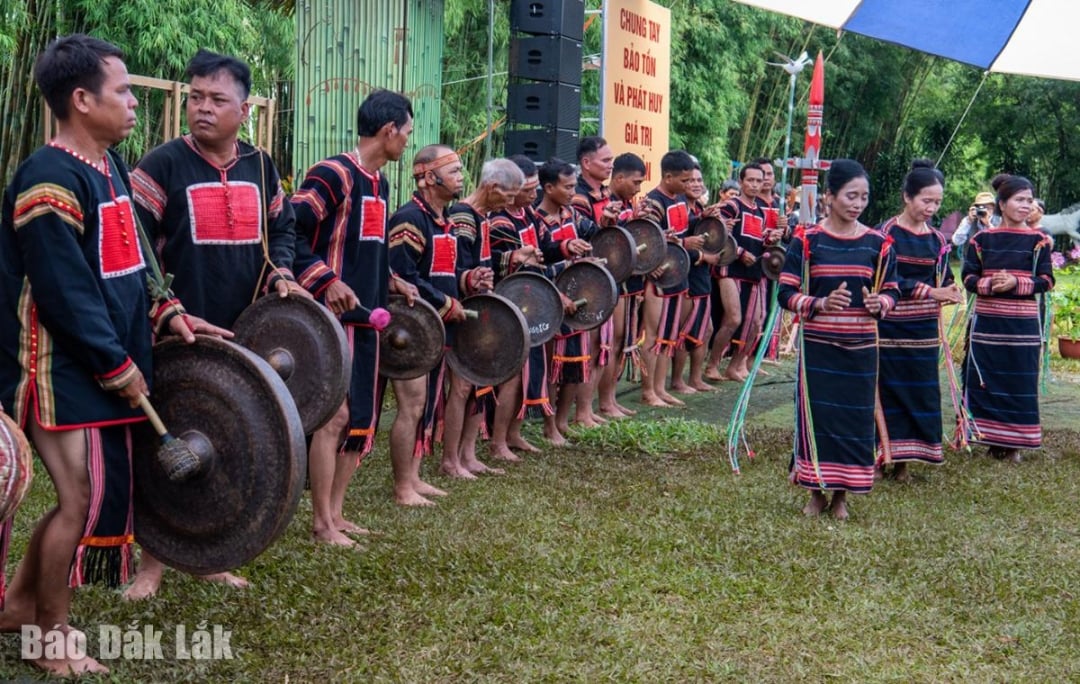
The gong heritage has been and continues to be exploited and promoted as a strength for development. Photo: Huu Hung |
Determining how to inherit and promote the cultural heritage of gong music in contemporary life presents both challenges and opportunities for local authorities and the communities that own and benefit from it.
Associate Professor, Dr. Tuyet Nhung Buon Krong (Center for Social Sciences and Humanities - Tay Nguyen University) believes that, to date, there are still no specific and accurate statistics on the contribution of the gong heritage to the economic and social development of each locality; however, its role in establishing a spiritual foundation, as well as its unifying power and the dissemination of its values across cultural and economic aspects in contemporary life, cannot be overlooked. As mentioned, the gong heritage, if properly preserved and promoted, is one of the outstanding and typical elements contributing to the value chain of the "cultural industry" of the country in general and the Central Highlands in particular.
Mr. Lai Duc Dai commented that the gong heritage in Dak Lak has been and is being exploited and promoted by localities as a strength for socio-economic development, especially in tourism, introducing and promoting their image in the process of exchange and integration. Since 2017, traditional rituals and festivals of the people have been restored and recreated by all levels, sectors, and local ethnic communities. Many rituals and festivals associated with gong performances of the Ede, M'nong, J'rai, and Xe Dang people have been surveyed and restored to create opportunities and environments for the gongs to resonate and spread. It can be said that thanks to these efforts, gong culture has truly "revived" to blend in with today's life.
Accordingly, in addition to the gong culture performance program (held twice a month with the theme "Echoes of the Great Forest") to serve the people and tourists from the end of 2017 to the present, the cultural sector has also coordinated with many domestic and international organizations and media units to promote and introduce this typical heritage to a wider audience through cultural and artistic festivals and exchanges nationwide as well as in some European countries and the ASEAN community, with the aim of expanding and spreading the value of the gong heritage in the flow of cultural, economic and diplomatic integration.
Clearly, preserving and promoting the cultural value of the gong culture in conjunction with socio-economic development has become a fresh source of inspiration, attracting communities and society in this heritage region to pursue and promote it in a more substantive and effective way. This is especially true now that local authorities and the ethnic communities who possess this heritage have taken appropriate and proactive steps to integrate the Central Highlands gong culture into and stimulate the development of the "cultural industry" of the region and the nation, commensurate with its potential.
Source: https://baodaklak.vn/van-hoa-du-lich-van-hoc-nghe-thuat/202505/nang-tam-gia-tri-di-san-944169f/





![[Image] National conference summarizing one year of operation of the overall organizational model of the political system, the three-tiered government model.](https://vphoto.vietnam.vn/thumb/1200x675/vietnam/resource/IMAGE/2026/07/01/1782882811691_ndo_br_1-jpg.webp)