


Preserving the spirit of the mountains and forests through songs and gongs.
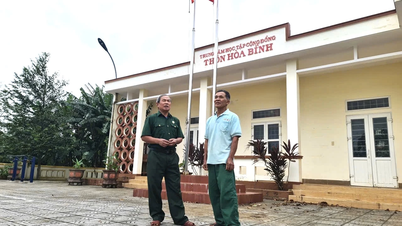
Elder Dieu Do, from Dien Du hamlet, Quang Tan commune, is deeply connected to the sounds of gongs and stone xylophones – sacred musical instruments of the M'nong people. In the hamlet, only a handful of people still know how to play the stone xylophone, and he is one of those rare few. Fearing the loss of their cultural identity, Elder Dieu Do persistently teaches the younger generation, including his daughter, Thi San, an 11th-grade student who is now proficient in both gongs and stone xylophones, continuing her father's passion and the echoes of the mountains and forests.
Every festival season, people see old man Dieu Do diligently tuning the gongs, teaching the children how to strike each rhythm and listen to each note. He shared: "Preserving the sound of the gongs is preserving the soul of the nation." For him, each resonant sound is not just a melody, but a story about the origins, a thread connecting the past with the present, conveying the hope for peace for the village.
Like Dieu Do, artisan Thi Py On in N'Jang Lu hamlet, Duc An commune, diligently teaches folk songs to the younger generation. At over 60 years old, she still regularly teaches the younger generation, without a blackboard or chalk, only her singing echoing through the trees or in her small house filled with laughter and songs. In this way, the lyrics, rhythms, and breath of the mountains and forests are gently, naturally, and lovingly sown into the hearts of the younger generation. She shared: "If folk songs are no longer sung, it's like losing a part of the soul of our people." Therefore, despite her advanced age, she dedicates all her heart to teaching, hoping that the M'nong songs will continue to resonate throughout the mountains and forests.
Besides teaching children in her village, artisan Thi Py On is also a familiar face at local and district-level cultural performances. She performs while spreading her love of culture to many more people. For some songs, she spends many nights restoring the original lyrics and relearning the ancient pronunciation. For her, folk music is not just music , but the breath of life, something that has accompanied the M'nong people from lullabies and farming to harvest festivals.
Preserving the essence with hands and heart.
In the N'R Jieng neighborhood, three generations of artisan H'Bach's family still spend their days working at the loom. At 75 years old, Mrs. H'Bach still diligently weaves each piece of fabric, teaching her daughter H'Binh and granddaughter H'Nhan how to select threads, set up the loom, and weave patterns.
From her calloused hands, the threads weave into shapes of mountains, streams, birds, deer… all imbued with the memories of the Ma ethnic group. For her, weaving brocade is not just for clothing or decoration, but a way to preserve the stories of her ancestors, a way for her descendants to remember their roots.
Understanding this significance, her daughter, H'Binh, learned weaving from a young age. Currently, H'Binh is the head of the traditional brocade weaving cooperative and one of the seven outstanding brocade weaving artisans in the province. The products made by artisan H'Bach and her descendants have been featured in many festivals and fairs both domestically and internationally, becoming a source of pride for the Ma people. H'Bach confided: "As long as I have the strength, I will continue to teach. I only hope that my children and grandchildren will learn so that in the future there will still be weavers, preserving the soul of our people."
Artisans like Thi Py On, Dieu Do, and H'Bach are "living treasures" in the villages and hamlets. They quietly preserve and pass on the love of ethnic culture in contemporary life as a vibrant part of our identity. Along with them, village elders and respected individuals are also becoming important bridges, both mobilizing the community to preserve customs and working alongside the government in restoring and maintaining traditional festivals and cultural activities. Currently, relevant departments and agencies, along with the local governments, are striving to open training classes and build models for preserving folk culture, continuing the dedication of these artisans. This joint effort is helping to preserve, spread, and sustain traditional values over time.
Source: https://baolamdong.vn/nhung-kho-tang-song-giua-dai-ngan-398848.html
![[Photo] Prime Minister Pham Minh Chinh receives Lao Minister of Education and Sports Thongsalith Mangnormek](/_next/image?url=https%3A%2F%2Fvphoto.vietnam.vn%2Fthumb%2F1200x675%2Fvietnam%2Fresource%2FIMAGE%2F2025%2F12%2F16%2F1765876834721_dsc-7519-jpg.webp&w=3840&q=75)
![[Live] 2025 Community Action Awards Gala](/_next/image?url=https%3A%2F%2Fvphoto.vietnam.vn%2Fthumb%2F1200x675%2Fvietnam%2Fresource%2FIMAGE%2F2025%2F12%2F16%2F1765899631650_ndo_tr_z7334013144784-9f9fe10a6d63584c85aff40f2957c250-jpg.webp&w=3840&q=75)
![[Image] Leaked images ahead of the 2025 Community Action Awards gala.](/_next/image?url=https%3A%2F%2Fvphoto.vietnam.vn%2Fthumb%2F1200x675%2Fvietnam%2Fresource%2FIMAGE%2F2025%2F12%2F16%2F1765882828720_ndo_br_thiet-ke-chua-co-ten-45-png.webp&w=3840&q=75)
![[Photo] Prime Minister Pham Minh Chinh receives the Governor of Tochigi Province (Japan)](/_next/image?url=https%3A%2F%2Fvphoto.vietnam.vn%2Fthumb%2F1200x675%2Fvietnam%2Fresource%2FIMAGE%2F2025%2F12%2F16%2F1765892133176_dsc-8082-6425-jpg.webp&w=3840&q=75)

![[Image] The tenacious fighting spirit of Vietnamese women's football](/_next/image?url=https%3A%2F%2Fvphoto.vietnam.vn%2Fthumb%2F1200x675%2Fvietnam%2Fresource%2FIMAGE%2F2025%2F12%2F17%2F1765990260956_ndo_br_4224760955870434771-copy-jpg.webp&w=3840&q=75)

















































![[Live] Closing Ceremony and Award Presentation for the "Impressive Vietnam Tourism" Video/Clip Creation Contest 2025](https://vphoto.vietnam.vn/thumb/402x226/vietnam/resource/IMAGE/2025/12/17/1765974650260_z7273498850699-00d2fd6b0972cb39494cfa2559bf85ac-1765959338756946072104-627-0-1338-1138-crop-1765959347256801551121.jpeg)











Comment (0)