

The recent conflict between the Sudanese army and the Rapid Support Forces (RSF), which has claimed hundreds of lives, highlights the complex interplay between domestic and external forces. These factors have fueled the escalating conflict, with ceasefires repeatedly broken despite international efforts.
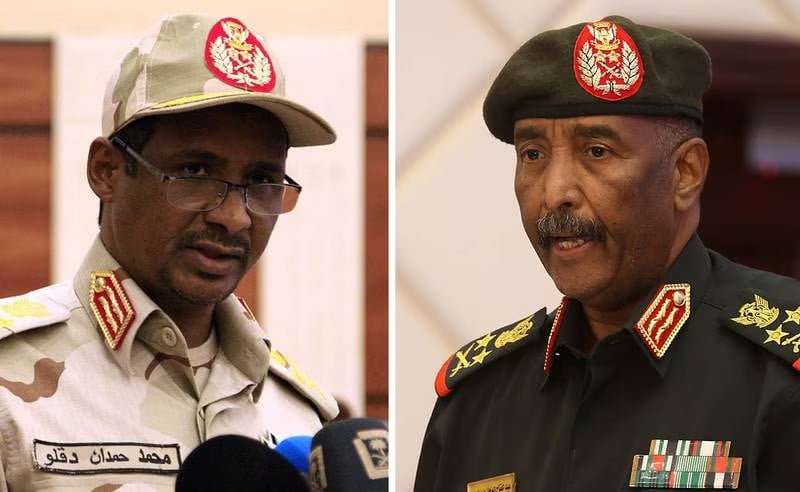 |
| General Mohammed Hamdan Dagalo, leader of the Rapid Support Force (left), and General Abdel Fattah Burhan, leader of the Sudanese army (Source: Arab News) |
Since the ouster of former Sudanese President Omar al Bashir in 2019, regional actors, including Egypt, the UAE, Saudi Arabia, and Israel, have become deeply involved in Sudan. Their support for the warring factions has exacerbated the situation, fueled conflict, and led to the current chaos.
The feud between the two generals
The power vacuum stemming from President al-Bashir's 30-year rule created a golden opportunity for the two generals to vie for power and assert their influence. Initially, they allied against the civilian government of former President Abdalla Hamdok, stemming from a power-sharing agreement reached in August 2019 between the military and civilian forces. In October 2021, they orchestrated a coup that overthrew President Hamdok's government and seized power, abruptly ending the brief two-year transition period after ousting al-Bashir.
Since then, the rift and disagreements between al-Burhan and Hemedti have increased significantly. Hemedti blames al-Burhan for Sudan's economic and security decline. Tensions between the two sides peaked after the signing of a framework agreement last December. This agreement aimed to facilitate the military's withdrawal from politics and the transfer of power to civilians. It also aimed to integrate the RSF into the military forces under Burhan's command. This sensitive plan further deepened the rift between the two sides.
Over the past few months, both sides have sought to leverage the terms of the agreement to advance their interests and achieve their agendas. Al Burhan has accelerated the process of integrating the RSF into the military, a move that could diminish the influence of his rival Hemedti, who has emphasized the transfer of power to civilians in order to limit al Burhan's power as head of the Transitional Sovereign Council (TSC).
In an effort to transform his disagreement with al Burhan into a struggle for democracy rather than a power struggle, Hemedti formed an alliance with the Forces for Freedom and Change (FFC) – a key civil coalition that had led the uprising against former President al Bashir.
General Hemedti also approved the FFC's demands for the transfer of power to civilians and for the Sudanese military to return to their barracks to remove al-Burhan. Over time, the distrust between the two generals deepened and became irreparable.
| RELATED NEWS | |
 | Sudan: Army agrees to extend ceasefire for another 7 days; Organization of Islamic Cooperation holds emergency meeting. |
Regional factors
Like other conflicts in the Middle East and North Africa, external actors such as Egypt, Saudi Arabia, the UAE, and Israel play a significant role in exacerbating the ongoing crisis in Sudan.
Egypt pursued a "flawed and short-sighted" policy toward Sudan, contributing significantly to the ongoing conflict between al Burhan and Hemedti. Following the removal of al-Bashir, the regime of Egyptian President el Sisi was determined to prevent a civilian government, let alone a democratic one, in Sudan.
For President Sisi, this was seen as an existential threat to the regime's survival. Therefore, Cairo supported the military faction led by al-Burhan and Hemedti in an attempt to weaken the civilian government. Furthermore, Cairo encouraged the coup against Hamdok's government, ending the transitional period and paving the way for the current conflicts.
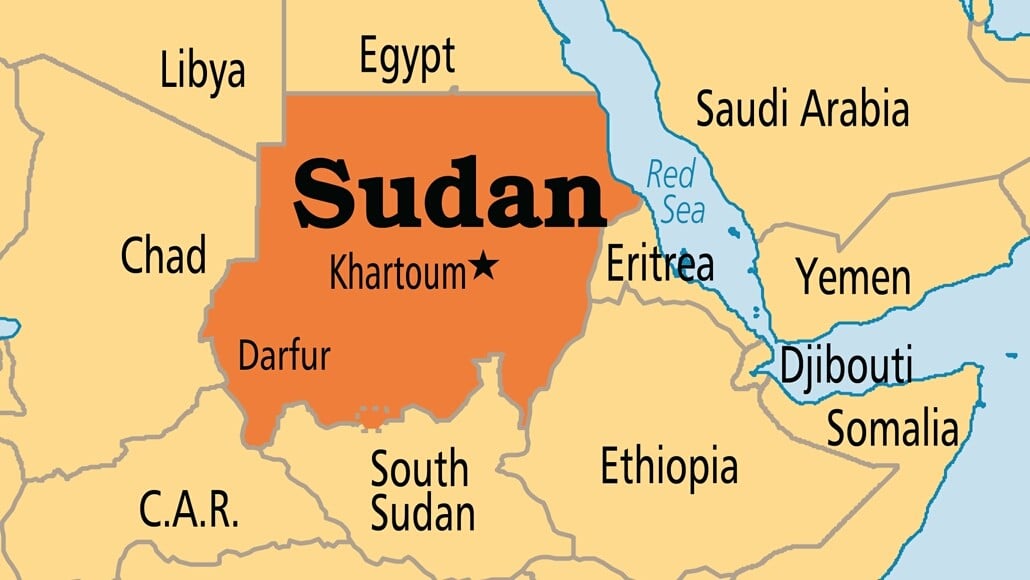 |
| External actors such as Egypt, Saudi Arabia, the UAE, and Israel are playing a significant role in exacerbating the ongoing crisis in Sudan (Source: premiumtimesng.com). |
Egypt's policy toward Sudan is guided by three main objectives. First , Egypt seeks to consolidate military rule in Sudan so that it can control and manipulate it in a way that benefits Egypt.
Secondly , Egypt assured Sudan that it would not pursue an independent foreign policy that could affect its interests, particularly regarding the Grand Renaissance Dam (GERD), which is a major concern for Cairo.
Third , President Sisi wants to prevent Sudan's failure, which would lead to significant political, geostrategic, economic, and humanitarian challenges for Egypt, especially as the country is facing a severe economic crisis.
Egypt's strategy in Sudan has yielded the exact opposite of these benefits. By supporting the military regime in Sudan, Egypt has sown discord and division not only between military and civilian forces but also between the military and the RSF. Egypt seeks to create a parallel process with the framework agreement to sow discord and division among political factions in Sudan.
When the rift between al Burhan and Hemedti became apparent, Egypt sided with al Burhan instead of acting as a mediator. President Sisi believed that al Burhan was a more reliable partner and would safeguard Egypt's interests. Conversely, Hemedti had close ties with external allies, raising more suspicions in Cairo. Egypt's support for al Burhan was the primary cause of the current crisis.
Numerous reports emphasize that Egypt provided fighter jets and pilots to support the SAF in the conflict against the RSF. At the start of the war, the RSF captured 27 Egyptian soldiers stationed at the Merowe air base in Sudan and many others elsewhere.
Despite the two countries' long-standing historical and geographical ties, Egypt's influence in Sudan has diminished in recent years. This is reflected in Egypt's exclusion from the Quartet – comprising the US, UK, Saudi Arabia, and the UAE – tasked with overseeing Sudan's transition. Egypt's search for support from regional allies like the UAE to secure the release of soldiers captured by the RSF is a clear indication of this reality.
| RELATED NEWS | |
| Sudan situation: More countries prepare to evacuate citizens, signs of a ceasefire emerging? |
The role of the Gulf region
Over the past decade, Gulf Arab states, particularly Saudi Arabia and the UAE, have played a significant role in Sudan's affairs. These countries forged strong ties with the former regime of Omar al Bashir, supporting it in addressing its challenges at the time. In exchange for billions of dollars in grants, loans, and investments, al Bashir provided military support and sent troops to assist the two countries' campaign against Houthi forces in Yemen in 2015.
Furthermore, al Bashir's regime allied with Saudi Arabia against and severed ties with Iran in 2016. These moves marked a significant shift in Sudan's foreign policy, which had been characterized by close ties with Iran.
Following the 2019 uprising that ousted al Bashir, the UAE and Saudi Arabia forged close ties with the leaders of the SAF and RSF. Fearing the potential spread of pro-democracy movements in the region, the two countries, with their ample financial resources, supported the Sudanese military in preventing the establishment of civilian and democratic regimes. Like Egypt, both countries endorsed the coup against the civilian government led by Hamdok in 2021, despite international condemnation and calls for his reinstatement.
However, both countries have differing and sometimes conflicting interests in Sudan. Therefore, they tend to support different sides in the current conflict. Saudi Arabia has a long-standing and strong relationship with al Burhan, while the UAE has invested heavily in Hemedti over the years.
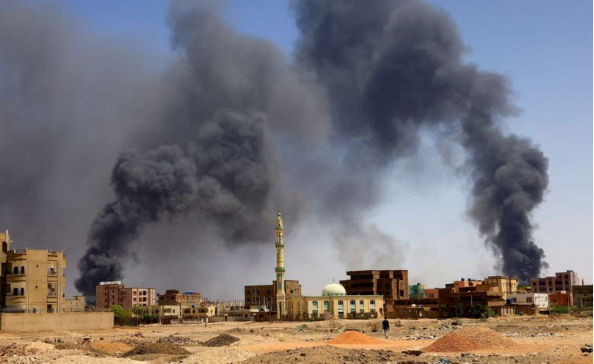 |
| Smoke rises over buildings during clashes between RSF and government forces in Khartoum (Source: Reuters) |
Saudi Arabia's support for the SAF and al-Burhan is driven by several objectives. Firstly , Saudi Arabia seeks to protect its interests in the Red Sea from potential regional and international competitors such as Turkey, Iran, the UAE, and Russia. This includes securing sea lanes, access to natural resources, and maintaining stability and security in the region.
Secondly, Saudi Arabia's focus on Red Sea security is an integral part of Crown Prince Mohammed bin Salman's Vision 2030, which aims to diversify the Saudi economy and position the country as a global hub for trade, innovation, and tourism.
Third , Saudi Arabia seeks to protect its economic and financial investments in various sectors in Sudan, including agriculture, energy, water, sanitation, transportation, and telecommunications. Given Sudan's significant growth and development potential in these areas, Saudi Arabia views its investments in these sectors as crucial to both Sudan's and its own economic interests.
Ultimately, Saudi Arabia is interested in enhancing its emerging role as a regional power and asserting Thailand's position as a new regional leader. In recent days, Saudi Arabia has facilitated direct dialogue between opposing factions in Sudan with the support of the United States. The goal of these talks is to secure a lasting ceasefire, potentially paving the way for political negotiations and ultimately ending the ongoing conflict. Whatever the outcome of these talks, they will reveal the extent of Saudi Arabia's influence in Sudan.
Meanwhile, the UAE has forged a strong relationship with Hemedti in recent years, recognizing him as a key ally capable of advancing its diverse interests in Sudan and the wider region. Firstly , the UAE is seeking to eliminate the remnants of the previous Sudanese regime, particularly the Muslims it views domestically, regionally, and globally. Hemedti has skillfully positioned himself alongside Abu Dhabi to counter the Muslims in Sudan and beyond. Hemedti has framed the conflict as a fight against Islamist extremists who want Sudan isolated and shrouded in darkness, far removed from democracy. This is also the language used by Arab leaders to describe their adversaries.
Secondly, the UAE is aiming to protect its strategic interests in the Red Sea and the Horn of Africa. In December 2022, the UAE signed a $6 billion investment agreement with Sudan to build a new port on the Red Sea coast.
Third, the UAE has invested in Sudan's agricultural sector to secure food supplies. Last June, the two countries signed a memorandum of understanding on an agricultural initiative related to a new port on the Red Sea.
The UAE considers Hemedti an indispensable partner in achieving these goals and has expanded its financial, political, and military support to Hemedti over the past few years. According to reports, the UAE has provided Hemedti with a platform to manage finances and offered public relations support for the RSF. Furthermore, General Khalifa Haftar, a major ally of the UAE, is reportedly providing military support to the RSF.
Reports have indicated that Haftar sent fuel, weapons, and other resources to support Hemedti against al-Burhan. The alliance between the UAE, Haftar, and Hemedti has been a significant aspect of the security and geopolitical landscape in Sudan and North Africa for several years.
| RELATED NEWS | |
| Sudan conflict: US considers appropriate sanctions, UN calls for international cooperation. |
Israel becomes involved in Sudan's crisis.
Since the outbreak of hostilities in Sudan, Israel has been deeply concerned about the impact on hopes of normalizing relations. In 2020, the two countries agreed to normalize relations but have not yet signed a comprehensive treaty to complete the normalization process.
In fact, Israel values its interests in Sudan for several reasons. Tel Aviv considers securing a peace treaty with Sudan crucial to expanding the Abraham Accords and normalizing relations with other Arab nations. Such normalization would strengthen Israel's influence in sub-Saharan African countries, with which Israel has established strong ties over the past few decades. Furthermore, Israel would benefit from Sudan's abundant resources.
Therefore, after overthrowing al Bashir, Israel attempted to establish strong ties with al Burhan and Hemedti. In February 2020, al Burhan secretly met with Israeli Prime Minister Benjamin Netanyahu in Uganda and agreed to normalize relations. Following Sudan's accession to the Abraham Accords in October 2020, relations between the two countries were further strengthened, with Israeli officials visiting Khartoum and meeting with al Burhan and Hemedti on several occasions. Both expressed interest in deepening relations with Israel. Israel's Mossad intelligence agency has established close ties with Hemedti over the past few years.
In 2020, it was reported that the UAE had arranged a secret meeting between Hemedti and then-Moscow director Yosi Cohen. In June 2021, the two met in Khartoum, which also angered al Burhan. Clearly, Hemedti had established independent channels of communication with Israel to carry out his plans in Sudan.
Israel has offered to mediate between the two warring sides to end the ongoing fighting in Sudan. However, Israeli officials are divided on which side to support. The Israeli Foreign Ministry has established close ties and cooperated with al Burhan to promote normalization. However, Mossad officials tend to favor Hemedti due to his strong ties with the UAE.
In summary, the deep and complex involvement of regional actors in Sudan has significantly hampered efforts to resolve the ongoing conflict. While these actors are seen as playing a constructive role in negotiating a solution to the crisis, their own involvement has fueled escalating conflict and exacerbated the complexities of achieving lasting peace and stability in Sudan.
Source

![[Photo] General Secretary and President To Lam visits and delivers a policy speech at Tsinghua University.](https://vphoto.vietnam.vn/thumb/1200x675/vietnam/resource/IMAGE/2026/04/14/1776164592318_vna-potal-tong-bi-thu-chu-tich-nuoc-tham-va-phat-bieu-chinh-sach-tai-dai-hoc-thanh-hoa-trung-quoc-8700658-5437-jpg.webp)







































































Comment (0)