Decentralization and delegation of authority in licensing and professional certification in the field of medical examination and treatment.
Báo Tin Tức•10/11/2024
According to the agenda of the 8th Session of the 15th National Assembly, on the afternoon of November 11th and the morning of November 12th, the National Assembly will conduct questioning of the Minister of Health, Dao Hong Lan, on issues related to the health sector, including the issuance of licenses and professional certificates in the field of medical examination and treatment.
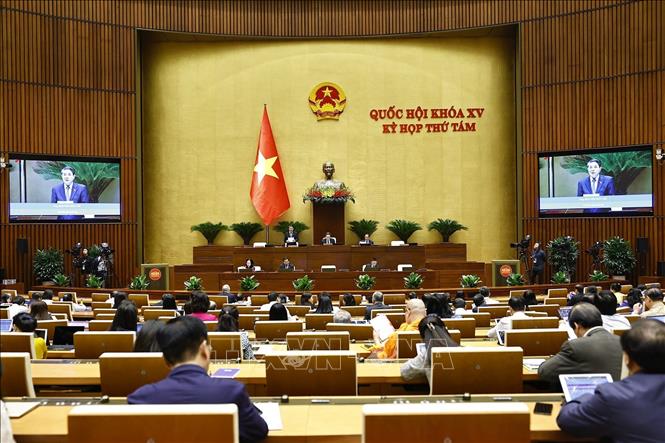
A view of the National Assembly session on the morning of January 7. (Illustrative photo: Doan Tan/TTXVN)
The Ministry of Health reports that, to date, the Ministry and local Departments of Health have issued 66,795 operating licenses and 637,519 professional practice licenses/certificates in the field of medical examination and treatment (excluding the Ministry of Public Security and the Ministry of National Defense). Of these, the number of applications for operating licenses at the Ministry of Health accounts for less than 1.5% of the total number of operating licenses nationwide (795 applications). Regarding licensing and professional practice certificates, from the beginning of 2024 to the present, the Ministry of Health has issued 28 new operating licenses for private hospitals (compared to 16 operating licenses in the same period last year, an increase of 75%); and issued 57 decisions to adjust operating licenses due to changes in the scope of professional activities or changes in the scale of operations (compared to 48 decisions in the same period last year, an increase of 18.75%). Essentially, the Ministry of Health has promptly processed the remaining pending applications. Currently, there are 5 applications for new operating licenses that have not yet undergone assessment at the Ministry of Health. The Law on Medical Examination and Treatment adds new regulations allowing for the renewal of practice licenses after 5 years, as well as increasing the number of training programs in medical specialties, the categories of individuals eligible for practice licenses, and synchronized policies to facilitate the development of private medical examination and treatment facilities. This has led to an increase in the number of applications for practice licenses (with the addition of new professional titles for medical examination and treatment requiring practice licenses) and operating licenses (allowing for more flexible organizational structures for medical examination and treatment facilities). Preliminary estimates suggest an increase of approximately 20% in the number of applications for practice licenses. The Ministry of Health has pointed out existing limitations in licensing and professional certification in the field of medical examination and treatment, including: infrequent and in-depth inspections and audits; a lack of involvement from all levels of government, relevant agencies, and the public in monitoring and supervising private medical examination and treatment activities; slow digital transformation due to obstacles in construction and price appraisal; difficulties in bidding procedures; and a lack of resources to upgrade software, resulting in the inability to meet the requirements for data connectivity, synchronization, and interoperability needed to implement Government Decree 06 on "Developing applications of population data, identification, and electronic authentication to serve national digital transformation in the period 2022-2025, with a vision to 2030"; and a lack of projects and programs aimed at improving the capacity and quality of medical examination and treatment management. According to the Ministry of Health, most provincial health departments report a shortage of personnel for managing medical practice and handling administrative procedures related to issuing operating licenses and practice permits, while the number of practitioners and medical facilities requiring licenses and operating permits is very large. Most staff members take on multiple additional tasks besides managing medical practice, treatment, prevention, and assessment. The shortage of personnel for managing medical practice is due to annual staff reductions and the need to handle multiple tasks while the workload continues to increase. Promoting digital transformation, decentralization, and delegation of authority in the implementation of administrative procedures are solutions proposed by the Ministry to overcome these shortcomings and limitations. The Ministry of Health announced that it will focus on implementing three breakthrough solutions in licensing medical examination and treatment activities: developing a new, streamlined, transparent, and simplified assessment process to shorten assessment time; increasing the number of assessment teams fourfold and doubling the personnel involved in state management of professional practice and operation licensing; and strengthening coordination between licensing agencies and facilities in training and guiding the preparation of assessment dossiers. To promote decentralization and delegation of authority in administrative procedures, the Ministry of Health has completed drafting a document and has sought feedback from 63 provincial and city People's Committees on the decentralization of licensing authority in the field of medical examination and treatment; it is expected to be issued in December 2024.
In addition, the Ministry of Health has completed the review and is currently submitting to the Government for consideration the continued promotion of decentralization of authority as stipulated in Decree No. 96/2023/ND-CP detailing some provisions of the Law on Medical Examination and Treatment. After decentralization, the Ministry of Health is expected to reduce the number of administrative procedures for granting and receiving practice licenses by approximately 70%. To promote digital transformation, the Ministry of Health is developing a Decree to be submitted to the Government regulating the national health database to enhance the application of information technology in health management in general and in medical examination, treatment, and licensing activities in particular. Simultaneously, it is upgrading the national system for managing medical practice to ensure transparency of information from medical facilities and practitioners, thereby saving time and manpower in practice management. In the administrative procedure reform effort, the Ministry of Health has developed seven internal procedures for granting operating licenses and medical practice licenses to provide specific guidance on the documents and procedures to be implemented. This aims to gradually clarify the detailed documentation so that businesses are aware of the content and requirements of the required documents. The internal procedures have been simplified compared to previous procedures, reducing the number of steps by 2 to 5 (depending on the specific procedure). The average time for granting operating licenses and medical practice licenses has been shortened by 10% to 20%, depending on the specific application (and the scale, organizational structure, type, and circumstances of the application). The internal procedures also include checklists to expedite the assessment process, ensuring consistency in handling applications and promoting transparency regarding requirements, conditions, and supporting documents. In addition, the Ministry is strengthening inspection, examination, and supervision work, organizing inter-agency inspection teams to inspect the operations of private medical examination and treatment facilities, and strictly handling individuals and organizations if violations are found; establishing inspection teams to inspect the medical examination and treatment inspection activities of the Departments of Health in provinces and centrally-administered cities.




![[Photo] Prime Minister Pham Minh Chinh attends the Conference on the Implementation of Tasks for 2026 of the Industry and Trade Sector](/_next/image?url=https%3A%2F%2Fvphoto.vietnam.vn%2Fthumb%2F1200x675%2Fvietnam%2Fresource%2FIMAGE%2F2025%2F12%2F19%2F1766159500458_ndo_br_shared31-jpg.webp&w=3840&q=75)























































































Comment (0)