

The question is whether this is a legal responsibility of the state or just discretionary humanitarian assistance?
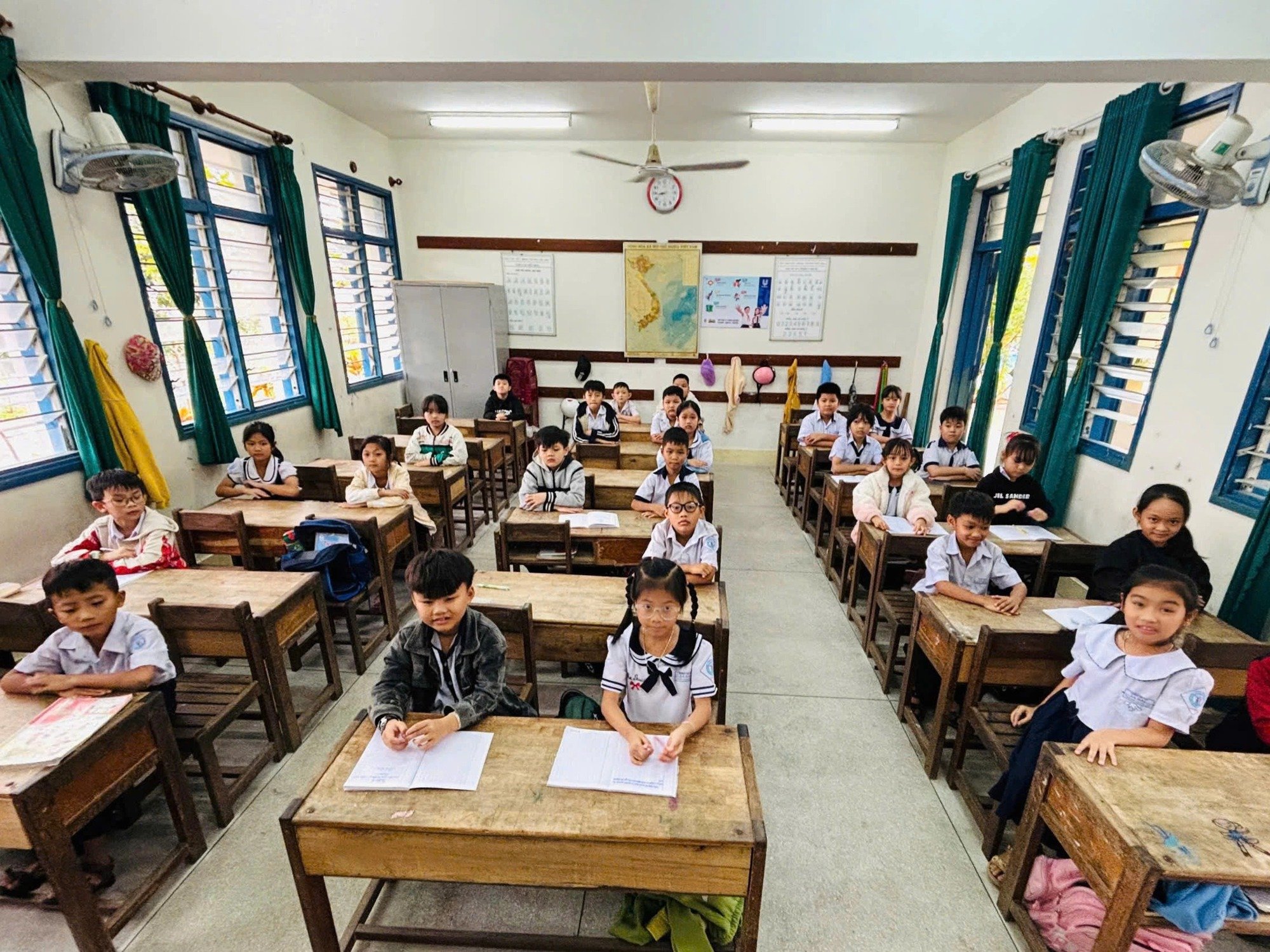
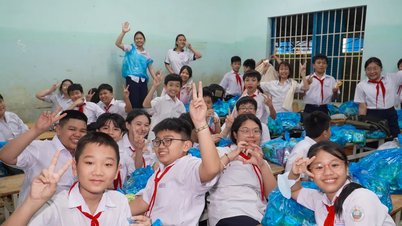
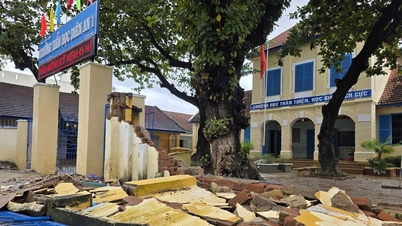
Students of La Hai Primary School, Dong Xuan Commune (formerly Dong Xuan District, Phu Yen ), Dak Lak returned to school in a state of lack of books and notebooks.
PHOTO: Contributor
RECOVERING EDUCATION AFTER A DISASTER: RIGHTS PROTECTED BY LAW
The 2019 Law on Education stipulates that studying is a citizen's right and obligation; at the same time, learners have the right to study in a safe and healthy educational environment according to Clause 4, Article 83. In terms of school safety, Circular 18/2023 of the Ministry of Education and Training sets out requirements for building safe schools and preventing accidents and injuries. The group of regulations on general education quality assessment and recognition of national standards are designed according to a separate set of criteria.
Article 83 affirms that learners have the right to study in a safe and healthy educational environment. However, when natural disasters occur, this right is interrupted through no fault of the students. Circular 18/2023 on the assessment of general education quality sets out criteria on facilities and learning conditions. This document does not specify specific cases after natural disasters, but the spirit is that all students must be guaranteed minimum learning conditions. If natural disasters destroy those conditions, who is responsible for restoring them?
The education sector's disaster prevention and control plan for the 2021-2025 period has identified the task of "ensuring the safety of life and property for students, teachers and school facilities". However, this document focuses on emergency prevention and response, and has not clarified the mechanism for post-disaster learning recovery as a right guaranteed by law.
NO FULL COMPENSATION POLICY: RISK OF INEQUALITY
In fact, after each flood, localities often organize make-up classes for students. But there are no specific regulations on how, for how long, and according to what criteria. Each locality decides based on actual conditions and financial capacity. This creates inequality. Students in one province may receive full make-up classes while students in another province may only receive a few brief classes before starting a new program. There are no minimum standards, no supervision, and no complaint mechanism if the right to make-up classes is not guaranteed.
Current law does not define compensatory learning as a right. The Decree on the regulations on organization and operation of general education institutions stipulates that schools are responsible for adjusting teaching plans when there are force majeure incidents, but does not specify to what extent, for how long, and with what resources.
Reducing the curriculum after a natural disaster sounds reasonable because students have lost many weeks of study and cannot keep up. But how to reduce the curriculum? Will students in flood-affected areas complete less curriculum than students in non-disaster areas? The general education program is regulated uniformly nationwide. High school graduation exams and separate university entrance exams also follow common standards. If students in flood-affected areas are reduced the curriculum without a compensation mechanism, they will be disadvantaged when competing with students in other areas, potentially leading to inequality in essence.
Education law affirms the principle of equity that all citizens have equal opportunities to learn. But when natural disasters create knowledge gaps without adequate policies to compensate, this principle is violated.

Students' desks and chairs were completely damaged at Dien An 1 Primary School ( Khanh Hoa )
PHOTO: BA DUY
3 LEGAL ISSUES
After natural disasters, many organizations and individuals donate books to students. This is a good thing but cannot replace the responsibility of the state. The Constitution stipulates that the state must invest in developing education and ensure the right to education of citizens. When students' books are swept away by floods, it is not a personal loss but an interruption of the right to education due to natural disasters, a force majeure factor.
Many localities have funds to support poor students, but there is no fund specifically for students affected by natural disasters. Students in flood-affected areas have to wait in line for general support, competing for resources with other groups while their needs are urgent.
Psychologically, many studies have shown that children after natural disasters are susceptible to stress, anxiety, and reduced ability to concentrate on studying. Although there are circulars on school health and school psychology, there is a lack of specialized procedures for post-disaster situations such as crisis intervention, screening criteria, expert mobilization mechanisms, and budgets. Teachers are trained in teaching methods, not in crisis intervention psychology. Without expert support, students are at risk of carrying psychological trauma for many years.
Current laws have many provisions on school safety and disaster prevention, but lack specific mechanisms for post-disaster learning recovery as a guaranteed right. There are no minimum standards for the number of compensatory hours, reduced content, book support, or psychological intervention. Everything depends on the goodwill and capacity of the locality.
This creates three legal problems. One is a violation of the principle of equality when students from the same country have different conditions for rehabilitating their studies depending on the locality. Two is the lack of a monitoring and accountability mechanism. If the locality does not organize adequate remedial classes or provide timely support, no agency will be responsible, and there will be no procedures for students or parents to file complaints. Three is an unreasonable financial burden on poor localities. The central provinces that often suffer from natural disasters are the localities with the most limited budgets. Asking them to take care of their own education recovery is pushing the burden onto the weakest.
Vietnam is one of the countries most severely affected by natural disasters. Every year, a large number of students in disaster-affected areas have to interrupt their studies due to floods and storms. This number will increase due to climate change. Without a full education recovery mechanism, natural disasters will have long-term consequences for entire generations.
Restoring education after a natural disaster is not a technical issue but a human right. Students in flood-affected areas do not only need sympathy, they need a legal mechanism to ensure their right to full education like their friends in other areas. When a natural disaster occurs, the state cannot choose not to protect its citizens. When the disaster is over, the state cannot choose not to compensate for the damage to children's right to education. It is time for the law to clearly define that restoring education after a natural disaster is the state's legal obligation, not goodwill.
Add some specific provisions to the law or issue a separate decree
It is necessary to supplement specific regulations in the Education Law or issue a separate decree on post-disaster education recovery, including:
First, clearly define that post-disaster learning recovery is the right of students, not the object of charity. This means that the state has a legal obligation to ensure, not to provide arbitrary support.
Second, set minimum standards for make-up learning such as the minimum number of hours to be made up, the teacher-to-student ratio, and the program completion deadline. These standards must be applied equally, regardless of rich or poor localities.
Third, establish a central and provincial education recovery fund to provide timely support for books and learning materials for students affected by natural disasters. Specify specific levels of support based on damage, without having to test family income.
Fourth, mandatory training for teachers in post-crisis psychological support, in coordination with school-based intervention psychologists for at least six months after a disaster.
Fifth, establish an independent monitoring mechanism and a complaint process when the right to education is not guaranteed. Education inspectors must report publicly on the status of education recovery after each major natural disaster.
Source: https://thanhnien.vn/phuc-hoi-hoc-tap-sau-lu-can-nghia-vu-phap-ly-185251126201635135.htm




























































Comment (0)