


And so, memories of roasting puffed rice for Tet (Vietnamese New Year) in the old days came flooding back…
In the old days, around the middle of December, one morning my father would take down the large cast-iron pan (a large pan with nine raised circles on the rim) from the kitchen loft, then busily add charcoal, light a fire, and heat the pan. Next, my mother would pour the glutinous rice into a basket, sift out the empty grains, and then measure out two bowls at a time and pour them into the pan. My father would stir continuously with large cooking chopsticks; my mother would fan the fire and add more charcoal; my siblings and I would sit behind them, watching the rice grains jump and pop, the popping sounds becoming more frequent and captivating. Under the blazing charcoal fire, the rice grains in the pan would leap and scatter, transforming from rough-shelled grains into pure white rice blossoms of various shapes. Some grains resembled grapefruit blossoms, apricot blossoms; some looked like lilies; some resembled miniature crowns; some exploded violently and flew out, which I would pick up, brush off the ash, put in my mouth, and they would melt quickly… The scent of fragrant rice was gentle, mixed with hints of straw, fields, and charcoal…
 |
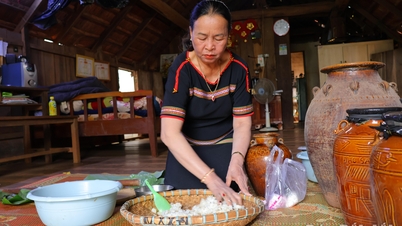
| Sticky rice flakes for Tet (Vietnamese New Year). |
After roasting for a few hours, the glutinous rice was poured onto a tray. My mother sifted it, removing all the husks, leaving a basket of pristine white rice flakes. My father poured them into a mortar and pounded them, the wooden pestle making a rhythmic, crackling sound… While my father pounded the rice flakes, my mother took a knife to the sugar container in the corner of the house, scooped out a knee-sized lump of sugar, and flattened it. Making rice flakes usually involves using dark sugar made from sugarcane, with fine, smooth grains and a yellowish-brown color. The pounded rice flakes are then mixed with sugar, and a little ginger juice is added for fragrance… The preparation of the ingredients is now complete; the remaining step is pounding the rice flakes (which my villagers call "dệnh cốm")…
Since yesterday afternoon, my father has been taking the rice puff mold out of the cupboard, scrubbing it clean, and drying it. The mold is rectangular, made of good quality wood, and consists of two parts: the outer shell and the inner core, which, when joined, have negligible gaps (like a cylinder and piston in an engine). You put the glutinous rice and sugar mixture into the outer shell, insert the piston, press firmly, then gently pull the shell up, and you get a piece of rice puff lying perfectly still on the tray…
In my hometown, almost every family has a plate of green rice flakes (cốm) on the ancestral altar during Tet because it's a delicate, vegetarian dish made from ingredients sourced from the fields of our homeland... Green rice flakes also appear on the plates of sweets offered to guests during the three days of Tet. And green rice flakes can be kept for a long time, eaten gradually throughout the month of January.
After Tet, even after the seventh day of the lunar month, there were still sticky rice cakes left in the house. Coming home from school, I would run straight into the house, open the lid of the bamboo container, take a piece of sticky rice cake and eat it while walking, then go to the water pot and drink a full ladleful, feeling full and refreshed…
In addition, during Tet, we have to make a lot of sticky rice flakes to take with us when we work in the fields. After harvesting the rice, we step ashore, take a piece of sticky rice flake, break it in half, and each person gets one half… The sweet, fragrant taste of brown sugar with the warm, pungent aroma of ginger blends with the chewy sticky rice, feeling so soothing in our throats; looking up at the clear blue January sky… how much we love our homeland!
Later, as I grew older, roasting rice flakes was no longer done manually; there were many less laborious methods, such as pressure cookers. During the twelfth lunar month, the rice flake roasting ovens would be bustling with people waiting to have their rice flakes roasted. But, no matter how joyful it was, I would always fondly remember the traditional "at-home" rice flake roasting experience of my parents in the old days…
Ngo Trong Cu
Source: https://baodaklak.vn/van-hoa-xa-hoi/van-hoa/202602/rang-com-tet-e40389b/
![[Photo] Prime Minister Pham Minh Chinh receives the delegation from the Japan Chamber of Commerce and Industry (JCCI)](https://vphoto.vietnam.vn/thumb/1200x675/vietnam/resource/IMAGE/2026/02/09/1770641860646_ndo_br_dsc-0142-jpg.webp)

![[Photo] Reflections on "Building for Tet 2026" at the Sycamore High-Rise Project construction site.](https://vphoto.vietnam.vn/thumb/1200x675/vietnam/resource/IMAGE/2026/02/09/1770642982527_image.jpeg)
![[Photo] Young people in Da Nang radiate the spirit of spring in traditional ao dai dresses.](https://vphoto.vietnam.vn/thumb/1200x675/vietnam/resource/IMAGE/2026/02/09/1770643241262_anh-man-hinh-2026-02-09-luc-20-20-03.png)











































Comment (0)