

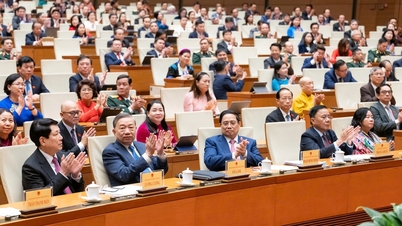
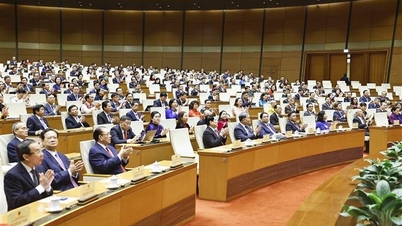
On June 10th, the National Assembly held group discussions on the draft Law on Telecommunications (amended). National Assembly Chairman Vuong Dinh Hue emphasized that there are two transformations in the world that no one can ignore: energy transformation and digital transformation.
In particular, digital transformation, which relates to national digital sovereignty , safety, and non-traditional security, presents many opportunities but also significant challenges. "The Telecommunications Law, viewed broadly, will create a foundation for digital transformation, moving towards a digital society and digital citizens," the Speaker of the National Assembly emphasized.
Focusing on major policies leads to a longer lifespan for new laws.
The Speaker of the National Assembly reviewed several recently amended laws related to digital transformation and affirmed that the amendment of the Telecommunications Law is part of an overall effort to serve the digital transformation process, placed within the context of other laws to ensure consistency.
According to the Speaker of the National Assembly, the 2009 Telecommunications Law mainly focused on regulating "telecommunications business activities," while this draft defines it more broadly as "telecommunications activities."
Telecommunications activities are not simply a pure business. They encompass the right to participate in telecommunications activities; the right to guaranteed telecommunications security for both service providers and users; and the issue of fair competition in telecommunications activities.

The Speaker of the National Assembly acknowledged that the drafting committee had made many efforts in this direction, including very good provisions, but emphasized the need to focus on major policies so that the law would have a long lifespan.
Noting that this law has cross-border issues, attracting significant attention both domestically and internationally, the Speaker of the National Assembly emphasized: "Digital transformation relates to national digital sovereignty and information security, and latecomer countries like ours have opportunities."
Regarding international commitments, the Chairman of the National Assembly pointed out that there are five groups that need to be reviewed to finalize the draft Law on Telecommunications (amended), including: commitments to market opening; commitments on the institutional and business environment of telecommunications; commitments related to international law in general; regulations on procedures at specialized forums and organizations; and concepts in the field of telecommunications that have been defined in international treaties.
Going into specifics, National Assembly Chairman Vuong Dinh Hue stated that data centers, cloud computing services, and OTT services are becoming increasingly popular, significantly impacting social life and the rights and interests of individuals and organizations.
In the draft law, it is stated that several countries, including China, Thailand, and South Korea, have enacted similar laws concerning telecommunications services, therefore, additions are necessary to ensure national interests and consumer interests. This is the viewpoint of the drafting agency.
Another opinion suggests considering including these three services in the draft amended Telecommunications Law at an appropriate level, ensuring that it encourages the development of telecommunications technology without affecting foreign investment attraction in Vietnam.
This opinion also suggests studying international experience to more specifically regulate the business of data centers, cloud computing services, and OTT services in terms of management levels and conditions.
"Personally, I and the Standing Committee of the National Assembly are in this direction," the Speaker of the National Assembly said. He noted that inappropriate regulations would be very complicated to implement. Therefore, the bill needs to have a comprehensive view.
"Don't think that technical laws like this don't have a big impact; this is a game that many countries are very interested in. The important thing when drafting laws is to stay on the big picture; the technical design later won't be too difficult," Mr. Vuong Dinh Hue emphasized.
Other opinions expressed concerns about the method of service provision as stipulated in the draft law, as the management and provision of OTT services remains a controversial topic in many countries.
Amending the law is "absolutely necessary".
Representative Hoang Duc Thang (Quang Tri) commented that the Telecommunications Law of 2009 has been in effect for 13 years, giving it a relatively long lifespan.
According to the representative from Quang Tri province, the telecommunications sector is developing very rapidly each year, with technology advancing significantly, but the legal framework was established quite a long time ago, so this revision is "absolutely necessary".
According to Mr. Thang, the draft Law on Telecommunications (amended) has "touched" upon fundamental issues, from the scope of regulation to the rights of organizations and individuals participating in telecommunications activities.

Considering that the draft still heavily focuses on telecommunications business and other contents are not clearly defined, the delegates suggested that the drafting agency review the chapters and articles to make appropriate adjustments.
Regarding Article 4, which outlines the State's policy on telecommunications, "creating conditions for organizations and all economic sectors to participate in telecommunications investment and business to create breakthroughs in telecommunications infrastructure development," the representative commented that the word "breakthrough" is not the language of law but rather resembles a resolution or action program, and therefore should not be used.
Speaking at the Hanoi delegation meeting, delegate Ta Dinh Thi (Deputy Chairman of the National Assembly's Committee on Science, Technology and Environment) stated that Resolution No. 6 of the 13th Central Committee on continuing to promote industrialization and modernization of the country until 2030, with a vision to 2045, identifies digital infrastructure as essential and ensuring cybersecurity as key, moving quickly and ahead of the curve.
According to delegates from Hanoi, the goal is for the digital economy to account for approximately 20% of the economy by 2025. Along with that, we also aim for a digital society, encompassing digital citizens and a digital society as a whole.
"To achieve such goals, we must build institutions, and the Telecommunications Law is part of that plan," said delegate Ta Dinh Thi.
According to Mr. Thi, the review process of the 2009 Telecommunications Law clearly identified the necessary amendments and additions to meet the demands of reality.
In its review report, the Committee on Science, Technology and Environment emphasized that the amendment to the law expands its scope to include areas such as data center services, cloud computing, and telecommunications services to align with the new development context.
"In the draft law, I find these contents to basically meet the requirements," Mr. Thi said.
Representative Ly Van Huan, Deputy Chief Prosecutor of Thai Nguyen Provincial People's Procuracy, proposed adding several prohibited acts to the list of prohibited actions: "Abusing official position and authority to leak information"; "using technology to interfere with telecommunications operations"...
Furthermore, he pointed out that during prosecution and trial, many crimes related to telecommunications activities were handled with great delay despite requests for documents from investigative agencies, the Procuratorate, and the courts. This created significant difficulties for the investigating authorities.
"For example, in the case of online fraud, investigative agencies desperately want to receive personal identification information, banking-related information, etc., promptly, but these agencies are very slow to provide it, leading to ineffective investigations," Representative Huan cited as an example.
Therefore, Representative Huấn expressed his wish that this law should stipulate that, upon request from prosecuting authorities, state agencies, including telecommunications companies, must provide information promptly and within a clear timeframe to ensure the progress of investigations.
Source

































































































Comment (0)