

The U.S. Food and Drug Administration (FDA) has approved a device that uses ultrasound waves to destroy tumors in the liver.
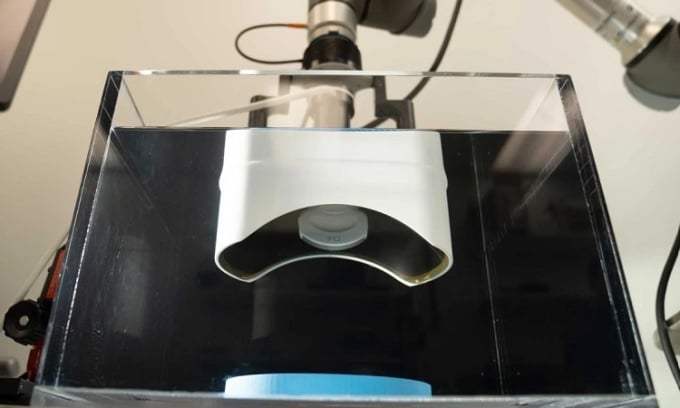
HistoSonics' tumor destruction device. Photo: Erica Bass
The device, which requires no needles, scalpels, or medication, and is called histotripsy, was developed by HistoSonics, a company founded in 2009 by engineers and doctors at the University of Michigan, Popular Science reported on October 15. The decision to grant approval came after a series of clinical trials showed the device could effectively destroy liver tumors while remaining safe for patients. Currently, hospitals in the US can purchase the device and offer it as a treatment option for patients.
The machine works by directing high-energy ultrasound pulses directly at the tumor, creating clusters of microbubbles inside. As the bubbles form and burst, they put pressure on surrounding cells and tissues, facilitating the breakdown of the tumor's internal structure, leaving behind scattered fragments that the immune system can then process.
After the patient is anesthetized, a treatment device resembling a pair of virtual reality glasses is placed over their abdomen. The doctor examines and locates the tumor through a control screen. Then, they deliver sound waves. The process is quick and painless, and the recovery time is very short.
Thanks to the dual imaging system, doctors can also observe sound waves directed at the tumor while avoiding other parts of the body. The robotic arm will remove obstructions to better target the tumor area. During this process, the patient's immune system also learns to recognize tumor cells as a threat, thereby preventing reinfection or metastasis in 80% of the experimental mice.
The test results are very encouraging. Tissue fragmentation techniques are being applied in many preclinical trials for tumors outside the brain, such as kidney cancer, breast cancer, pancreatic cancer, and musculoskeletal cancer. In addition to tumors, a similar technique called lithotripsy also helps break up kidney stones, causing pain until they are small enough to be passed out of the body naturally.
An Khang (According to Popsci )
Source link

![[Photo] Prime Minister Pham Minh Chinh presides over a meeting on private sector economic development.](/_next/image?url=https%3A%2F%2Fvphoto.vietnam.vn%2Fthumb%2F1200x675%2Fvietnam%2Fresource%2FIMAGE%2F2025%2F12%2F20%2F1766237501876_thiet-ke-chua-co-ten-40-png.webp&w=3840&q=75)





























































































Comment (0)