

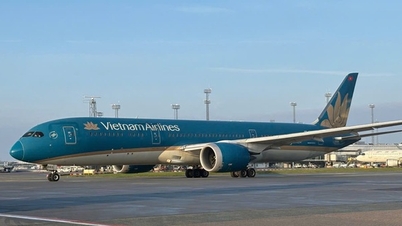
This decision was approved by the Ministry of National Defence and the General Staff after close coordination with the Civil Aviation Authority of Vietnam, the Air Defence and Air Force Command, and the Vietnam Air Traffic Management Corporation (VATM), marking an important step in "unleashing" the airspace around Tan Son Nhat airport, the busiest air traffic area in the country.
The trial period will last from December 19, 2025 to March 31, 2026, coinciding with the peak of the Lunar New Year (Year of the Horse), aiming to optimize airspace and bring "double" benefits to civil aviation.
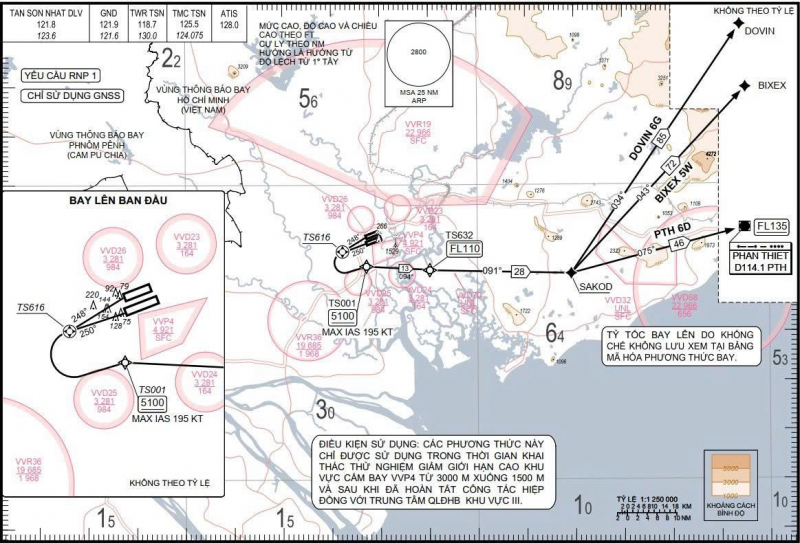
The VVP4 no-fly zone, as defined by Decision No. 159/2006/QD-BQP of the Ministry of National Defense, covers the inner city airspace of Ho Chi Minh City with an altitude limit of 3,000m from ground level, prohibiting all civil aviation activities 24 hours a day. This location is situated in the center of the Tan Son Nhat - Bien Hoa - Long Thanh airport cluster, making the airspace congested, especially during military operations in Bien Hoa. Reducing the altitude of the VVP4 no-fly zone from 3,000m to 1,500m opens up the necessary space for civil aviation activities, resolving long-standing limitations such as aircraft having to circle around the area and altitude restrictions, leading to increased fuel consumption and flight time for airlines.
Reducing the altitude of the VVP4 no-fly zone has yielded the following notable results: With an average of 750 daily takeoffs and landings at Tan Son Nhat (primarily north and northeast, accounting for 70%), aircraft can now fly straighter, shortening the distance and time needed to gain altitude. It is estimated that each flight saves 1-3 minutes during peak hours. Based on airline calculations, every 11 km (equivalent to 1 minute of flight time) saves approximately VND 1.6 million for A321 aircraft, VND 3 million for A350 aircraft, and VND 2.5 million for B787 aircraft (the average figure is VND 2.4 million). Official implementation will significantly reduce costs for airlines.
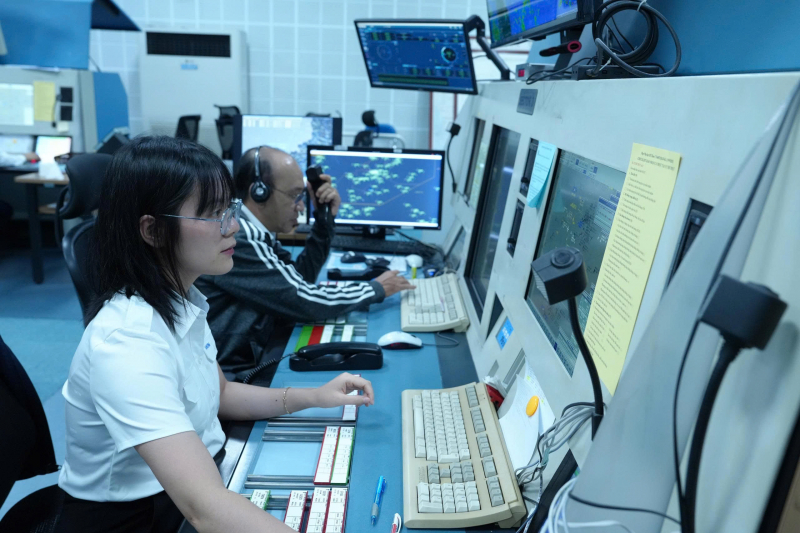
Previously, aircraft making misdirected approaches on flight path CHC 07/25 often had to circle towards the VVP4 no-fly zone at low altitude, posing a significant risk. Now, with the reduced altitude of the no-fly zone, aircraft are more maneuverable while maintaining safety. Fuel savings mean reduced CO2 emissions, aligning with the "green aviation" commitment. With the high density of flights at the southern gateway, the benefits of minimizing environmental impact will contribute to the sustainable development goals of the civil aviation industry.
VATM leaders added that when Long Thanh airport becomes operational, with the simultaneous operation of both Tan Son Nhat and Long Thanh airports, reducing the altitude of the VVP4 restricted area will create flexible spaces, separate flight paths, and reduce conflicts for flight operations in this area.
This trial will not only alleviate immediate pressure on Tan Son Nhat Airport during the 2026 Lunar New Year but also serve as a "key" to solving the problem of airspace planning in this area. Upon completion of the trial phase, VATM will compile data to report to relevant authorities for consideration of official implementation.
This coordinated pilot project affirms VATM's pioneering role in preparing the "soft" infrastructure for the new era of Vietnamese aviation. With the upcoming opening of Long Thanh Airport, this is a strategic step that promises to enhance regional competitiveness, bringing long-term benefits to passengers and contributing to the socio-economic development of Vietnam.
Source: https://cand.com.vn/Giao-thong/thu-nghiem-giam-do-cao-khu-vuc-cam-bay-buoc-dot-pha-trong-toi-uu-hoa-vung-troi-i791228/

![[Image] Leaked images ahead of the 2025 Community Action Awards gala.](/_next/image?url=https%3A%2F%2Fvphoto.vietnam.vn%2Fthumb%2F1200x675%2Fvietnam%2Fresource%2FIMAGE%2F2025%2F12%2F16%2F1765882828720_ndo_br_thiet-ke-chua-co-ten-45-png.webp&w=3840&q=75)
![[Live] 2025 Community Action Awards Gala](/_next/image?url=https%3A%2F%2Fvphoto.vietnam.vn%2Fthumb%2F1200x675%2Fvietnam%2Fresource%2FIMAGE%2F2025%2F12%2F16%2F1765899631650_ndo_tr_z7334013144784-9f9fe10a6d63584c85aff40f2957c250-jpg.webp&w=3840&q=75)

![[Photo] Prime Minister Pham Minh Chinh receives the Governor of Tochigi Province (Japan)](/_next/image?url=https%3A%2F%2Fvphoto.vietnam.vn%2Fthumb%2F1200x675%2Fvietnam%2Fresource%2FIMAGE%2F2025%2F12%2F16%2F1765892133176_dsc-8082-6425-jpg.webp&w=3840&q=75)
![[Photo] Prime Minister Pham Minh Chinh receives Lao Minister of Education and Sports Thongsalith Mangnormek](/_next/image?url=https%3A%2F%2Fvphoto.vietnam.vn%2Fthumb%2F1200x675%2Fvietnam%2Fresource%2FIMAGE%2F2025%2F12%2F16%2F1765876834721_dsc-7519-jpg.webp&w=3840&q=75)






























![[Photo] Prime Minister Pham Minh Chinh attends the Vietnam Economic Forum 2025](https://vphoto.vietnam.vn/thumb/402x226/vietnam/resource/IMAGE/2025/12/16/1765893035503_ndo_br_dsc-8043-jpg.webp)



















Comment (0)