


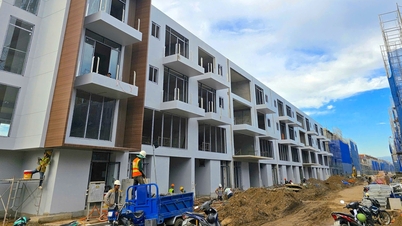
Real estate project in District 1, Ho Chi Minh City - Photo: QUANG DINH
Recently, among the 11 laws passed at the 7th session of the 15th National Assembly , the Law amending and supplementing a number of articles of 4 laws related to real estate, namely the Land Law 2024, the Housing Law 2023, the Real Estate Business Law 2023, and the Law on Credit Institutions 2024, received the highest number of disapproval votes.
While other laws were almost unanimously approved, this bill saw 37 out of 469 deputies present vote against it and 28 abstain (a total of nearly 14%).
These figures accurately reflect the concerns of some delegates when commenting on these bills. Delegates expressed worries that the drafting of guiding documents (decrees, circulars, decisions) by the Government , ministries, and localities would not be timely enough to ensure that the laws could be implemented immediately from August 1st.
However, one factor that led the majority of remaining delegates to place their trust in and agree to pass the bill was the commitment, promise, and political determination of the Government, the Prime Minister, ministries, and localities to have the National Assembly approve the law so that it can soon take effect and remove obstacles and bottlenecks.
The delegates placed their hopes and expectations on every button they pressed in the law, believing it would revitalize the real estate market and unlock land resources.
There is only one month left for central and local agencies to focus on accelerating the drafting of guiding documents. This initial step in fulfilling the promise to develop sufficient sub-legal documents is crucial, as it demonstrates the effectiveness of the government and relevant agencies in fulfilling their commitments to the draft law.
Preventing situations where circulars "wait" for decrees, or local documents "wait" for central government documents, is only the first step. The implementation phase is what determines the effectiveness and efficiency of bringing laws into practice. And the most important aspect of this is the sense of public duty of the implementing team.
Previously, regulatory agencies acknowledged obstacles and bottlenecks due to overlapping and unclear regulations. With the upcoming application of this new law, many businesses are questioning whether projects will run smoothly and whether the obstacles will be completely resolved.
Currently, the issue of calculating land use fees is the most anticipated by businesses. Deputy Prime Minister Tran Hong Ha affirmed that the new Land Law has resolved the issue of shirking responsibility and fear of accountability in land valuation.
Once the law comes into effect, local authorities will have confidence, and with a clear and transparent process, land valuation will be able to calculate land use fees for projects.
When implemented effectively, there will be no reason for agencies to shirk their responsibilities or cite difficulties in resolving projects. The number of projects whose financial obligations are resolved and approved will be proof of the effectiveness of public service once the new law comes into effect.
Similarly, in other project-related issues, once the law comes into effect, it requires the early involvement of ministries, localities, and central and local real estate project obstacle resolution teams to apply the law and resolve difficulties.
From the perspective of the people, many families are also waiting for the issuance of land ownership certificates when the conditions in the new law are more flexible and prioritize the rights of the people. With the law in place and clear regulations, if people still complain about difficulties and obstacles, it will be difficult to explain this to businesses and the public.
Regulations for dealing with civil servants who shirk responsibility, avoid accountability, or are afraid of taking responsibility should also be applied to ensure the integrity of public service.
The government has been entrusted by the National Assembly with the responsibility of organizing the implementation of the Land Law, the Housing Law, the Real Estate Business Law, and the Law on Credit Institutions, ensuring their effectiveness and efficiency.
The concrete results in resolving each obstacle, each project, and each issue that has been hindering and congesting the real estate market are clear evidence of the government's fulfillment of its promises and responsibilities.
Source: https://tuoitre.vn/thuc-thi-go-vuong-bat-dong-san-20240703083643092.htm


![[Photo] General Secretary and President To Lam presides over a meeting with the Central Organizing Committee.](https://vphoto.vietnam.vn/thumb/1200x675/vietnam/resource/IMAGE/2026/06/03/1780482764658_a1-bnd-4741-3342-jpg.webp)

![[Photo] Secretary of the National Assembly Party Committee, Chairman of the National Assembly presides over the meeting of the Standing Committee and Executive Committee of the National Assembly Party Committee.](https://vphoto.vietnam.vn/thumb/1200x675/vietnam/resource/IMAGE/2026/06/03/1780480353201_ndo_br_bnd-2585-jpg.webp)
![[Photo] First session of the 14th Congress of the Vietnam Trade Union](https://vphoto.vietnam.vn/thumb/1200x675/vietnam/resource/IMAGE/2026/06/03/1780465947883_ndo_br_img-3852-jpg.webp)


















































![[Video] Sunset at Lap An Lagoon – Where the sun sets over the fishing nets](https://vphoto.vietnam.vn/thumb/1200x675/vietnam/resource/IMAGE/2026/05/31/1780192137701_beach-landscape-sea-water-nature-grass-745871-pxhere-com.jpeg)




































Comment (0)