

A 17-year-old male student (currently in 11th grade) came to the Institute of Nutrition for a check-up because his family was worried that his peers were growing noticeably taller, while he had "almost stopped growing." He had only increased by 1-2 cm in the past year. Currently, he is 162.3 cm tall and weighs 50.1 kg. Through questioning, we learned that he began puberty in the middle of 7th grade (13 years old) and experienced rapid height growth for about 1.5 years (from 7th to 9th grade), then slowed down and almost stopped completely in the past year. He frequently skips breakfast, eats lunch at school, and his dinner is irregular depending on his extracurricular schedule. His daily diet mainly consists of lean meat and fish, with few calcium-rich foods. He often goes to bed late (0-1 AM) because he studies and uses his phone. He has very limited physical activity, mostly sitting to study and use a computer, and commutes to school by electric bicycle. Upon examination, we observed a low BMI, flabby arm and thigh muscles, pale skin, and a history of height growth showing a sharp decline in height from 15–16 years of age.
High bone density is a key factor in maintaining a strong skeleton, reducing the risk of osteoporosis and fractures later in life. Bone growth goes through two main stages. During the growth phase (teens, pre- and during puberty), bones grow rapidly in length, but bone mineral density may be deficient because accumulation does not keep pace with the growth rate, making children prone to bone density deficiency during this period. Children with delayed puberty (due to genetic or hormonal factors) have lower bone density than those who experience puberty at or early onset, thus having a higher risk of fractures later in life. Height growth peaks around 10-14 years old for girls and 12-16 years old for boys, but peak bone density is only reached a few years after this period. A diet deficient in calcium and vitamin D, or a lack of physical activity, reduces the body's ability to accumulate minerals in bones, increasing the risk of fractures due to osteoporosis after age 50. The post-puberty period (18–25 years old) is when the body reaches its highest bone density (peak bone density). This is the stage where the body completes 90–95% of its total bone density. Studies have shown that peak bone density in the spine is usually reached between the ages of 20–29 for women and 21–25 for men. After age 30, bone density begins to decline, with an average rate of decrease of 0.3–1.1% per year before menopause and a rapid decrease of 1.5–3.5% per year after menopause in women; this rate is lower in men (0.7%). If peak bone density is low, the risk of osteoporosis and hip and spinal fractures in old age increases significantly.
Returning to the case mentioned above, the doctor diagnosed: Stunted growth due to nutritional deficiencies and an inappropriate lifestyle during puberty; micronutrient deficiencies (vitamin D, zinc, iron); low physical activity, poor sleep, and impaired growth hormone (GH). The student was advised to follow a diet with sufficient protein from meat, fish, eggs, milk, beans, etc.; supplement with vitamin D, zinc, and iron; increase calcium intake (800–1200 mg/day) from food; go to bed early before 11 PM and sleep at least 8 hours per night to optimize GH secretion. Simultaneously, the student needed to exercise for 45–60 minutes per day through activities such as running, playing soccer, swimming, or light strength training; and limit sugary drinks and fried foods sold in restaurants. The student was also advised to monitor their height progress every 3 months.
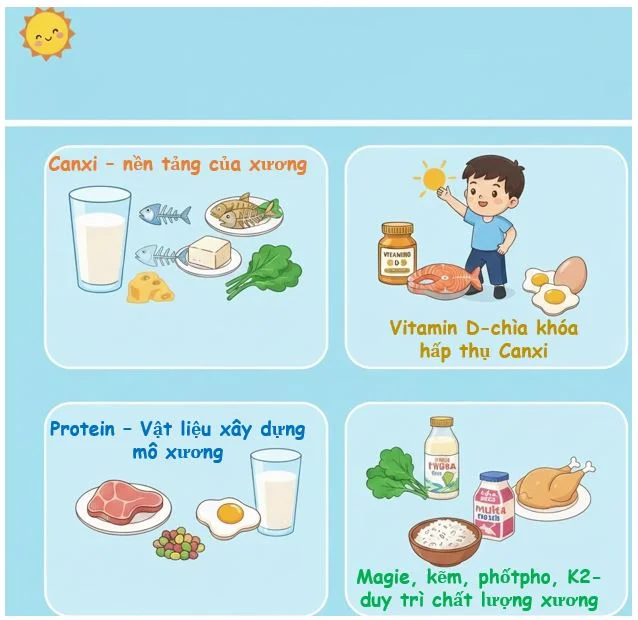
Dietary considerations for increasing bone density.
Calcium is the foundation of bone density. It makes up 99% of the body's total calcium, primarily found in bones and teeth, and is an irreplaceable mineral for bone formation. Adolescents and young adults need an average of 1000–1200 mg of calcium per day. Good sources of calcium include milk and dairy products (200–300 mg/100 ml), small fish eaten whole like anchovies and sardines (150–300 mg/100 g), tofu (250–300 mg/100 g), and dark green leafy vegetables such as spinach, kale, and collard greens (100–150 mg/100 g). It's best to consume calcium throughout the day rather than concentrating it in one or two meals to optimize absorption.
Vitamin D is key to calcium absorption. No matter how rich your diet is in calcium, a lack of vitamin D will prevent adequate absorption. Vitamin D helps increase calcium absorption in the intestines and binds calcium to the bones. Post-pubescent individuals need approximately 800 IU of vitamin D daily. The main source of vitamin D is sunlight, with a reasonable amount of sun exposure of about 10-15 minutes per day in the early morning or late afternoon. Foods rich in vitamin D include salmon, mackerel, egg yolks, and fortified milk.
Protein is the building material of bone tissue. It makes up nearly 50% of the volume and 30% of the weight of bone, forming the foundation for collagen – the supporting framework for minerals to attach to. An adequate protein intake (1–1.2 g/kg body weight/day) from lean meats, fish, eggs, dairy, and legumes will help improve bone formation rate. Conversely, consuming too much animal protein along with high salt content can increase calcium excretion in urine.
Magnesium, zinc, phosphorus, and vitamin K2 also play a significant role in maintaining bone quality. Magnesium helps stabilize bone structure; zinc promotes new bone formation; and vitamin K2 helps calcium be properly transported into the bones instead of depositing in blood vessels. A varied diet including whole grains, green vegetables, eggs, meat, and fermented products will help supplement these micronutrients.
Caffeine, sugary drinks, excessive salt intake, smoking, and alcohol consumption all reduce calcium absorption or increase its excretion. A sedentary lifestyle also leads to a gradual decrease in bone density. Activities such as brisk walking, jogging, jumping rope, and strength training are essential for calcium to be securely "locked" into the bones.
In summary, although bone growth in length slows or stops after puberty, bone density still needs to be continuously increased to reduce the risk of osteoporosis and fractures in the future.
Department of Communication - Health Education (according to the Institute of Nutrition)
Source: https://yte.nghean.gov.vn/tin-chuyen-nganh/tre-da-ngung-phat-trien-chieu-cao-la-xuong-da-truong-thanh-987961
![[Photo] Prime Minister Pham Minh Chinh receives Lao Minister of Education and Sports Thongsalith Mangnormek](/_next/image?url=https%3A%2F%2Fvphoto.vietnam.vn%2Fthumb%2F1200x675%2Fvietnam%2Fresource%2FIMAGE%2F2025%2F12%2F16%2F1765876834721_dsc-7519-jpg.webp&w=3840&q=75)

![[Image] Leaked images ahead of the 2025 Community Action Awards gala.](/_next/image?url=https%3A%2F%2Fvphoto.vietnam.vn%2Fthumb%2F1200x675%2Fvietnam%2Fresource%2FIMAGE%2F2025%2F12%2F16%2F1765882828720_ndo_br_thiet-ke-chua-co-ten-45-png.webp&w=3840&q=75)

![[Live] 2025 Community Action Awards Gala](/_next/image?url=https%3A%2F%2Fvphoto.vietnam.vn%2Fthumb%2F1200x675%2Fvietnam%2Fresource%2FIMAGE%2F2025%2F12%2F16%2F1765899631650_ndo_tr_z7334013144784-9f9fe10a6d63584c85aff40f2957c250-jpg.webp&w=3840&q=75)
![[Photo] Prime Minister Pham Minh Chinh receives the Governor of Tochigi Province (Japan)](/_next/image?url=https%3A%2F%2Fvphoto.vietnam.vn%2Fthumb%2F1200x675%2Fvietnam%2Fresource%2FIMAGE%2F2025%2F12%2F16%2F1765892133176_dsc-8082-6425-jpg.webp&w=3840&q=75)




















































![[Video] Independence and self-reliance linked with international integration through 40 years of reform](https://vphoto.vietnam.vn/thumb/402x226/vietnam/resource/IMAGE/2025/12/16/1765899635777_1-1-8054-png.webp)



































Comment (0)