

According to the Law amending and supplementing a number of articles of the Law on Education recently passed by the National Assembly, the national education system will include vocational secondary education, officially recognized as equivalent to high school education. This is a new direction aimed at expanding choices for students after completing lower secondary education.
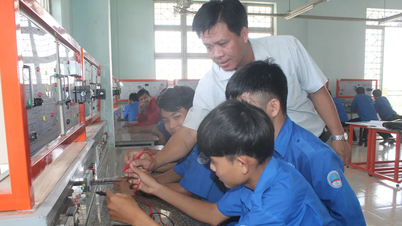
According to information from the Ministry of Education and Training , vocational high schools are designed for students who are oriented towards vocational training early on, focusing on practical skills and preparing them to enter the labor market in a shorter time than the traditional academic path.
Vocational high school programs ensure the provision of foundational general education knowledge while increasing the duration of vocational training. Through this, learners can develop clear professional competencies from the secondary school level, meeting the skilled workforce needs of the labor market.
The addition of this educational level is expected to fundamentally address the long-standing problem of streaming students after lower secondary school. Instead of putting pressure on students to pursue upper secondary education and then university, they will have more options that suit their abilities, strengths, and personal career aspirations.
According to the roadmap, in the period 2025-2026, the Ministry of Education and Training will focus on building a legal framework and standardized training programs for vocational high schools. From 2026 to 2030, the program will be officially implemented with the first enrollment nationwide at eligible institutions. By 2030, the vocational high school model will be reviewed and evaluated for further adjustment and improvement.
The institutions permitted to provide vocational secondary education include vocational high schools; secondary and college-level schools that meet the requirements; and some higher education institutions in specialized fields such as arts and sports . For universities, vocational secondary education is only permitted for majors and professions within the specialized fields that the university is already offering at the undergraduate level.
The planned duration of vocational high school training is 3 years, replacing the current intermediate-level model with entry requirements for students graduating from lower secondary school. When vocational high school is implemented, the intermediate-level program in vocational education will only enroll students who have graduated from upper secondary school, thereby clearly defining the different levels of education within the education system.
The government also plans to issue policies for training and developing teachers and lecturers to meet the requirements of vocational high school teaching; and at the same time, consider waiving or supporting tuition fees for learners to encourage streaming and ensure equal access to education.
Because their training objectives differ from those of high school, vocational high schools will have their own assessment and graduation regulations, combining the evaluation of general knowledge and vocational skills. This approach is expected to facilitate students entering the workforce sooner or continuing their education at appropriate levels and in suitable professions within the national education system.
Source: https://baolaocai.vn/tu-nam-2026-hoc-sinh-tot-nghiep-thcs-co-them-lua-chon-hoc-trung-hoc-nghe-post888986.html
![[Photo] Prime Minister Pham Minh Chinh receives the Governor of Tochigi Province (Japan)](/_next/image?url=https%3A%2F%2Fvphoto.vietnam.vn%2Fthumb%2F1200x675%2Fvietnam%2Fresource%2FIMAGE%2F2025%2F12%2F16%2F1765892133176_dsc-8082-6425-jpg.webp&w=3840&q=75)


![[Photo] Prime Minister Pham Minh Chinh receives Lao Minister of Education and Sports Thongsalith Mangnormek](/_next/image?url=https%3A%2F%2Fvphoto.vietnam.vn%2Fthumb%2F1200x675%2Fvietnam%2Fresource%2FIMAGE%2F2025%2F12%2F16%2F1765876834721_dsc-7519-jpg.webp&w=3840&q=75)

![[Image] Leaked images ahead of the 2025 Community Action Awards gala.](/_next/image?url=https%3A%2F%2Fvphoto.vietnam.vn%2Fthumb%2F1200x675%2Fvietnam%2Fresource%2FIMAGE%2F2025%2F12%2F16%2F1765882828720_ndo_br_thiet-ke-chua-co-ten-45-png.webp&w=3840&q=75)





































![[Photo] Prime Minister Pham Minh Chinh attends the Vietnam Economic Forum 2025](https://vphoto.vietnam.vn/thumb/402x226/vietnam/resource/IMAGE/2025/12/16/1765893035503_ndo_br_dsc-8043-jpg.webp)






















Comment (0)