

A breakthrough in materials science could soon make the computers and phones we use obsolete.
Researchers at Northeastern University (USA) have found a way to use light to control a type of quantum material, paving the way for processors up to 1,000 times faster than current silicon technology.
For decades, the speed of electronic devices has been determined by transistors made from silicon. But as the technology approaches its physical limits, scientists are looking for a new paradigm. And they may have found the answer in a material called "1T-TaS₂."
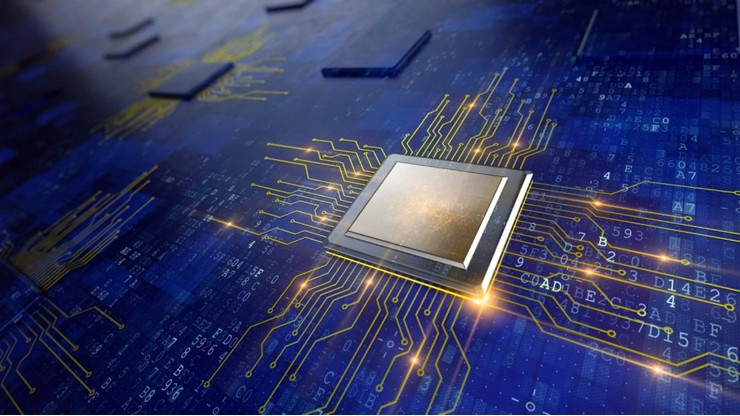
The quantum material 1T-TaS₂ could enable device speeds up to 1,000 times faster.
The material has a unique ability to switch between conducting and insulating states. However, it previously only worked at extremely cold temperatures, making practical applications impossible.
Now, the team has succeeded in "locking" this useful state at much warmer temperatures (-63°C) and maintaining it stably for months, which is considered a huge step forward.
“Current processors operate at gigahertz (GHz) frequencies,” said assistant professor Alberto de la Torre, lead author of the study. “The rate of change that this method can provide will allow you to reach terahertz (THz) frequencies” (1 THz = 1,000 GHz).
Their secret lies in using light to control it. "Nothing is faster than light, and we are using light to control the properties of materials at the fastest speeds physically possible," explains Professor Gregory Fiete.
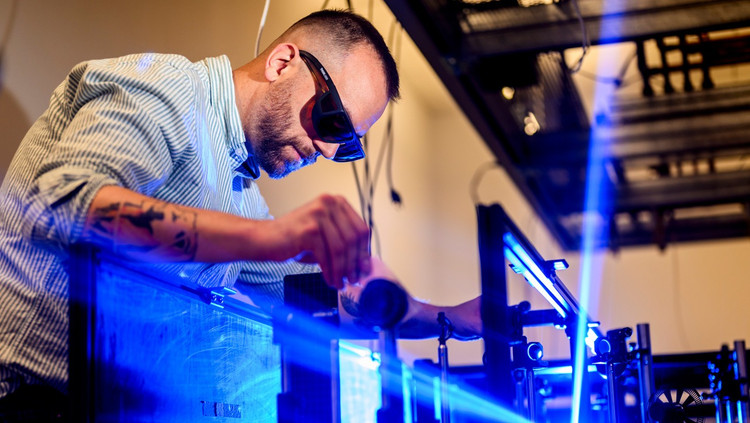
Assistant Professor Alberto de La Torre experiments with quantum materials at Northeastern University - USA.
Essentially, they turned a material into a super-sensitive, light-activated switch that is not only faster but also much simpler than today's complex transistor structures.
“We eliminate one of the technical challenges by putting it all in a single material,” says Mr. Fiete.
This discovery is considered a "new paradigm" for the computing industry, alongside quantum computing.
Instead of trying to cram more transistors onto an increasingly cramped chip, engineers can now aim to build devices from smarter, stronger, and more efficient materials.
Source: https://khoahocdoisong.vn/vat-lieu-luong-tu-moi-thuc-day-may-tinh-va-dien-thoai-nhanh-hon-1000-lan-post2149044059.html





![[Photo] Urgently help people soon have a place to live and stabilize their lives](/_next/image?url=https%3A%2F%2Fvphoto.vietnam.vn%2Fthumb%2F1200x675%2Fvietnam%2Fresource%2FIMAGE%2F2025%2F12%2F09%2F1765248230297_c-jpg.webp&w=3840&q=75)











![[INFOGRAPHIC] Little known facts about Benin President Patrice Talon](https://vphoto.vietnam.vn/thumb/402x226/vietnam/resource/IMAGE/2025/12/09/1765286018308_thumb-tong-thong-benin-jpg.webp)










































![[Photo] General Secretary To Lam works with the Standing Committees of the 14th Party Congress Subcommittees](https://vphoto.vietnam.vn/thumb/402x226/vietnam/resource/IMAGE/2025/12/09/1765265023554_image.jpeg)





























Comment (0)