

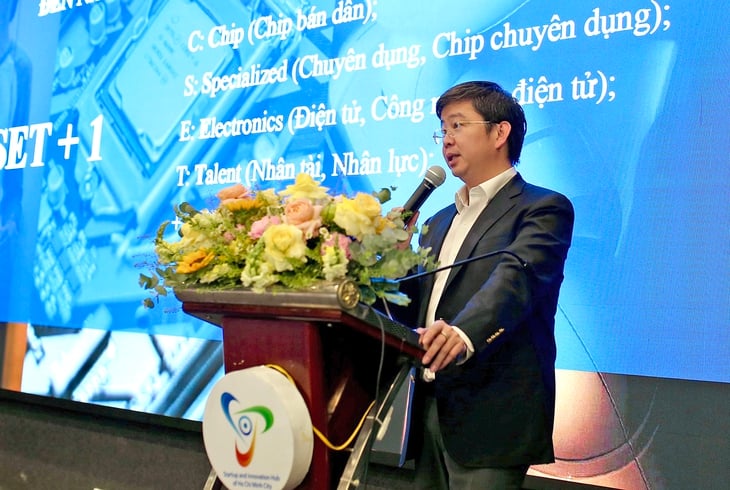
Deputy Minister of Science and Technology Bui Hoang Phuong speaks at a workshop on the development of the semiconductor industry - Photo: Vu Hien
At the workshop "Developing Policies and Solutions to Promote the Development of Vietnam's Semiconductor Industry," held on December 17, 2025, in Ho Chi Minh City, the goal of training 100,000 semiconductor engineers by 2030 was set as a major challenge, determining the feasibility of realizing the industry's development strategy in the coming decades.
When semiconductors become the foundation of the digital economy .
Speaking at the workshop, Mr. Nguyen Anh Tuan, Acting Deputy Director of the Information Technology Industry Department, stated that the semiconductor industry has transcended the boundaries of a typical high-tech industry, becoming an infrastructure linked to technological security and national self-reliance.
"A semiconductor development strategy requires a systematic, long-term approach, avoiding a trend-following mindset," Mr. Tuan emphasized.
Accordingly, Vietnam aims to focus directly on high value-added stages, especially chip design and product design, instead of just assembly and processing.
Based on this, developing high-quality human resources is identified as the first and most crucial step.
In its national strategy, Vietnam aims to increase the number of semiconductor engineers to 100,000 by 2030, while focusing on developing specialized semiconductor chips and closely linking the semiconductor and electronics industries to avoid dependence on foreign output.
2025 is considered a crucial turning point as the National Assembly enacts the Law on Digital Technology Industry, which for the first time dedicates a separate chapter to the semiconductor industry.
Along with laws on investment, taxation, and import/export, the new policy system has created a relatively comprehensive legal framework for the industry.
According to the Ministry of Science and Technology, the semiconductor industry has been classified for the first time as a specially prioritized investment sector, with a series of policies such as a 10% corporate income tax rate for 15 years, tax exemption for the first 4 years, and a 50% reduction for the following 9 years; R&D costs are doubled during tax settlement; land rent is waived; and import duties are exempted for chip manufacturing lines and equipment.
Notably, preferential policies for high-tech human resources are considered a highlight, including exemption from work permits, granting 5-year visas for experts and their relatives, and exempting personal income tax for 5 years.
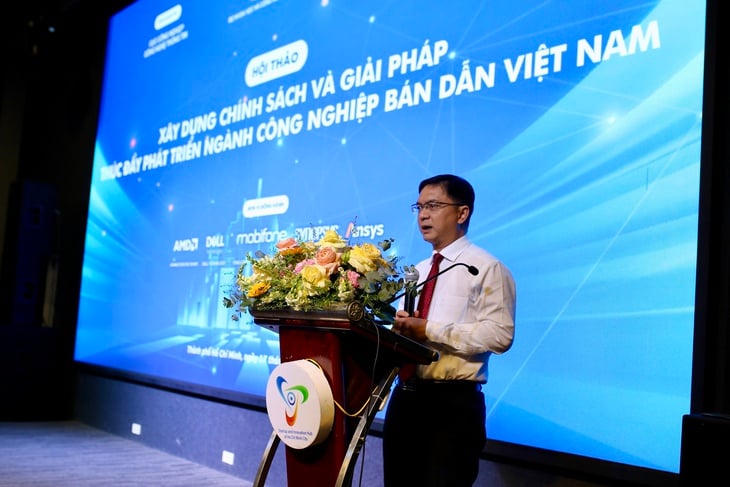
Vice Chairman of Ho Chi Minh City People's Committee Nguyen Manh Cuong speaks about the role of the locality in developing the semiconductor industry ecosystem - Photo: Vu Hien
The "three-party" cooperation model
Speaking at the workshop, Deputy Minister of Science and Technology Bui Hoang Phuong emphasized that the development of the semiconductor industry cannot remain merely a strategy, but needs to be concretized through practical implementation models that can be scaled up.
According to the Deputy Minister, the model of cooperation between the State, schools, and businesses is a suitable approach to solving the problem of training semiconductor personnel.
In this model, the State plays the role of institution builder and guide; training institutions focus on teaching and research; and businesses participate from curriculum development and training orders to workforce recruitment.
This approach is expected to bridge the gap between training and production, overcoming the problem of training being heavily theoretical and lacking connection to the practical needs of businesses. This is a long-standing bottleneck in the high-tech sector.
From a local perspective, Mr. Nguyen Manh Cuong, Vice Chairman of the People's Committee of Ho Chi Minh City, believes that data and semiconductor chips are becoming new drivers for economic growth.
The Prime Minister's issuance of the semiconductor industry development strategy opens up opportunities for Ho Chi Minh City to become one of the key areas for implementation.
Following the spatial arrangement of development between Ho Chi Minh City, Binh Duong, and Ba Ria - Vung Tau, the city is moving towards a regional semiconductor ecosystem model.
In this model, Ho Chi Minh City plays the role of a research and design center; Binh Duong focuses on production, packaging, and testing; and Ba Ria - Vung Tau handles logistics with the Cai Mep - Thi Vai port complex.
Source: https://tuoitre.vn/100-000-ky-su-ban-dan-bai-toan-nhan-luc-chua-tung-co-20251217143557944.htm

![[Photo] Prime Minister Pham Minh Chinh receives the Governor of Tochigi Province (Japan)](/_next/image?url=https%3A%2F%2Fvphoto.vietnam.vn%2Fthumb%2F1200x675%2Fvietnam%2Fresource%2FIMAGE%2F2025%2F12%2F16%2F1765892133176_dsc-8082-6425-jpg.webp&w=3840&q=75)
![[Live] 2025 Community Action Awards Gala](/_next/image?url=https%3A%2F%2Fvphoto.vietnam.vn%2Fthumb%2F1200x675%2Fvietnam%2Fresource%2FIMAGE%2F2025%2F12%2F16%2F1765899631650_ndo_tr_z7334013144784-9f9fe10a6d63584c85aff40f2957c250-jpg.webp&w=3840&q=75)
![[Image] Leaked images ahead of the 2025 Community Action Awards gala.](/_next/image?url=https%3A%2F%2Fvphoto.vietnam.vn%2Fthumb%2F1200x675%2Fvietnam%2Fresource%2FIMAGE%2F2025%2F12%2F16%2F1765882828720_ndo_br_thiet-ke-chua-co-ten-45-png.webp&w=3840&q=75)
![[Photo] Prime Minister Pham Minh Chinh receives Lao Minister of Education and Sports Thongsalith Mangnormek](/_next/image?url=https%3A%2F%2Fvphoto.vietnam.vn%2Fthumb%2F1200x675%2Fvietnam%2Fresource%2FIMAGE%2F2025%2F12%2F16%2F1765876834721_dsc-7519-jpg.webp&w=3840&q=75)
























































![[Live] Closing Ceremony and Award Presentation for the "Impressive Vietnam Tourism" Video/Clip Creation Contest 2025](https://vphoto.vietnam.vn/thumb/402x226/vietnam/resource/IMAGE/2025/12/17/1765974650260_z7273498850699-00d2fd6b0972cb39494cfa2559bf85ac-1765959338756946072104-627-0-1338-1138-crop-1765959347256801551121.jpeg)

















Comment (0)