

In which, the value of goods exports reached $430.14 billion , a 16.1% increase compared to the same period last year.
Notably, 36 items reached export value exceeding [amount]. $1 billion , especially for the 8 export items mentioned above. $10 billion marks the rise of Vietnamese goods in the global market, despite fluctuations in global import policies.
Accordingly, computers, electronics, and components continue to be the largest export item. $96.9 billion , a 48.5% increase year-on-year.
Machinery, equipment, tools, and other spare parts are located behind it. $53.3 billion , an increase of 11.6%. Phones and components reached... $52.6 billion , an increase of 4.8%.
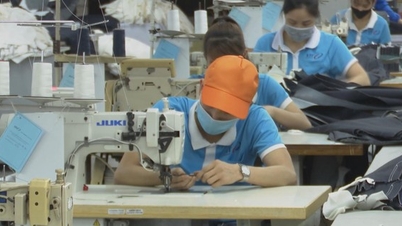
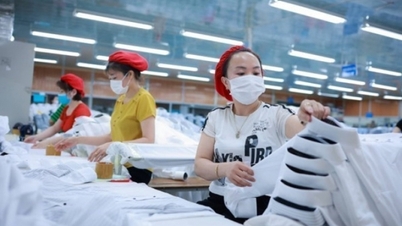
Textile and garment export turnover reached $35.9 billion , an increase of 6.7%. The footwear industry achieved... $21.9 billion , up 5.5%.
Transportation vehicles and spare parts meet standards. Exports of wood and wood products reached US$15.8 billion , an increase of 13.4%. $15.5 billion , a 5.4% increase compared to the same period last year.
And finally, the seafood industry achieved... $10.3 billion , an increase of 12.6%.

What needs to be done in 2026 to maintain the record?
The impressive export performance in 2025 not only created momentum but also placed significant pressure on 2026.
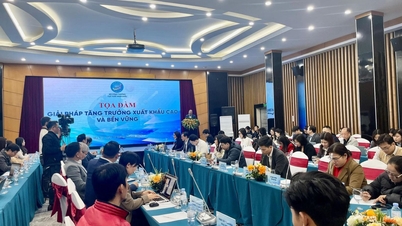
According to Tran Thanh Hai, Deputy Director of the Import-Export Department of the Ministry of Industry and Trade , 2025 will see the US implementing reciprocal tariffs. In this context, Vietnamese businesses are adapting and overcoming difficulties. Entering 2026, the impact of these tariff policies will continue to affect overall trade activities. Therefore, Vietnamese businesses must be aware of this and take timely countermeasures.
According to Mr. Hai, in the long-term strategy, businesses should focus on building product quality. This is the long-term path to retaining partners, maintaining export results, and creating a foundation for conquering new markets.
In addition, focusing on brand building is crucial for maintaining customer trust in both traditional and new markets.
"These two factors should be implemented simultaneously. Currently, in Vietnam, businesses may be interested in building quality but haven't really focused on brand building," Mr. Hai said.
Furthermore, Vietnam's export story cannot ignore the requirement for green transition. Markets are increasingly interested in green value and environmental protection. In 2026, the EU will begin applying the CBAM environmental tax on certain goods such as steel and aluminum. Therefore, green adaptation and emission reduction will be mandatory requirements in production processes, especially for businesses like steel and cement, both now and in the future.
Concurring with this view, Mr. Vu Ba Phu, Director of the Trade Promotion Department, stated that to address export challenges, the national trade promotion plan for the coming period will be implemented based on five main strategic directions.
Accordingly, Vietnam will promote its products in industry clusters, shifting from an approach targeting individual businesses to organizing them into supply chains and product clusters with deep linkages, thereby strengthening the national brand.
Furthermore, we must continue to promote green transformation and sustainability standards. This promotion should not only focus on exporting goods globally, but also on exporting them through green channels, requiring cleaner production, low-emission logistics, and clear traceability.
A digital trade promotion ecosystem will be formed, building a national digital platform, integrating data and applying Big Data and AI to analyze, forecast, and support accurate decision-making.
Vietnam will also develop a national export identity, unifying the image of Vietnamese goods in the international market.
Finally, Vietnam will implement a key "Go Global" program, selecting leading enterprises to act as driving forces, pulling along a satellite business ecosystem to expand globally.
According to the draft program, in the period 2026-2027, Vietnam will complete its institutional framework, build a favorable internationalization environment, and create momentum for businesses to expand into international markets; and form and develop an ecosystem to support private enterprises in expanding into international markets.
During the period 2028-2030, Vietnam will design and pilot tools to support businesses in expanding into international markets; and develop leading businesses to reach international markets.
And during the period 2031-2035, Vietnamese businesses will effectively expand into international markets and successfully integrate into global value chains. The institutional system, business environment, and tools supporting the private sector's expansion into international markets will be established and operate effectively.
Source: https://baoquangninh.vn/8-nganh-hang-viet-nam-xuat-khau-tren-10-ty-usd-3388692.html


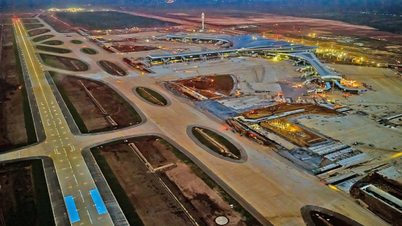
![[Photo] Two flights successfully landed and took off at Long Thanh Airport.](/_next/image?url=https%3A%2F%2Fvphoto.vietnam.vn%2Fthumb%2F1200x675%2Fvietnam%2Fresource%2FIMAGE%2F2025%2F12%2F15%2F1765808718882_ndo_br_img-8897-resize-5807-jpg.webp&w=3840&q=75)















































































Comment (0)