

The forum focused on one of the key elements for promoting sustainable development in the new era: science and technology. This theme was considered consistent with the spirit of Resolution 57 of the Politburo , which takes science and technology, innovation, and digital transformation as the driving force for development.
Optimize operations, reduce costs.
Technology platforms are considered key to realizing grand visions of sustainable development. In particular, AI, Big Data, and the Internet of Things (IoT) are the crucial trio for businesses to achieve a dual transformation (digital and green), ensuring optimal resource utilization – a vital element in the new era.
AI has developed tremendously, no longer merely providing support but gradually replacing humans in many specific tasks to maintain the three elements of Environment, Society, and Governance in a completely automated manner.
Pioneering businesses that apply technology to ESG are transforming from a cost burden into a breakthrough opportunity.
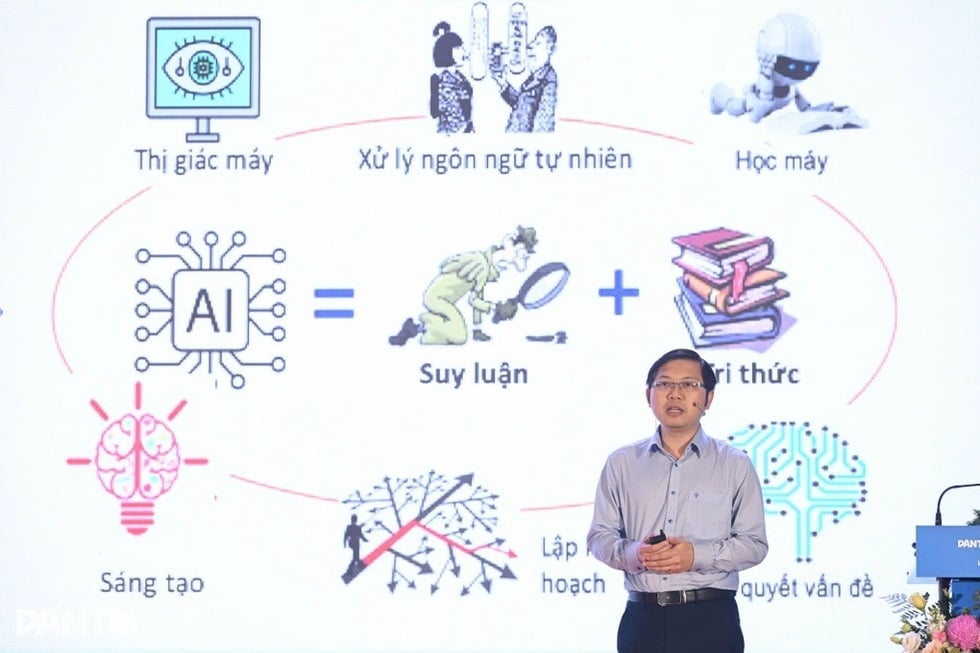
Dr. Dinh Viet Sang stated that AI is not only a tool for improving productivity but also a key factor in helping Vietnamese businesses ensure sustainable development and global competitiveness (Photo: Manh Quan).
The most profound change brought about by AI lies in the Governance (G) pillar, as it shifts from the role of a "tool" (AI Tool) to the "brain of the business" (AI Brain). This "AI brain" is capable of continuously updating data, analyzing millions of variables, and making timely decisions based on real-world data. This gradually replaces traditional governance activities that rely heavily on intuition or delayed reports.
When all of a business's data is fed into this manufacturing system and "digital brain," it helps the business become a truly "living organism" in the business environment. With current AI capabilities, the business brain operates non-stop 24/7, with all the information to make optimal resource decisions immediately.
This management revolution has also created an entirely new workforce, known as the digital workforce. This force can supplement the labor force equivalent to millions of employees but at extremely low cost.
AI also provides strong support in many other management areas such as planning, data analysis, human resource optimization, procurement, distribution, risk management, and automatically finding and screening suitable candidates. AI helps businesses reduce repetitive tasks, shorten processing times, and improve employee satisfaction.
In reality, for a successful green transformation, businesses must first undergo digital transformation. If they continue with outdated production methods, relying on experience and human labor, businesses will create significant environmental consequences and extremely low efficiency.
The root of the problem lies in digitizing processes through AI, IoT, and Big Data. Only when data systems are analyzed can businesses optimize their performance.
When operating at optimal efficiency, businesses consume the least amount of energy possible per unit of product. This is key to green transformation, helping to reduce emissions and save operating costs.
Enhancing transparency and expanding international integration.
AI is also a key factor in enabling fully automated ESG data collection and reporting. Businesses process massive amounts of data daily from multiple sources, including internal systems, social media, and sales channels.
Without effective tools, businesses certainly cannot manage and transparently process all this data. AI processing helps analyze and transfer data from the Data Lake to the Data Warehouse, cleaning it to create the "purest" data possible.

AI, Big Data, and the Internet of Things (IoT) are the key trio for businesses to achieve double transformation (Photo: CNN).
The greatest value here is the real-time nature of everything, updated in seconds. This allows businesses to quickly grasp small changes in policies and market conditions, enabling them to adjust production plans immediately and avoid significant losses.
AI helps businesses manage risk, support decision-making, and enhance transparency. By processing massive amounts of data, AI can predict potential risks.
Integrating AI into governance processes also helps automate real-time reporting, rather than quarterly or annually, enhancing transparency. AI also contributes to building ESG reports, identifying shortcomings and thereby improving governance efficiency.
When data is standardized, transparent, and fully traceable, businesses can easily share verified information with investors, green credit institutions, or international regulatory bodies.
This transparency strengthens trust and opens up opportunities to access green capital. Resolution 68 of the Politburo also encourages credit institutions to reduce interest rates for private enterprises borrowing to implement green and circular projects and apply the ESG framework.
In the context of globalization, compliance with ESG standards is gradually becoming a mandatory mechanism for participating in the international arena. For businesses that are oriented towards ESG and have already implemented AI, ESG is no longer a cost but a competitive advantage in terms of cost and performance.
For industries under high pressure, such as agriculture, forestry, fisheries, or textiles, traceability is a crucial and vital issue. When exporting to Europe or the US, partners need to know exactly where the raw materials originate and how they are processed in the importing country.
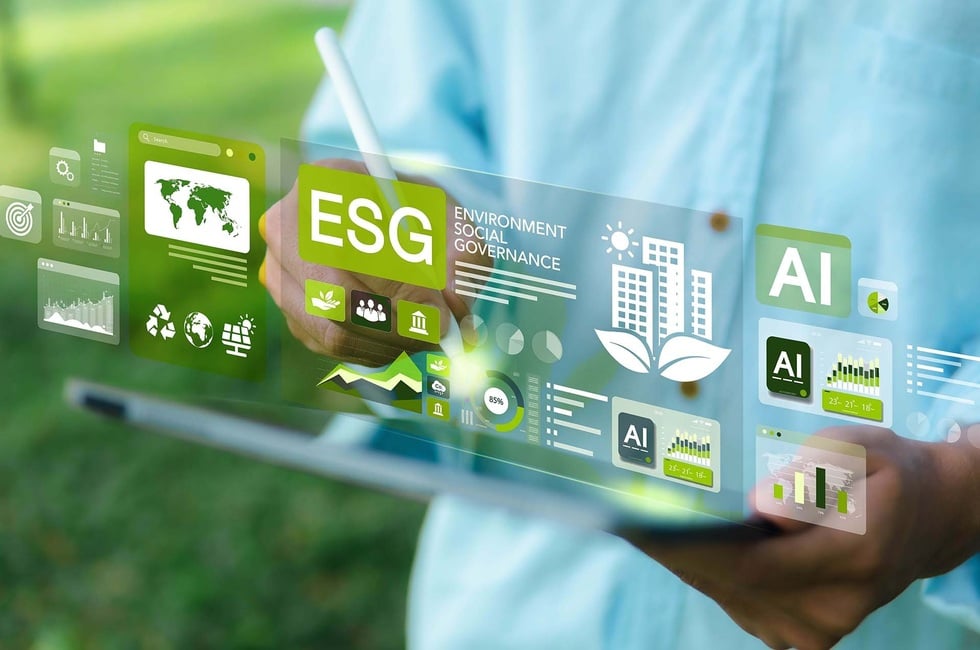
Compliance with ESG standards is gradually becoming a mandatory mechanism for participation in the international arena (Photo: GEP).
Blockchain technology combined with AI completely solves this problem. Blockchain helps to track the entire process of raw material circulation from planting and harvesting to the final product. This data cannot be modified, creating absolute transparency, which is the first factor in proving origin and meeting the requirements of demanding markets.
Alongside increased transparency, AI helps address the productivity issue, which represents a significant gap between Vietnamese labor and that of other countries in the region. Only AI technology can change this, helping businesses narrow the productivity gap.
Combining Blockchain (transparent origin) with AI, Big Data, and IoT technologies (optimizing productivity and automation) helps businesses meet stringent global standards. Businesses may only invest a small amount today, but in the future, they will reap hundreds or thousands of dollars thanks to the real value that AI brings.
Businesses that leverage the information and processing speed offered by AI will win, turning ESG into a differentiating advantage over competitors.
On the afternoon of December 15th, at the headquarters of Dan Tri newspaper , the judging panel of the Vietnam ESG Awards 2025 conducted the final round of evaluations of the submitted applications.
Organizations that excel in ESG implementation will be honored at the Vietnam ESG Forum 2025, held on December 22nd in Hanoi.

Professor Nguyen Duc Khuong - Director of International Development at De Vinci Higher Education, Executive Chairman of EMLV Business School - returned from France and participated in evaluating the application with members of the judging panel on the afternoon of December 15 (Photo: Thanh Dong).
Interested readers can register to attend the seminar with two limited-time packages: Standard and VVIP. Upon successful registration, the organizers will send your ticket via email for your convenience in checking in on December 22nd.
The benefits of the Standard tier (worth 500,000 VND) include a good seat, access to seminar materials, and event gifts.
The benefits of the VVIP tier (VND 2,000,000) include VIP seating, a private dinner with the speaker at Pullman Hanoi, exclusive gifts, a private check-in area, and seminar materials from the organizers.
Due to limited seating, registration for the program may close earlier if all seats are filled.
Source: https://dantri.com.vn/cong-nghe/dien-dan-esg-viet-nam-ai-thuc-day-doanh-nghiep-vua-xanh-vua-so-20251215203049903.htm

![[Photo] Prime Minister Pham Minh Chinh receives Lao Minister of Education and Sports Thongsalith Mangnormek](/_next/image?url=https%3A%2F%2Fvphoto.vietnam.vn%2Fthumb%2F1200x675%2Fvietnam%2Fresource%2FIMAGE%2F2025%2F12%2F16%2F1765876834721_dsc-7519-jpg.webp&w=3840&q=75)

![[Photo] Prime Minister Pham Minh Chinh receives the Governor of Tochigi Province (Japan)](/_next/image?url=https%3A%2F%2Fvphoto.vietnam.vn%2Fthumb%2F1200x675%2Fvietnam%2Fresource%2FIMAGE%2F2025%2F12%2F16%2F1765892133176_dsc-8082-6425-jpg.webp&w=3840&q=75)
![[Live] 2025 Community Action Awards Gala](/_next/image?url=https%3A%2F%2Fvphoto.vietnam.vn%2Fthumb%2F1200x675%2Fvietnam%2Fresource%2FIMAGE%2F2025%2F12%2F16%2F1765899631650_ndo_tr_z7334013144784-9f9fe10a6d63584c85aff40f2957c250-jpg.webp&w=3840&q=75)
![[Image] Leaked images ahead of the 2025 Community Action Awards gala.](/_next/image?url=https%3A%2F%2Fvphoto.vietnam.vn%2Fthumb%2F1200x675%2Fvietnam%2Fresource%2FIMAGE%2F2025%2F12%2F16%2F1765882828720_ndo_br_thiet-ke-chua-co-ten-45-png.webp&w=3840&q=75)
























































![[Photo] Prime Minister Pham Minh Chinh attends the Vietnam Economic Forum 2025](https://vphoto.vietnam.vn/thumb/402x226/vietnam/resource/IMAGE/2025/12/16/1765893035503_ndo_br_dsc-8043-jpg.webp)






























Comment (0)