

According to a 2024 report by McKinsey & Company, a leading global consulting firm, artificial intelligence (AI), particularly generative AI, is becoming a key tool for businesses to address sustainable development challenges.
In the United Nations' 17 Sustainable Development Goals, AI has demonstrated a prominent role in at least five, such as climate action, clean energy, and sustainable cities. McKinsey's data on approximately 600 AI applications in these areas shows significant potential in improving the effectiveness of ESG implementation.
As sustainable development becomes increasingly mandatory, many businesses are turning to AI as a tool to support ESG implementation. From emissions data collection and risk assessment to transparent reporting, AI helps improve the effectiveness of ESG enforcement, while also opening up opportunities to access green capital and optimize operations.
Why do businesses need AI in ESG implementation?
In the real estate sector, AI is gradually becoming a tool to help businesses integrate ESG criteria into project development and operation processes. Thomas Rooney, Deputy Director, Industrial Real Estate Department, Savills Hanoi, believes that AI contributes to enhancing sustainability while ensuring operational efficiency.
"In industrial projects, AI plays a crucial role in energy management, automation, resource optimization, and design improvement. AI algorithms can monitor and improve operational performance through the control of lighting, temperature, humidity, and air quality (HVAC) systems, and other systems that adapt in real time," he cited as an example.
Furthermore, Mr. Rooney stated that AI also assists in monitoring resource usage and predicting maintenance needs, thereby minimizing waste and costs. In addition, derivative design (using AI to automatically generate multiple optimal solutions based on input criteria) and AI-powered simulation help architects and project developers create energy-efficient and environmentally friendly buildings.
For projects aiming for green certifications like LEED, BREEAM, or Lotus, the process is often quite complex. However, this expert suggests that AI can help simplify this by monitoring and ensuring compliance with sustainability standards throughout the project lifecycle, from design to operation.

In the real estate sector, AI is gradually becoming a tool to help businesses integrate ESG criteria into project development and operation processes (Image: Medium).
"In a context where businesses prioritize sustainability and seek green-certified spaces, AI-powered industrial properties can achieve higher rental rates and occupancy levels. Investing in green technology integrated with AI simultaneously improves energy efficiency and increases tenant satisfaction," he stated.
According to Mr. Tran Anh Tuan, Deputy Director of the Institute for Applied Research and Business Innovation, AI can help Vietnamese businesses realize ESG goals. Specifically, AI can help collect and analyze data quickly and accurately.
"Instead of relying on manual methods that are time-consuming and labor-intensive, businesses can use IoT sensors to collect data on soil quality, irrigation water levels, and pest and disease conditions in the fields. Then, AI will analyze this data to provide recommendations on the rational use of fertilizers and pesticides, helping to minimize negative impacts on the environment," he explained.
Furthermore, AI can help optimize production and operational processes. For example, businesses can use AI to predict market demand and plan production accurately, minimizing inventory and waste. It can also be used to optimize transportation routes, reducing carbon emissions from vehicles.
The Deputy Director of the Institute for Applied Research and Business Innovation believes that AI can help improve transparency and accountability.
Businesses can use blockchain – an AI-based technology – to track the entire supply chain, from production to distribution, making it easier for customers to trace products and ensuring that products are produced sustainably and ethically.
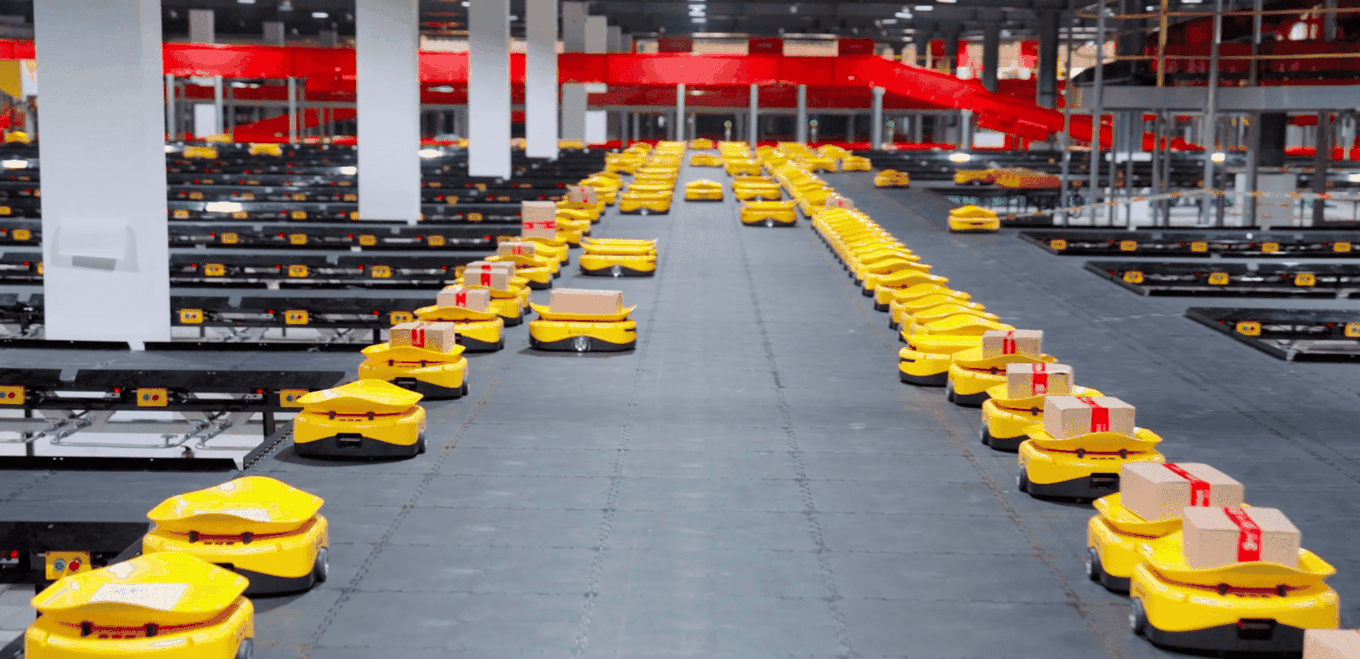
An automated robotic system for sorting goods at a shipping company (Photo: VP).
The expert shared the story of Lemit Foods, a startup producing plant-based meat from young jackfruit in the former Hau Giang province (now Can Tho ), as a prime example of applying AI to ESG.
"Lemit Foods has used AI to optimize production processes, control product quality, and predict market demand. As a result, the company not only creates delicious and nutritious products but also contributes to environmental protection and supports the local community," Mr. Tuan cited as an example.
He cited another example: C2T Ben Tre Media and Tourism Company Limited has used AI to optimize ecotourism tours, minimizing negative environmental impacts and providing meaningful experiences for tourists. "These success stories show that AI is not something far-fetched and is entirely applicable in Vietnam," the expert emphasized.
Regarding business management, Mr. Le Hong Quang, General Director of MISA Joint Stock Company, believes that AI has become a core tool in modern business management. AI helps businesses increase productivity, save costs, improve operational efficiency, enhance customer experience, automate accounting, and support businesses in accessing capital more quickly...
"In management, AI can assist in providing real-time reports to the leadership team, analyzing and forecasting key performance indicators, and offering recommendations to the leadership team," he observed.
Challenges
Besides the benefits, Thomas Rooney argues that the application of AI also poses some sustainability challenges. This is because AI technologies require a large amount of computing resources to train models, process, and store data. According to Gartner's forecast, at the current rate, AI could use up to 3.5% of total global electricity consumption by 2030.
"This puts pressure on efforts to reduce energy consumption to achieve sustainable development goals and comply with energy regulations. However, AI remains a key tool in keeping buildings operating at full capacity," he said.
He cited the fact that AI developers are increasingly understanding the carbon impact of this technology and are constantly researching solutions to reduce emissions. Large technology corporations are implementing numerous initiatives to minimize the environmental impact of AI.
"Amazon, one of the leading data center operators, is transitioning to 100% renewable energy, extending server lifespan, and aiming for 'positive water' status by 2030 – meaning it returns more water to the community than it consumes for system cooling. Additionally, Amazon aims for net-zero emissions by 2040," he cited as evidence.
Microsoft, with its Azure system, has even higher ambitions – achieving "negative carbon" levels by 2030. If more data centers follow suit, the environmental footprint of AI will continue to shrink and will no longer be a significant concern for real estate developers.

Vietnamese businesses, especially small and medium-sized enterprises (SMEs), often face significant challenges regarding data quality, a shortage of skilled human resources, and high initial investment costs (Photo: Shutterstock).
In addition, Mr. Rooney stated that the application of AI in Vietnam still faces difficulties, particularly due to power shortages in industrial zones in developed localities (tier 1 markets). These power limitations are causing investors to shift their focus to tier 2 localities – where there is less competition, more land available, and easier infrastructure development.
According to Mr. Tran Anh Tuan, deploying AI for ESG is not a bed of roses. Vietnamese businesses, especially small and medium-sized enterprises (SMEs), often face significant challenges regarding data quality, a shortage of skilled human resources, and high initial investment costs.
To overcome these challenges, he believes close coordination is needed between businesses, the government, and supporting organizations. The government can provide incentive policies and financial support to help businesses access and apply AI.
"Support organizations can provide training and consulting to help businesses enhance their capabilities in AI and ESG. On the business side, commitment from leadership, participation from all employees, and a well-structured implementation plan are needed," the Deputy Director of the Institute for Applied Research and Business Innovation cited.
AI must be a powerful "assistant".
Thomas Rooney noted that traditional operational thinking is making many businesses hesitant to adopt new AI-based solutions. Initial investment costs and personnel training are also factors to consider.
"However, investing in AI-integrated facilities not only improves operational efficiency but also increases the value of rental properties. Therefore, real estate businesses need to proactively incorporate AI into their warehouse development strategies, starting from research, technology collaboration, human resource training, to data transparency to strengthen market confidence," he observed.
To effectively implement ESG with the support of artificial intelligence, Mr. Tran Anh Tuan suggested that businesses can start with small and specific steps. First, it is necessary to clearly identify an existing ESG problem and choose the appropriate AI technology to solve it. Building a high-quality data platform while ensuring transparency and fairness in AI algorithms is a key factor.
Simultaneously, he argued that it is necessary to foster a culture of innovation within businesses, encouraging innovation and creativity in the fields of ESG and AI. Most importantly, businesses must believe that, with technology and determination, they can make a difference.

ESG and AI not only help optimize operations but are also core values that help Vietnamese businesses develop sustainably (Photo: GEP).
The expert asserted that AI should be a powerful "assistant," not just a tool to solve current problems. AI should be used to predict future risks and opportunities, helping businesses proactively respond to changes in the business environment. Creativity and innovation in applying AI to ESG should be encouraged, creating unique and effective solutions.
"Technology startups in the renewable energy sector can use AI to predict electricity output from solar and wind sources, optimizing electricity distribution and reducing reliance on fossil fuels. This not only creates environmentally friendly products and services but also generates profits for investors and creates jobs for the community," Mr. Tuan said.
According to the Deputy Director of the Institute for Applied Research and Business Innovation, ESG and AI not only help optimize operations but are also core values that help Vietnamese businesses develop sustainably. With the right strategy, Vietnamese businesses will not only grow but also create positive value for society.
Source: https://dantri.com.vn/kinh-doanh/ai-thay-doi-cuoc-choi-esg-20250806142244717.htm
![[Photo] General Secretary and President To Lam presides over a meeting with the Central Organizing Committee.](https://vphoto.vietnam.vn/thumb/1200x675/vietnam/resource/IMAGE/2026/06/03/1780482764658_a1-bnd-4741-3342-jpg.webp)


![[Photo] First session of the 14th Congress of the Vietnam Trade Union](https://vphoto.vietnam.vn/thumb/1200x675/vietnam/resource/IMAGE/2026/06/03/1780465947883_ndo_br_img-3852-jpg.webp)
![[Photo] Secretary of the National Assembly Party Committee, Chairman of the National Assembly presides over the meeting of the Standing Committee and Executive Committee of the National Assembly Party Committee.](https://vphoto.vietnam.vn/thumb/1200x675/vietnam/resource/IMAGE/2026/06/03/1780480353201_ndo_br_bnd-2585-jpg.webp)























































![[Video] Sunset at Lap An Lagoon – Where the sun sets over the fishing nets](https://vphoto.vietnam.vn/thumb/1200x675/vietnam/resource/IMAGE/2026/05/31/1780192137701_beach-landscape-sea-water-nature-grass-745871-pxhere-com.jpeg)













































Comment (0)