

 |
| Illustration: PV |
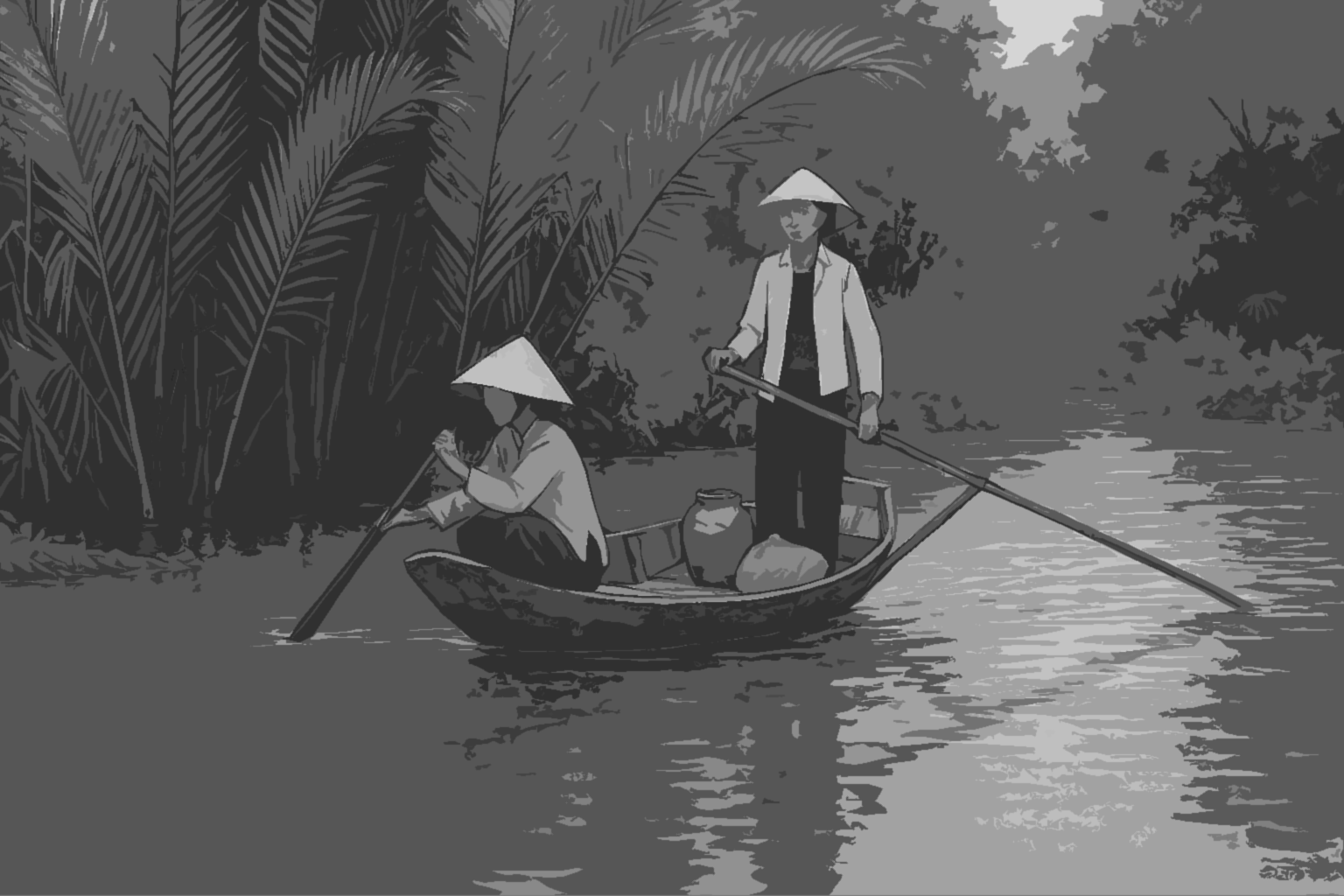
My mother went out into the yard to check the coal mine, which was billowing with white smoke.
"The wind is fierce; if we're not careful, a hole in the coal mine will burn down completely," my mother said, calling out as she walked, leaving me stunned by the suggestion I'd made countless times: "Let's go live in the city, Mom!"
I didn't reply, just cleared my throat, enough for Mom to know I was responding.
The charcoal kilns still quietly emitted smoke. The villagers on the edge of the forest lived mainly by charcoal burning, or honey harvesting, or setting traps in the river to catch shrimp and fish. Life was simple yet full of joy, above all because people lived in their birthplace, their souls connected to this land and river they cherished so deeply. In the quiet night, my village could only hear the rustling of the melaleuca forest, the crackling of the charcoal kilns, and the murmuring voices of the children from the forest village who had just started first grade.
I followed my mother towards the coal cellar. The banana trees next to the cellar were still green and healthy, bearing bunches of fruit, almost ripe. My mother bent down to fill in the holes that were about to burst. If the cellar wasn't sealed, the wind would get inside and burn all the firewood. The smoke made my mother cough violently, and tears streamed down her face. I looked at her, my heart aching. In the days I wasn't here, my mother would surely be lonely in this house, which had long been without my father. She would be alone from early morning until late at night. My mother's life had been full of hardship and struggle. Once, I couldn't bear it anymore and said to her:
- Mom! I can't quit my job and come live here with you, and you can't live alone here forever either. I'm worried! Mom, come live with me in the city. There'll be a big house there, and we'll be together...
My mother thought for a long time. I saw her look up at my father's altar, then out at the small canal in front of the house. Her eyes had a smoky white color. Suddenly, I saw her gently dab at the corners of her eyes with a handkerchief. I held her hand, my eyes welling up with tears.
Mom! If I said anything wrong, please don't be angry. I just want to live by your side, so you can have peace and quiet for the rest of your life.
My mother interrupted me:
- No, Mom isn't angry with you at all. You're right, it's just that Mom is still attached to this place, she can't bring herself to leave her hometown yet.
My mother's words, "leaving home," made my heart ache. I had "left home" the day I first arrived in the city to study, and since then, the days I've returned home can be counted on the fingers of one hand. My house, my hometown, where I lived throughout my childhood, has now become a temporary lodging, a foreign land, even though I still yearn for this place. I understand that, for a brief moment, my mother couldn't bring herself to agree to go to the city with me. The city is familiar to me, but strange to my mother. There's no longer the faint smell of charcoal smoke from the kilns each morning and evening, no rustling of melaleuca leaves in the wind, and no patch of land overgrown with weeds that held so many beautiful memories for us.
For my mother, her homeland is her flesh and blood, her soul, a beautiful paradise. Half her life has passed since she first arrived in this land. Half a lifetime she has lived, been attached to, loved, given birth to me, and then placed her heart here. My mother loves the river dearly, loves the mangrove forest where my father used to paddle his boat to set up beehives and return with beehives laden with honey, loves the smell of smoke rising from the charcoal kilns and spreading across the river, giving this countryside a unique character that my mother will never forget. During those days, she struggled a great deal. Yet she remained content and didn't crave anything extravagant or illusory. She remained loyal to the land, the forest, the river, and my father.
Looking around and seeing that the coal cellar was full, my mother went inside the house. I followed her. The flickering lamp cast a narrow circle of light across the yard. I felt a strange warmth and gentleness in my body. It was always like this; whenever I came home, I felt a profound sense of peace. Several times I had considered building a new house for my mother, but she stopped me. "The old house is precious because it holds so many memories," she said. I listened to her, partly because I also planned to bring her to live in the city in the near future, so I abandoned the idea of rebuilding the house in the countryside. The old house was warm and cozy; everything was meticulously preserved by my mother, unchanged for decades. The distance from the city to the countryside was nearly two hundred kilometers, yet whenever I could, I would drive back, and when I was tired, I would take the bus. Leaving my mother alone in the countryside made me feel uneasy.
Night fell over the countryside, and as the night deepened, the wind grew stronger. The scent of melaleuca flowers from the forest drifted in on the breeze, filling the air with a fragrant aroma. I sat beside my mother, and suddenly, time seemed to rewind to my childhood, when I sat beside her just like this, under the oil lamp, while she mended my father's clothes and taught me to spell each letter… Those times were so beautiful and peaceful!
"Mom knows you're all grown up now, and you have a comfortable life, so you want to make up for all the hardships I endured when I was younger. But my child, this place means everything to me. You can have your own home, your own family, but all I have are beautiful memories associated with this countryside. I can't leave it, my child..."
I gazed at my mother thoughtfully, and tears welled up in my eyes without me realizing it. Old people often cherish past memories; they live for them, clinging to a place because it holds unforgettable memories. My mother is living for that, and so am I.
- Mom! I'm so sorry...
My mother stroked my head, then pulled me closer to her. The smell of charcoal smoke clung to her clothes and hair, a sweet fragrance. My mother said affectionately:
- Mom has always wanted her children to have a place to return to. She will always be here, keeping the warmth of the house, the comforting scent of incense on Dad's altar, and preserving for her children the roots that they must never forget.
I understand my mother's heart. Her heart is forgiving. One's roots are something that, no matter where one goes, one should never forget, never allow oneself to be uprooted.
I sat beside my mother. The night was quiet. The village was immersed in silent sleep, broken only by the mournful cries of nocturnal forest birds and the crackling of embers carried on the wind. In that simple yet warm moment, I sensed the echoes of the land, the rivers of my homeland, the vast mangrove forests, and the echoes of my mother's kind and generous heart. Someday, on what seems like a long and arduous journey through life, I will be like my mother, cherishing every beautiful memory and keeping it all to myself.
I leaned against his cheek, as if leaning against the river, against the homeland, against the shade of the mangrove trees, against my sacred and precious origins!
Source: https://baophuyen.vn/sang-tac/202505/ben-que-con-ma-1ce28e9/
![[Photo] Prime Minister Pham Minh Chinh receives Lao Minister of Education and Sports Thongsalith Mangnormek](/_next/image?url=https%3A%2F%2Fvphoto.vietnam.vn%2Fthumb%2F1200x675%2Fvietnam%2Fresource%2FIMAGE%2F2025%2F12%2F16%2F1765876834721_dsc-7519-jpg.webp&w=3840&q=75)

![[Image] Leaked images ahead of the 2025 Community Action Awards gala.](/_next/image?url=https%3A%2F%2Fvphoto.vietnam.vn%2Fthumb%2F1200x675%2Fvietnam%2Fresource%2FIMAGE%2F2025%2F12%2F16%2F1765882828720_ndo_br_thiet-ke-chua-co-ten-45-png.webp&w=3840&q=75)
![[Photo] Prime Minister Pham Minh Chinh receives the Governor of Tochigi Province (Japan)](/_next/image?url=https%3A%2F%2Fvphoto.vietnam.vn%2Fthumb%2F1200x675%2Fvietnam%2Fresource%2FIMAGE%2F2025%2F12%2F16%2F1765892133176_dsc-8082-6425-jpg.webp&w=3840&q=75)
![[Live] 2025 Community Action Awards Gala](/_next/image?url=https%3A%2F%2Fvphoto.vietnam.vn%2Fthumb%2F1200x675%2Fvietnam%2Fresource%2FIMAGE%2F2025%2F12%2F16%2F1765899631650_ndo_tr_z7334013144784-9f9fe10a6d63584c85aff40f2957c250-jpg.webp&w=3840&q=75)




















































![[Live] Closing Ceremony and Award Presentation for the "Impressive Vietnam Tourism" Video/Clip Creation Contest 2025](https://vphoto.vietnam.vn/thumb/402x226/vietnam/resource/IMAGE/2025/12/17/1765974650260_z7273498850699-00d2fd6b0972cb39494cfa2559bf85ac-1765959338756946072104-627-0-1338-1138-crop-1765959347256801551121.jpeg)













Comment (0)