

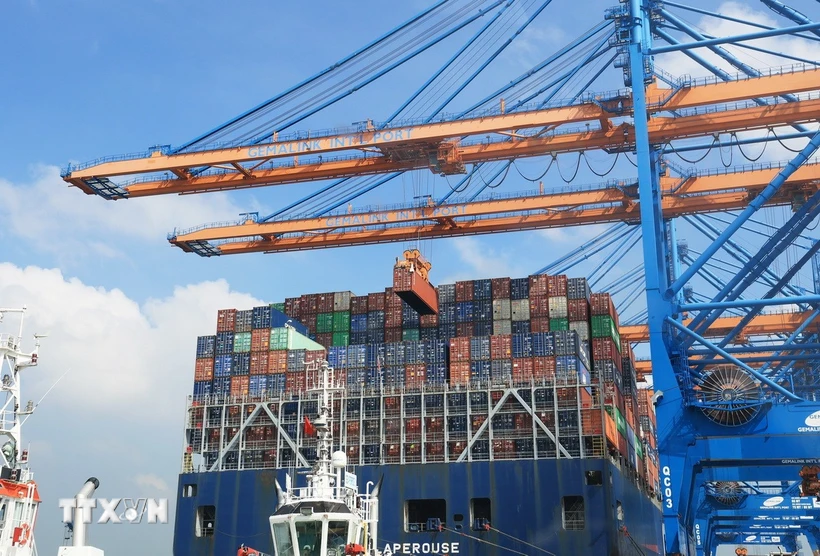
Loading containers onto a ship at Gemalink International Port, Phu My town, Ba Ria-Vung Tau province. (Photo: Hong Dat/VNA)
The Politburo issued Resolution No. 59-NQ/TW (dated January 24, 2025) on "International Integration in the New Situation," opening a new phase of development for Vietnam on its journey towards comprehensive integration.
General Secretary To Lam remarked that Resolution 59 has captured the flow of the times and "elevated" international integration with revolutionary, groundbreaking, nationalistic, scientific , and contemporary perspectives.
The overall objectives of the Resolution include improving the quality, effectiveness, consistency, comprehensiveness, and depth of international integration; maintaining a peaceful and stable environment; maximizing the utilization of external resources and favorable conditions to build an independent, self-reliant, and self-sufficient economy; strengthening national overall strength; enhancing the country's role, position, and international prestige; and striving to become a developed, high-income country with a socialist orientation by the middle of the 21st century.
Resolution 59 marks a historic turning point in the country's international integration process, identifying integration as a strategic driving force for Vietnam to confidently move into a new era.
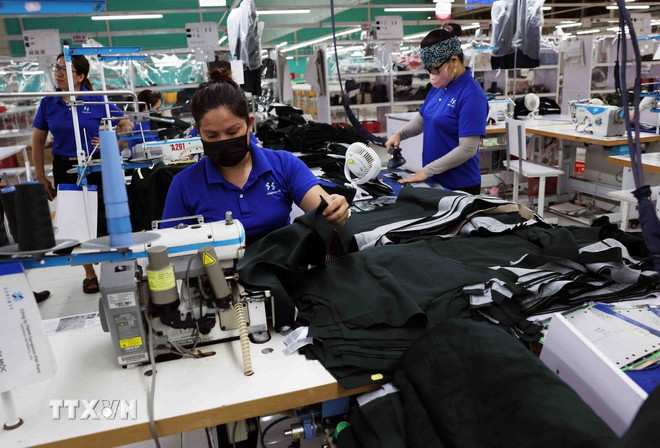
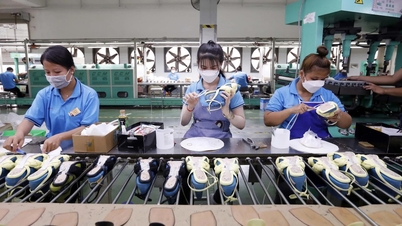
Sewing garments for export to the European market at the SangWoo Vietnam Co., Ltd. factory, VSIP Nghe An Industrial Park. (Photo: Vu Sinh/VNA)
From 1986 to the present, Vietnam's international integration process has achieved many impressive results: establishing diplomatic relations with 194 countries; having strategic partnerships and comprehensive partnerships with 34 countries; being a member of more than 70 regional and international organizations; participating in international economic cooperation and linkage agreements, including 17 free trade agreements (FTAs); ranking among the top 20 countries with the largest trade volume in the world; and being among the top 20 economies attracting the most foreign investment in the world from 2019 to the present.
However, according to General Secretary To Lam, looking at the overall picture seriously and objectively, the results of implementing international integration policies still have some shortcomings, failing to achieve the set goals and meet development requirements. In particular, there are still many existing limitations, obstacles, and bottlenecks hindering development.
International integration brings many opportunities, but also numerous challenges and negative consequences such as unfair competition, unsustainable growth, widening wealth gap, environmental pollution, and the risk of "deviation," "cultural invasion," "self-evolution," "self-transformation," and "erosion of trust" within the country.
To avoid being led astray in international integration, we must recognize that internal strength plays a decisive role, and we must consolidate our internal power while simultaneously leveraging external resources.
Internal strength is the primary resource and the root of power. Resolution 59 clearly states that one of the major solutions of integration policy in the new situation is to enhance the effectiveness of international economic integration to serve the building of an independent, self-reliant, and strong economy, to accelerate economic restructuring, innovate the growth model, and promote digital transformation.
Internal strength is the root of Vietnam's power, but our internal strength is not yet truly solid. The majority of export value is still generated by foreign direct investment (FDI) enterprises, leading to a situation where production is high but creates little value for the country.
Vietnam does not yet have many leading economic sectors and businesses capable of expanding and dominating regional and global markets.
In the context of international integration, only nations with strong internal capabilities can compete with the world's leading economies. If we do not adequately prepare our production base, integration will not yield the expected results.
Internal strength here includes not only capital, land, and human resources, but also science and technology, and innovation. Therefore, Resolution 59 is closely related to Resolution No. 57-NQ/TW dated December 22, 2024, of the Politburo, with the guiding principle: Developing science, technology, innovation, and national digital transformation is a top priority breakthrough, the main driving force for the rapid development of modern productive forces, perfecting production relations, reforming national governance methods, developing socio-economic aspects, preventing the risk of falling behind, and enabling the country to achieve breakthrough development and prosperity in the new era.
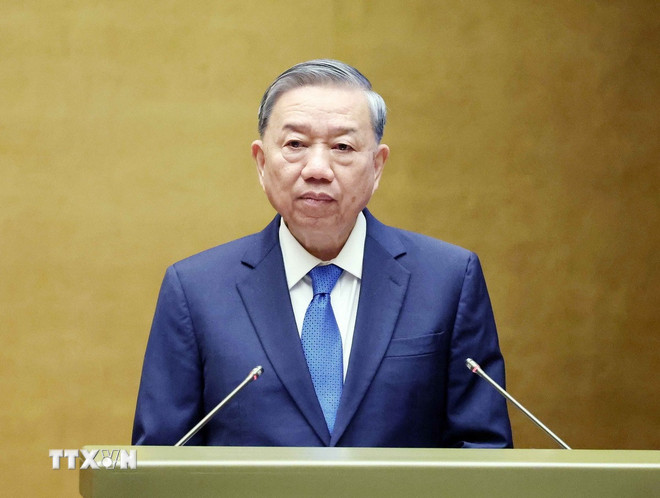
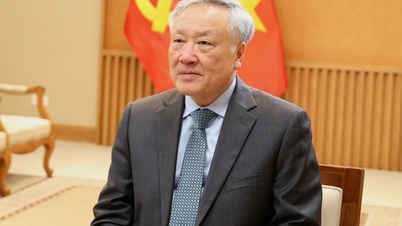
General Secretary To Lam. (Photo: Thong Nhat/VNA)
In the spirit of Resolution 59, "raising the bar" of international integration is mutually beneficial to strengthening Vietnam's internal capacity and its policy of independence and self-reliance. Internal capacity, independence, and self-reliance are the basis, conditions, and prerequisites for "raising the bar" and proactively and actively integrating into the international community.
Internal strength, in a broad sense, is the manifestation of sovereignty, self-determination, the right to choose and decide the path and model of development of a nation and its people; it is independence and self-reliance in politics, economics, culture, defense, security, and foreign relations. Without internal strength, independence, and self-reliance, it is impossible to proactively and positively integrate into the international community.
Conversely, international integration helps us enhance our ability to maintain national independence and self-reliance. If we were still surrounded, embargoed, or had limited international integration, Vietnam, starting from a combined economy of $22 billion in 1975, would not have been able to reach the top 34 largest economies in the world as it is today, with an economic size that has increased nearly 100 times since 1986 and per capita income rising from under $100 to nearly $5,000 per year.
Specifically in the economic field, we are "raising the bar" of economic integration while simultaneously strengthening our internal capabilities, building economic institutions geared towards international integration on the basis of ensuring independence and self-reliance; maintaining the socialist orientation in a market economy; and ensuring that the country's economy is not dependent on external forces.
The core principle is to place national interests first in international integration. Vietnam aims to "elevate" its international integration, "keeping pace with the world, identifying and seizing opportunities to position the country in the right direction of the times in the next 10 or 20 years." If we fail to do so and integrate passively, the risk of falling behind is unavoidable.
In his article "Rising Up in International Integration," General Secretary To Lam emphasized: “In today’s interdependent world, the development of each nation cannot be isolated, standing outside the impacts of the world and the times, of the current situation and its context. The country is facing a great opportunity to rise, but the challenges are also enormous. The achievements of integration to date have contributed to accumulating strength and momentum for the next breakthrough. Continuing in that spirit, Resolution 59 marks an important shift in the Party’s thinking and orientation towards international integration in the coming period, creating momentum to lead the country towards the glorious pinnacle of independence, freedom, happiness, prosperity, and longevity.”
(VNA/Vietnam+)
Source: https://www.vietnamplus.vn/bo-tu-tru-cot-de-viet-nam-cat-canh-nang-tam-hoi-nhap-tren-nen-tang-noi-luc-post1041822.vnp


![[Photo] Prime Minister Pham Minh Chinh receives the Governor of Tochigi Province (Japan)](/_next/image?url=https%3A%2F%2Fvphoto.vietnam.vn%2Fthumb%2F1200x675%2Fvietnam%2Fresource%2FIMAGE%2F2025%2F12%2F16%2F1765892133176_dsc-8082-6425-jpg.webp&w=3840&q=75)
![[Live] 2025 Community Action Awards Gala](/_next/image?url=https%3A%2F%2Fvphoto.vietnam.vn%2Fthumb%2F1200x675%2Fvietnam%2Fresource%2FIMAGE%2F2025%2F12%2F16%2F1765899631650_ndo_tr_z7334013144784-9f9fe10a6d63584c85aff40f2957c250-jpg.webp&w=3840&q=75)
![[Image] Leaked images ahead of the 2025 Community Action Awards gala.](/_next/image?url=https%3A%2F%2Fvphoto.vietnam.vn%2Fthumb%2F1200x675%2Fvietnam%2Fresource%2FIMAGE%2F2025%2F12%2F16%2F1765882828720_ndo_br_thiet-ke-chua-co-ten-45-png.webp&w=3840&q=75)
![[Photo] Prime Minister Pham Minh Chinh receives Lao Minister of Education and Sports Thongsalith Mangnormek](/_next/image?url=https%3A%2F%2Fvphoto.vietnam.vn%2Fthumb%2F1200x675%2Fvietnam%2Fresource%2FIMAGE%2F2025%2F12%2F16%2F1765876834721_dsc-7519-jpg.webp&w=3840&q=75)


























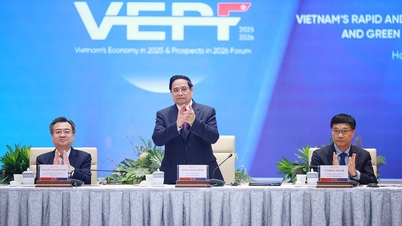
![[Photo] Prime Minister Pham Minh Chinh attends the Vietnam Economic Forum 2025](https://vphoto.vietnam.vn/thumb/402x226/vietnam/resource/IMAGE/2025/12/16/1765893035503_ndo_br_dsc-8043-jpg.webp)

















Comment (0)