Move
The historical site is located 7 km north of Viet Tri city center and 90 km from Hanoi . From Hanoi, visitors can reach it by road via National Highway 2 or by the Hanoi - Lao Cai railway line.
Main activities for the Ancestor Commemoration Day 2024
The Hung Kings Commemoration Day takes place on the 10th day of the 3rd lunar month every year at Hung Temple. This year, the holiday falls on April 18th in the Gregorian calendar, but the activities extend from April 9th to 18th.
Location: In Viet Tri city, the Hung Temple Historical Site, and districts, towns, and cities within the province.
I. The Ceremony
1. Commemoration Ceremony for National Ancestor Lac Long Quan and Offering of Incense to Ancestress Au Co on April 14th (6th day of the 3rd lunar month).
2. Commemoration Ceremony of Hung Kings' Ancestors and Flower Offering at the relief sculpture "Uncle Ho speaking with officers and soldiers of the Vanguard Army" on April 18th (March 10th in the lunar calendar).
3. The incense offering ceremony to commemorate the Hung Kings will be held by districts, towns, and cities in Phu Tho province from April 9th to April 13th (March 1st-5th in the lunar calendar).

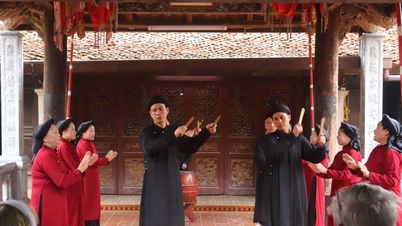
Xoan folk singers at Hung Lo ancient village. Photo: Phuong Anh
II. The Festival Part
1. Opening Ceremony of the Hung Kings Commemoration Day - Hung Temple Festival and the Ancestral Land Culture and Tourism Week in the Year of the Dragon 2024 (8:00 AM on April 9th at the Central Festival Stage, Hung Temple Historical Site).
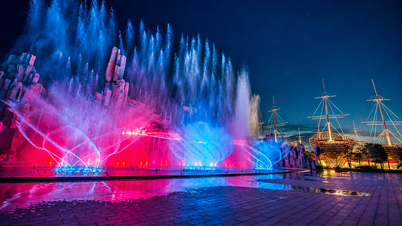
2. Art program with the theme "Reunion of the Nation" and high-altitude fireworks display (8:15 PM on April 17th at the Southern Stage - Van Lang Park/Van Lang Park Pedestrian Bridge, Viet Tri City).
3. Cultural camp and exhibition, promotion and introduction of products (from April 9-18, 2024 (March 1-10 in the lunar calendar at the Hung Temple Historical Site)).
4. Exhibition of artifacts, world documentary heritage, books, newspapers, and photographic documents (at Phu Tho Provincial Library; Hung Vuong Museum, Viet Tri City and Hung Vuong Museum, Hung Temple Historical Site (April 9-18, or March 1-10 in the Lunar calendar)).
5. Competition for wrapping and cooking banh chung (traditional Vietnamese rice cakes) and pounding banh giay (traditional Vietnamese rice cakes) (8:00 AM on April 16th, which is the 8th day of the 3rd lunar month, at the Hung Temple Historical Site).
6. Exhibition of artistic orchids (April 13-18, or March 5-10 in the lunar calendar, at the Five-Way Intersection, Gieng Temple, Hung Temple Historical Site).
7. Performance of Xoan singing from ancient villages (April 14-18, or March 6-10 in the lunar calendar, at An Thai Temple, Lai Len Shrine, Hung Lo Temple, Viet Tri City).
8. The "Viet Tri Livemusic" street music program and evening cultural activities (April 9-17, or March 1-9 in the Lunar calendar, at Van Lang Park, Viet Tri City).
9. Art exhibition with the theme "Homeland, Country, and People of Phu Tho" (April 14-18, or March 6-10 in the Lunar Calendar. Opening ceremony at 9:00 AM on April 14, or March 6 in the Lunar Calendar, at the Hung Temple Historical Site).
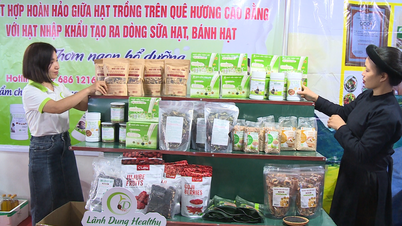
10. Phu Tho OCOP Trade Fair and Product Exhibition (April 12-18, or March 4-10 in the Lunar Calendar, at Hung Vuong Square, Gia Cam Ward, Viet Tri City).
11. Traditional folk games, sports, and physical activities (from April 14-18, which is from March 6 to March 10 in the lunar calendar; from 8:00 AM to 2:00 PM at the Hung Temple Historical Site).
12. Xoan Festival Art Program - Heritage Region (8 PM on April 14th, which is the 6th day of the 3rd lunar month, at the Central Festival Stage and the area in front of the Guest Reception House, Hung Temple Historical Site).
13. Art program featuring folk songs and some recognized intangible cultural heritage forms; Xoan Festival - Heritage Region (from April 14-15, or March 6-7 in the lunar calendar).
14. Inauguration of the relief sculpture "Uncle Ho speaking with officers and soldiers of the Vanguard Army Division" (9:00 AM on April 8th, which is the 30th day of the 2nd lunar month, at the Hung Temple Historical Site).

Hung Temple was packed with people on the anniversary of the founding of the Hung Dynasty.
Attractions
The Hung King Temple on Nghia Linh Mountain is built on a mountain with an altitude of 175 meters. Legend says that Nghia Linh Mountain is the head of a dragon facing south, its wide body curving into Van and Trok mountains. Van mountain is 170 meters high, and Trok mountain, located in the middle, is 145 meters high. According to legend, these three peaks are called "three forbidden mountains," and are considered sacred by the local people.
Temple gate
Before ascending to the temple, visitors must pass through the temple gate, which marks the beginning of their pilgrimage to the ancestral land, the birthplace of the Vietnamese people.
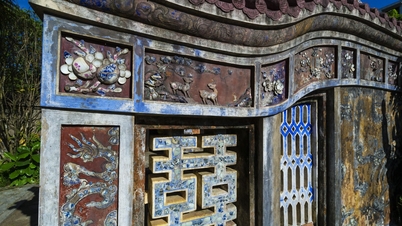
The gate is decorated in an arched architectural style, with a double dragon motif flanking the moon on the roof. The gate has two levels, measuring 8.5m high and 4.5m wide. In the center of the upper gate is a large inscription of four Chinese characters: Cao Son Canh Hanh (High Mountain, Grand Road).
Lower Temple
The temple was built between the 17th and 18th centuries and has undergone several renovations (most recently in 2011), but it still retains its original architecture. The building has two sections: the front section is the main hall, and the back section is the sanctuary. The sanctuary houses the ancestral tablets and thrones dedicated to the mountain god, the Hung Kings, and Princesses Tien Dung and Ngoc Hoa.
Legend says that the Lower Temple is where Mother Au Co gave birth to a hundred eggs, which later hatched into 100 sons. Because of its connection to the legend of Mother Au Co, people often pray at the Lower Temple for good fortune, blessings regarding children and family, and safe childbirth, as they believe the Mother Goddess is the protector of a healthy mother and child.
At the foot of the Lower Temple stands the stele house, a hexagonal structure with six roofs. Inside the stele house is a stone stele inscribed with President Ho Chi Minh's words during his visit on September 19, 1945: "The Hung Kings had the merit of founding the nation. We, their descendants, must together preserve it."
Ancient well
Right behind the Lower Temple is the Ancient Well (Dragon Well). Legend says this is where Mother Au Co took water to bathe her children.


Thien Quang Pagoda
The temple's name means "light shining from the heavens." Legend says that when Âu Cơ gave birth to a hundred eggs, a beam of light shone directly down from the sky at the temple's location. The temple was built around the 18th-19th centuries, during the Trần Dynasty. Thiên Quang Temple worships Mahayana Buddhism. Currently, the temple houses 32 wooden Buddha statues painted in red and gold.
In front of the temple stands a three-branched cycad tree, approximately 800 years old. The three branches spread out in three directions, symbolizing the three regions of North, Central, and South Vietnam. On September 19, 1954, President Ho Chi Minh sat at the base of this cycad tree to listen to Comrade Thanh Quang, Chief of the Central Military Commission's Office, and Song Ha, Political Commissar of the Vanguard Army Division, report on the situation and the plan for taking over Hanoi.
Trung Temple
After climbing 159 stone steps, visitors arrive at Trung Temple, located halfway up the mountain. Trung Temple's official name is "Hung Vuong Ancestral Temple," or the temple dedicated to the Hung Kings. Legend says this was where the Hung Kings often discussed state affairs with their lords and generals.
During the reign of the 6th Hung King, this was also the place where a competition was held to find a talented person to rule the country. The youngest prince, Lang Liêu, won by creating the sticky rice cakes (bánh chưng and bánh giày) symbolizing the round sky and square earth. King Hung praised the cakes as delicious and the idea as brilliant, so he passed the throne to Lang Liêu. Lang Liêu became the 7th Hung King.
Upper Temple
From the Middle Temple, climbing about 100 steps will lead to the Upper Temple, located at the highest point on the mountain. The temple's official name is Kính Thiên Lĩnh Điện, meaning "Temple of Heaven on Nghĩa Lĩnh Mountain." Legend says this is where King Hùng often set up altars to worship Heaven and pray for national peace and prosperity. It is also the main location for the most important rituals on the anniversary of the Ancestor's death.


Oath Stone
To the left of the Upper Temple stands the Oath Stone Pillar. Over the years, the pillar was buried and later restored with permission from the Ministry of Culture, Sports and Tourism, so that future generations could understand the oath of their ancestors. Legend has it that during the reign of the 18th Hung King, the king, having no heir, followed the advice of his son-in-law Tan Vien and passed the throne to his nephew, Thuc Phan. Thuc Phan erected the stone pillar, pointed to the sky, and swore: "The country of Nam will endure forever, and the temple dedicated to the Hung Kings will remain forever." After ascending the throne, Thuc Phan took the title An Duong Vuong, named the country Au Lac, and moved the capital to Co Loa.
Hung Vuong Mausoleum
Legend has it that this is the tomb of the 6th Hung King, with the instruction: "When I die, bury me on the summit of Mount Ca so that I can watch over the borders for my descendants." The tomb was built in a position where its head rests on the mountain and its feet touch the water. Although the Hung King's mausoleum has undergone many renovations, it still retains its original architecture: nestled against the slope of Mount Hung and overlooking the Bach Hac junction.
Each wall is adorned with a tiger-faced figure, the steps are decorated with unicorns, and the main gate of the mausoleum bears two couplets in Nôm script expressing the reverence and gratitude of descendants towards their ancestors: "The mausoleum has stood since time immemorial, Mount Tản and the Đà River still return to the ancestral land. - In this new era of civilization, the descendants of Hồng and Lạc still remember the graves of their forefathers."
Well Temple
Descending approximately 600 steps towards the southeast leads to the Well Temple, dedicated to the two princesses Tien Dung and Ngoc Hoa. The love story between Princess Tien Dung and Chu Dong Tu reflects the aspiration for freedom in love and marriage. The story of Ngoc Hoa and Son Tinh, on the other hand, reflects the efforts in flood control and also leaves behind a Vietnamese cultural custom: the bride price.
The temple is located at the foot of the mountain. The roof is adorned with four mythical creatures: dragon,麒麟 (qilin), turtle, and phoenix. In the center of the main hall are three large calligraphic inscriptions: "Drinking water, remember the source," "The heroic emperor of the Southern Kingdom," and "Mountains and rivers are as precious as gold and jade."

Sunrise over Long Coc tea hills. Photo: Nguyen Anh Chiem
According to Le Hai, Vice Chairman of the Phu Tho Provincial Tourism Guides Association, visiting the Hung Kings' temple only takes half a day. Therefore, tourists can combine it with visits to other destinations in the city such as the Tich Dien Altar (where the Hung Kings taught the people how to cultivate rice), the Tien Temple (dedicated to the wife of King Kinh Duong Vuong, the mother of Lac Long Quan), and the Ken Re Pavilion located on the Golden Bridge in Van Lang Park.
If you plan a two-day trip, visit Long Coc tea hill to chase the morning mist and watch the sunrise, Xuan Son National Park ecotourism area, Thanh Thuy hot spring resort...
See also: Must-see destinations in Phu Tho
Eat and drink
Le Hai suggests that tourists should buy souvenirs and try local delicacies such as: palm fruit, fermented pork (priced from 40,000 VND), cassava cake, multi-toed chicken, and five-colored sticky rice.
If tourists want to explore the entire Hung Temple complex, they should have lunch at one of the restaurants within the complex grounds. If they only intend to visit the temples dedicated to the kings, they should stop by Viet Tri city for more options.


Hai suggested several restaurants in the city: Ca Lang Song Da, Ha Tri fish restaurant, Xuan Thuyet chicken restaurant, or Coi Nguon restaurant to try cassava cake. In addition, tourists can visit other restaurants such as Pho Viet, Gia Hoang, and Sen Vang. The average price per meal is around 200,000 VND per person.
Phuong Anh
Source: Phu Tho Provincial Electronic Information Portal, Phu Tho Tourism Promotion Center
Source: https://vnexpress.net/cam-nang-du-lich-den-hung-4595429.htm


![[Photo] General Secretary and President To Lam presides over a working session with the Central Policy and Strategy Committee on the development of the materials industry.](https://vphoto.vietnam.vn/thumb/1200x675/vietnam/resource/IMAGE/2026/05/21/1779359935432_a3-bnd-3129-1412-jpg.webp)











































Comment (0)