

The dirt road leading to Mr. Nguyen Van Dung's house in Hamlet 10, Ea Tieu Commune, has been replaced with a smooth concrete road. What's particularly impressive is that along both sides of the road, every house has a lush betel nut garden or a coffee plantation intercropped with betel nut trees. Mr. Dung proudly boasts that, by growing this crop, each household earns from tens of millions to hundreds of millions of dong per year.
Previously, Mr. Dung's family also focused on growing pepper and coffee on their 7 sao (approximately 0.7 hectares) of land, but the income was only enough for reinvestment and daily living expenses. The desire for a more prosperous life motivated him and his wife to explore and innovate their economic approach. After visiting and learning about many successful models, he decided to try betel nut cultivation. In 2015, he and his wife gradually removed the 7 sao of pepper and coffee plants to plant betel nut trees. After 4 years of care, their betel nut garden began to bear fruit.
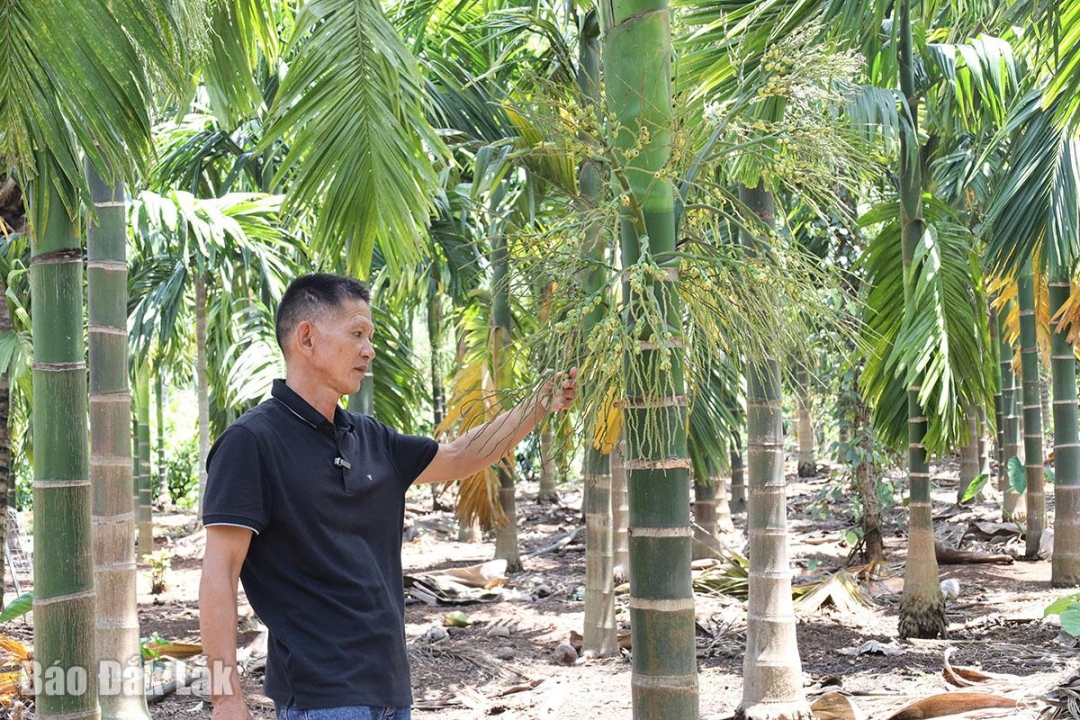 |
| Mr. Nguyen Van Dung's betel nut garden brings in several hundred million dong in income each year. |
Areca palms bloom from January and harvesting begins in June. In one areca palm season, Mr. Dung's family harvests an average of over 10 tons of fruit, priced from 50,000 to 100,000 VND/kg, depending on the time of year. In the 2024 areca palm harvest alone, his family earned over 500 million VND. According to Mr. Dung, areca palms are easy to care for, require little fertilizer, and are less susceptible to pests and diseases. Compared to many other crops, areca palms yield significantly higher economic returns.
Through market research, Mr. Dung realized that many places needed to buy betel nut seedlings, so he researched and learned how to grow them himself. With over one sao (approximately 1000 square meters) of land dedicated to growing betel nut seedlings, his family supplies the market with an average of 50,000 seedlings annually, earning over 150 million VND. Previously, with the same area of land, even with hard work, his family only earned enough to make ends meet. However, with innovative thinking in business, perseverance, and unwavering determination, even during periods of low betel nut prices, his family has reaped the rewards.
In the same village of 10, Ea Tiêu commune, Mrs. Lê Thị Tám's family not only earns over 150 million VND per year from 3 sao (approximately 0.3 hectares) of betel nut trees but also finds a way to increase economic efficiency on the same cultivated area thanks to the model of intercropping betel plants in the betel nut garden.
Over four years ago, when she saw some traders buying betel nuts asking to buy betel leaves, Mrs. Tam came up with the idea of learning how to grow this plant that "sells its leaves for money." Because betel is a climbing plant, she and her husband took advantage of their betel nut garden to interplant 100 betel vines.
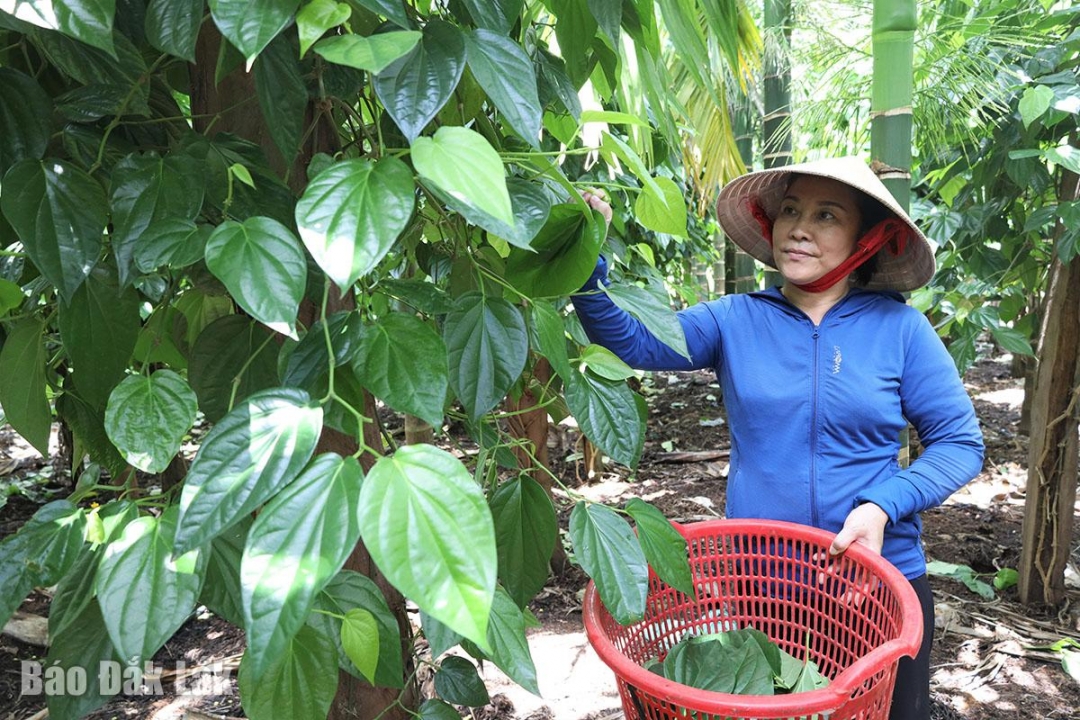 |
| The model of intercropping betel plants in the areca palm garden provides a stable income for Mrs. Le Thi Tam's family. |
Ms. Tam said that cultivating a lush betel garden with evenly distributed, beautiful leaves is quite a laborious process. Betel is known as a plant that can be planted once and harvested for a lifetime. However, because it is a "fussy" plant that cannot tolerate drought, cold, waterlogging, and is susceptible to fungal infections, planting, caring for, and harvesting are all meticulous. In particular, attention must be paid to preventing fungal diseases and maintaining sufficient moisture in the garden. Especially with betel plants, uncomposted manure should not be used as fertilizer. When harvesting betel leaves, one must know how to select leaves that are mature enough, dark green in color, and gently pluck them to avoid damaging the betel vines.
Depending on market demand and orders from traders, Mrs. Tam will harvest betel leaves, carefully package them, and send them to the North. During holidays and Tet (Lunar New Year), she harvests betel leaves every few days. With selling prices ranging from 20,000 to 80,000 VND/kg depending on the time of year, Mrs. Tam's family earns an average of about 70 million VND per year.
Visiting Ea Tiêu commune today, one can not only feel the transformation of the rural landscape with paved and concrete roads and beautiful, tall houses, but also the prosperity of each family. The shift from a "monoculture" mindset in household economic development to diversified farming, intercropping, and the discovery of suitable new crops has helped many households become millionaires, creating a more prosperous and fulfilling village.
Source: https://baodaklak.vn/kinh-te/202506/cay-trieu-phu-o-ea-tieu-1d1182b/

![[Photo] Commemorating the unwavering friendship between Vietnam and Laos](/_next/image?url=https%3A%2F%2Fvphoto.vietnam.vn%2Fthumb%2F1200x675%2Fvietnam%2Fresource%2FIMAGE%2F2026%2F01%2F27%2F1769518372051_ndo_br_1-jpg.webp&w=3840&q=75)
![[Photo] Announcement Ceremony of the Art Program “Light Concert – Welcoming the New Year 2026”](/_next/image?url=https%3A%2F%2Fvphoto.vietnam.vn%2Fthumb%2F1200x675%2Fvietnam%2Fresource%2FIMAGE%2F2026%2F01%2F27%2F1769514762857_le-cong-bo-ct-hoa-nhac-anh-sang-1772-9042-jpg.webp&w=3840&q=75)


![[Hightling] Conference on the Implementation of Tasks for 2026](/_next/image?url=https%3A%2F%2Fvphoto.vietnam.vn%2Fthumb%2F402x226%2Fvietnam%2Fresource%2FIMAGE%2F2026%2F01%2F27%2F1769477856197_dsc01637.jpeg&w=3840&q=75)


![OCOP during Tet season: [Part 2] Hoa Thanh incense village glows red.](/_next/image?url=https%3A%2F%2Fvphoto.vietnam.vn%2Fthumb%2F402x226%2Fvietnam%2Fresource%2FIMAGE%2F2026%2F01%2F27%2F1769480573807_505139049_683408031333867_2820052735775418136_n-180643_808-092229.jpeg&w=3840&q=75)
![OCOP during Tet season: [Part 1] Ba Den custard apples in their 'golden season'](/_next/image?url=https%3A%2F%2Fvphoto.vietnam.vn%2Fthumb%2F402x226%2Fvietnam%2Fresource%2FIMAGE%2F2026%2F01%2F26%2F1769417540049_03-174213_554-154843.jpeg&w=3840&q=75)


Comment (0)