

"Nomadics" in the plains
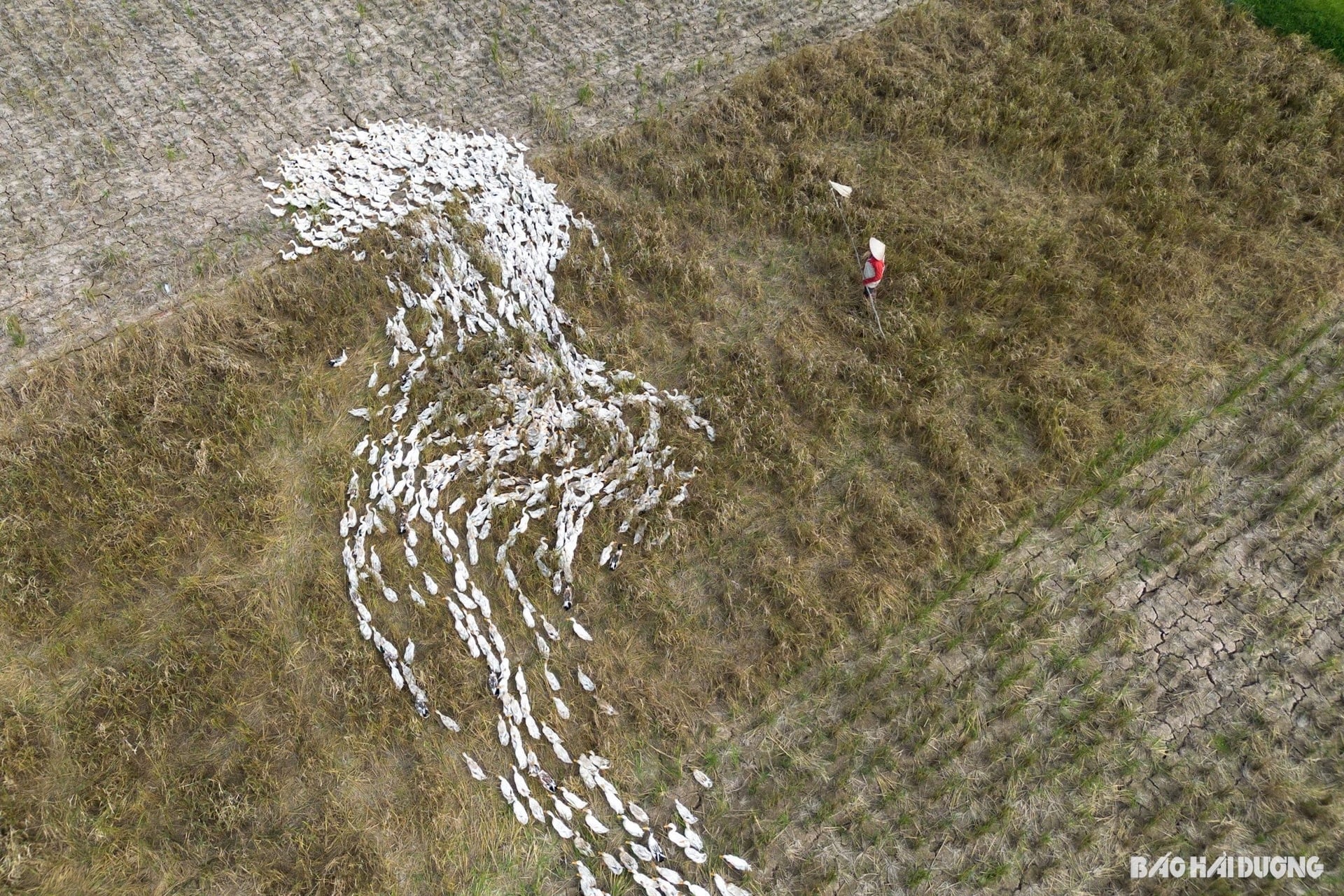
On the vast, stubble-strewn fields, the duck farmers diligently continue their work. Undeterred by rain or sunshine, they are like nomads, roaming with their flocks of ducks from one field to another.
Having been involved in duck farming for nearly 10 years, Mr. Pham Cong Vu in Ngo Quyen commune (Thanh Mien district) knows every rice field like the back of his hand. During the harvest season, wherever the rice is harvested, Mr. Vu brings his ducks there. For duck farmers, the season of "white fields and clear water" is no different from the golden season. Because the ducks are allowed to roam freely, they can scavenge for scattered grains of rice. Sometimes they even scavenge for snails and algae in the irrigation ditches... Thanks to this, farmers save a lot of costs, and the quality of the ducks is also better.
Mr. Vu said that when the last rice stalks are harvested, it's also the time for ducks to roam freely in the fields. For many years, people have mainly harvested rice using machines, so the rate of grain loss is higher compared to hand harvesting. For duck farmers, this is a huge source of food, but not everyone can endure the sun, wind, and hard work of taking the ducks to the fields. Besides, with a flock of thousands of ducks and rice stalks taller than knee-high, looking after them is not easy.
To avoid duck losses, farmers usually "germinate" the ducks 15-20 days before letting them out into the fields. At this time, the ducks are stronger, know how to forage, and are less susceptible to disease. However, free-range ducks are inevitably subject to losses due to straying. "If we lose many, we can still go out and look for them, but if one or two get lost, it's a total loss. Because the entire field is vast, with a network of ditches and stubble taller than knee-high, how can we possibly find them?" Mr. Vu shared.

As dusk falls, Mr. Tran Van Huyen from Ngo Quyen commune (Thanh Mien district) brings his flock of laying ducks back to his house. Across the vast hundreds of hectares of farmland, only he and over 1,000 laying ducks remain, leisurely making their way home. Mr. Huyen, small in stature, wearing a conical hat and carrying a long pole, looks like a beggar amidst the endless fields. Yet, he is the owner of a well-known farm in the area.
After more than 10 years of hard work, Mr. Huyen now owns over 7,000 square meters of ponds, orchards, and a farm raising over 2,000 laying ducks. Because the farm is near the fields, after each harvest season, he takes the ducks out to the fields to graze. Raising laying ducks takes twice as long as raising meat ducks. When it's time for them to lay eggs, Mr. Huyen brings them back home to raise them. In the fields, the ducks are easily dispersed, leading to premature egg laying. Harvesting eggs and managing the laying ducks is also more difficult.
According to Mr. Huyen, raising ducks in the fields is a job of "eating on the roadside and sleeping outdoors." It might seem like someone is herding ducks, but in reality, the ducks are leading the person from one field to another. The hardships of this job could fill an entire day. They endure rain and sun, their faces, hands, and feet always covered in mud. Sometimes, when it rains, they have to cover themselves with raincoats and stand rooted to the spot in the middle of the desolate fields. Because of the many worries that constantly threaten the flock, a moment of carelessness on the part of the farmer can lead to the loss of everything.
The problem stems from the continued practice in many areas of discarding dead animals and pesticide containers into canals and ditches, leading to severe water pollution. Furthermore, free-range ducks exposed to harsh weather conditions are susceptible to disease outbreaks, requiring experienced farmers to avoid losses. Typically, farmers vaccinate their ducks against diseases such as hemorrhagic septicemia, cholera, and avian influenza.
"When ducks are raised free-range, they eat a variety of foods, so the risk of disease is relatively high. The most dangerous thing is when a disease outbreak occurs in ducks, which can spread rapidly to the entire flock, even to flocks of other farmers. Therefore, we always strictly follow the instructions of the veterinary agency in sanitation, disinfection, and vaccination of poultry," Mr. Huyen said.
"One investment, four times the profit."
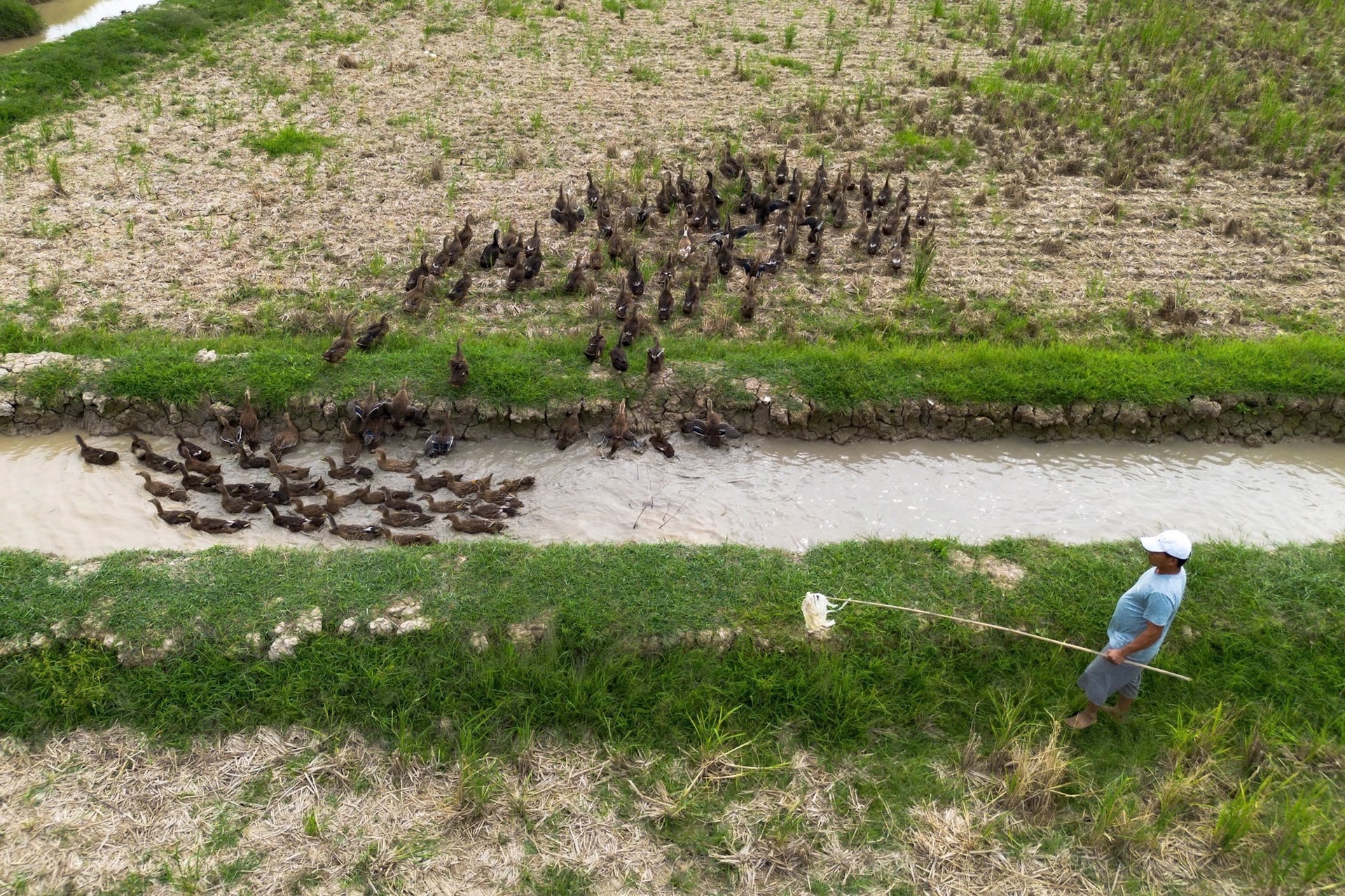
In the past, there was a folk saying, "If you want to be rich, raise fish; if you want to be well-off, raise pigs; if you want to be poor, raise ducks." Nowadays, with consumers increasingly concerned about quality and origin, free-range ducks are becoming a sought-after source of clean food among traders. In many places, traders reserve free-range ducks days in advance to secure their orders. As a result, free-range duck farming is proving to be a highly profitable business , yielding a fourfold return on investment.
According to Mr. Nguyen Van Na in Ung Hoe commune (Ninh Giang district), free-range ducks have a growth period of about 60 days, 15-20 days longer than industrially raised ducks. However, for 1,000 industrially raised ducks, farmers spend over 1 million VND per day on feed. Compared to free-range farming, this method is about 80% more expensive. On the other hand, letting the ducks out into the fields also helps reduce environmental treatment costs in the duck pens. Meanwhile, the fields are supplemented with fertilizer from the ducks.
Mr. Na's family currently maintains a flock of about 500 ducks. Since October, he has spent almost no money on commercial feed because he lets the ducks roam freely in the fields. With the money saved, his family will have additional funds to expand their farming operation and invest in more modern facilities. "Raising ducks in the fields often faces many risks such as disease outbreaks and losses. However, if managed and cared for well, it will certainly not be as expensive as industrial farming. It's even less financially risky because the price of free-range ducks is usually higher while the price of animal feed is constantly increasing," Mr. Na said.

Amidst the dry, windy weather, Mr. Nguyen Ngoc Lam in Thanh Mien district is still diligently working in the fields, herding ducks into traps. He recounts that about 10 days ago, his flock of ducks numbered over 1,000, but now almost all have been sold. Besides wholesale, Mr. Lam also sells to large restaurants in the district and province. Because he raises them in the fields, he chose to breed the ancient "Bau Dat" duck. This breed not only has good resistance to disease and is suitable for free-range farming, but also has small bones and tender, flavorful meat.
"Since I started letting the ducks roam freely in the fields, they forage for food and are exposed to the elements. Every day, I just check on the number of ducks and move them closer to home for easier supervision. Thanks to this completely natural way of raising them, the duck meat is very flavorful and delicious, and many traders are interested in buying them. I'm currently selling these ducks for 50,000 VND/kg. After deducting expenses and losses from this batch of ducks, I expect to make a profit of about 20 million VND," Mr. Lam said.
According to farmers in Thanh Mien and Ninh Giang districts, free-range ducks are currently selling for 45,000-50,000 VND/kg, 5,000-10,000 VND/kg higher than industrially raised ducks. At the current price, farmers are making a profit of approximately 20,000 VND/kg. In addition, free-range duck eggs are priced at 2,800-3,000 VND/egg, about 300 VND/egg higher than industrially raised duck eggs.
Mr. Nguyen Van Chien, a duck buyer in Hai Duong City specializing in supplying ducks to restaurants, said: "The chilly weather has led to a huge demand for duck, especially free-range ducks. These ducks are raised naturally, so their meat is very flavorful and popular with customers. Currently, many restaurants and eateries only order free-range ducks for roasting and making duck blood soup. On average, I supply about 300 free-range ducks daily throughout the city."
According to the Department of Agriculture and Rural Development of Thanh Mien District, the largest duck farming area in the district is concentrated in Ngo Quyen commune. At one point, this locality had a total flock of over 110,000 ducks. Every year, after the harvest season ends, many households often take their ducks out to the fields to graze. Although more laborious, free-range ducks not only produce better quality meat but also fetch higher prices. Due to consumer preference, most free-range duck farmers do not worry about sales. To ensure supply when the free-range duck season ends, many households have adopted VietGAP standards. However, currently, the price of ducks raised using this method is not highly competitive compared to industrially raised ducks, causing many households considerable difficulties. They hope for specific policies to support farmers in building and protecting the brand of free-range ducks.
DO QUYETSource: https://baohaiduong.vn/chay-theo-nhung-dan-vit-tha-dong-399104.html
![[Photo] Conference on the transfer and reception of Party organizations and Party members between the Party Committee of the Government and the Party Committees of the Central Party Agencies](https://vphoto.vietnam.vn/thumb/1200x675/vietnam/resource/IMAGE/2026/04/01/1775036784472_ndo_br_bnd-2620-jpg.webp)



![[Photo] Conference announcing the Politburo's Decision on organizational and personnel matters](https://vphoto.vietnam.vn/thumb/1200x675/vietnam/resource/IMAGE/2026/04/01/1775017881825_bnd-2410-1472-jpg.webp)
















































Comment (0)