

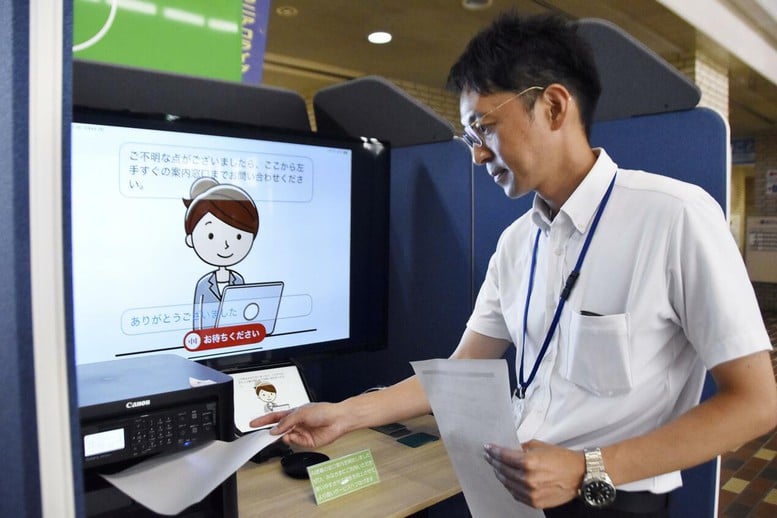
Photo: Kyodo
The device is located right in the city hall headquarters. The screen displays a female AI character who can chat directly with citizens, guide them to the correct department, or assist with filling out forms.
When citizens scan their driver's license or My Number ID card, the system automatically enters personal information such as full name and address into the form, saving time spent filling it out manually.
The Ichinoseki city government stated that, due to the constant overload of administrative staff and the difficulty in fully meeting the needs of citizens, the city government decided to use equipment from EasyDialog GK, a Yokohama-based company specializing in developing AI chatbots.
The city of Ichinoseki aims to "AI-ize" all its in-person service counters, but may face considerable difficulties due to the large number of elderly people who are unfamiliar with digital technology .
Masaharu Sugawara, the person in charge of digitizing Ichinoseki City's administrative work, shared: "Just as self-checkout kiosks have become commonplace in daily life, we will strive to gradually familiarize people with AI kiosks and expand their use."
According to EasyDialog, the AI-integrated device installed at the city hall connects directly to Ichinoseki's knowledge database, which includes over 7,000 websites, in order to provide accurate responses.
The system is described as a "comprehensive integrated solution," providing not only information but also performing practical tasks, from facial recognition and document scanning to automated form processing.
Japan: The challenge of an aging population and the hope for AI.
Japan faces a demographic challenge as nearly one-third of its population is 65 or older, compared to only about 15% in China. With a declining workforce, the country is placing high hopes on AI.
AI education in Japan is guided by the "AI Strategy 2022," a comprehensive document issued by the Japanese Cabinet, which emphasizes educational reform to enhance skills in mathematics, data science, and AI.
Accordingly, AI is incorporated into compulsory subjects from elementary to high school. Japanese students are introduced to basic knowledge of AI, helping to spark interest from an early age. At the elementary level, the curriculum focuses on introducing the basics of AI, such as how AI works and simple applications, through practical activities like programming robots or using data software. At the middle and high school levels, the content becomes more advanced, including programming, machine learning, and the application of AI in daily life.
Guidelines from Japan's Ministry of Education, Culture, Sports, Science and Technology in 2023 emphasize the use of AI for English language learning and teamwork, while also teaching students about the benefits and risks, such as the leakage of personal information or copyright infringement. Students are instructed not to input personal information into AI and to use AI-generated misinformation as fact-checking teaching material.
Last May, the Japanese Parliament passed the Law on Promoting Research, Development, and Application of AI Technology, identifying AI as a foundation for economic and social growth.
Source: https://baochinhphu.vn/chinh-sach-ai-nhat-ban-dung-nhan-vien-ai-giup-nguoi-dan-lam-thu-tuc-hanh-chinh-102250824122016554.htm


![[Photo] Prime Minister Pham Minh Chinh receives Lao Minister of Education and Sports Thongsalith Mangnormek](/_next/image?url=https%3A%2F%2Fvphoto.vietnam.vn%2Fthumb%2F1200x675%2Fvietnam%2Fresource%2FIMAGE%2F2025%2F12%2F16%2F1765876834721_dsc-7519-jpg.webp&w=3840&q=75)
![[Image] Leaked images ahead of the 2025 Community Action Awards gala.](/_next/image?url=https%3A%2F%2Fvphoto.vietnam.vn%2Fthumb%2F1200x675%2Fvietnam%2Fresource%2FIMAGE%2F2025%2F12%2F16%2F1765882828720_ndo_br_thiet-ke-chua-co-ten-45-png.webp&w=3840&q=75)
![[Live] 2025 Community Action Awards Gala](/_next/image?url=https%3A%2F%2Fvphoto.vietnam.vn%2Fthumb%2F1200x675%2Fvietnam%2Fresource%2FIMAGE%2F2025%2F12%2F16%2F1765899631650_ndo_tr_z7334013144784-9f9fe10a6d63584c85aff40f2957c250-jpg.webp&w=3840&q=75)
![[Photo] Prime Minister Pham Minh Chinh receives the Governor of Tochigi Province (Japan)](/_next/image?url=https%3A%2F%2Fvphoto.vietnam.vn%2Fthumb%2F1200x675%2Fvietnam%2Fresource%2FIMAGE%2F2025%2F12%2F16%2F1765892133176_dsc-8082-6425-jpg.webp&w=3840&q=75)

















































![[Photo] Prime Minister Pham Minh Chinh attends the Vietnam Economic Forum 2025](https://vphoto.vietnam.vn/thumb/402x226/vietnam/resource/IMAGE/2025/12/16/1765893035503_ndo_br_dsc-8043-jpg.webp)


























Comment (0)