

The sharp decline in demand for loans to buy houses, cars, and invest has caused the consumer lending sector to stagnate for the first time in many years.
The end of the year is usually the peak season for consumer loans such as those for real estate, cars, and home appliances... but bank leaders say "things have slowed down, and consumer credit is still on a difficult path."
While figures for the end of 2023 are not yet available, consumer loans, which account for 20% of total outstanding loans flowing into the economy , had only increased by 1.5% by the end of the first three quarters of last year. The disbursement rate for consumer loans was the lowest in five years, according to data from the Vietnam Banking Association (VNBA).
In Ho Chi Minh City, the economic hub, lending in this segment increased by only 1.4% by the end of October 2023, compared to nearly 19% growth in the same period of the previous year.

Transactions at a commercial bank. Photo: Giang Huy
People are borrowing less to buy houses and cars.
Mr. Nguyen Tung (Ho Chi Minh City) said that in 2022, when the market was still booming and prices were increasing weekly, he borrowed over one billion VND from the bank to buy a plot of land in the province. His plan was to take advantage of the very low preferential interest rate in the first year to use the capital to resell the land. However, the plan fell apart. After more than a year, he still couldn't find a buyer despite selling the land at break-even price, leaving him "stuck" with a debt of one billion VND and under pressure to pay bank interest every month.
"My income over the past six months hasn't been as good as before. Now I just hope to sell the property to pay off the loan and ease my debt. At this time, I doubt anyone would dare to take out short-term real estate loans anymore," Tùng said.
Every year, loans for real estate purchases and home renovations are a major pillar, contributing significantly to outstanding consumer loan balances. For example, in Ho Chi Minh City, 65% of outstanding consumer loans as of the end of October 2023 were disbursed for loans to purchase, renovate homes, and acquire real estate, according to data from the State Bank of Vietnam in Ho Chi Minh City.
According to Vietcombank Securities (VCBS), home loan lending has been the main growth driver of the retail sector for many years but slowed down in 2023 due to high interest rates and a "frozen" real estate market. Outstanding home loan balances across the entire system at the end of Q3 2023 even decreased by 1% compared to the beginning of the year.
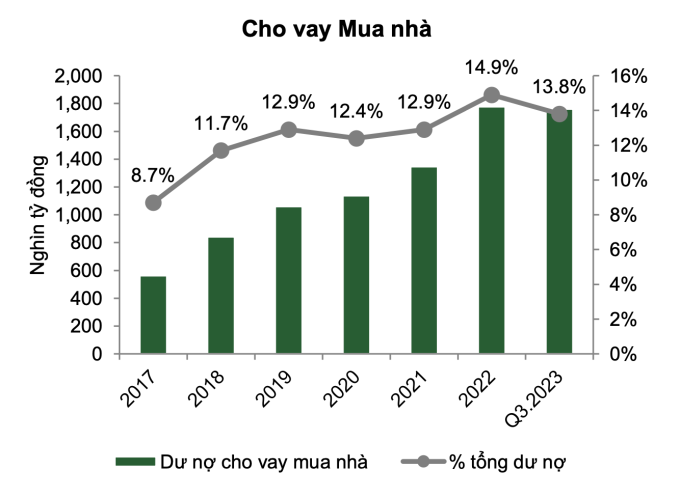
Outstanding mortgage loans, which were a driving force behind consumer lending growth, decreased by 1% by the end of Q3 2023 compared to the beginning of the year. Source: VCBS
The head of a 100% foreign-owned bank stated that borrowing from banks for real estate speculation has become very risky in the current context, leading to a decline in motivation for real estate investors. "Therefore, the number of customers borrowing for real estate investment purposes has decreased sharply, and only those with genuine needs are investing at this time," he said.
Not only are loans for real estate purchases weakening, but other consumer loan needs such as those for cars and home appliances are also declining as people's incomes decrease and they tighten their belts.
Mr. Manh (59 years old, Ho Chi Minh City) said he had considered borrowing money to buy a car for ride-hailing services and family needs. However, witnessing his friends struggling with low business for months and failing to recoup their investment, he reconsidered. Furthermore, the preferential policy of reduced registration fees has ended this year, forcing him to put his car purchase plans on hold.
As of the end of October 2023, automobile sales had decreased by nearly 30% compared to the same period last year. Meanwhile, in the electronics market, weak and prolonged consumer demand has led electronics retailers to engage in fierce price wars during the peak season, but the situation remains bleak.
Bankers are hesitant to lend due to rapidly increasing risks.
Retail lending used to be a favorite segment for banks, but now even they are cautious about this segment. Non-performing loans in the consumer lending sector have increased rapidly, from 2% in the 2018-2022 period to 3.7% in the second half of 2023, according to data from the Vietnam Banking Association.
Consequently, many banks have temporarily postponed their retail market expansion activities to adapt to the market context. Data from Vietcombank Securities Company (VCBS) shows that the proportion of retail credit to total outstanding loans decreased from 47% at the end of 2022 to 46% at the end of the third quarter of 2023.
At a conference with investors in 2023, Mr. Ho Van Long, Deputy General Directorof VIB, said that the method of allocating credit had to be adjusted compared to before.
"In previous years, VIB prioritized credit limits for the retail sector to develop the market for real estate loans, auto loans, and credit cards. However, due to the slow recovery of core demand for retail lending products, the bank will make way for other areas such as corporate lending and bonds," Mr. Long said.
Jens Lottner, CEO of Techcombank, also stated that the bank wants to boost its retail banking segment and does not want to expand its loan portfolio to corporate clients, but the current market conditions are "not suitable".
In the current environment, according to the CEO of Techcombank, large companies and corporations are more resilient. Their funding sources are diverse, coming from various sectors of the economy, which helps them maintain better balance. "We are not stopping our retail expansion, but if we had to look for investment opportunities right now, it should be large businesses," the Techcombank CEO stated.
With 16 finance companies serving "subprime" bank customers, the picture is even worse. These finance companies account for 5% of outstanding consumer loans, and lending by this group has plummeted. Outstanding loans from these 16 finance companies for living expenses as of August 2023 had even decreased by more than 30% compared to the beginning of the year.
According to VNBA Secretary General Nguyen Quoc Hung, the non-performing loan ratio of finance companies is at risk of exceeding 15%, with many companies facing difficulties and even losses due to increased provisions for bad debt. Many companies have had to halt new lending for periods.
Mr. Le Quoc Ninh, Chairman of the Consumer Finance Club (Vietnam Banking Association), stated at a meeting: "Consumer credit is currently in its most difficult phase in the past 15 years."
In the unsecured loan segment at finance companies, the main target customers are low-to-middle income earners who have experienced a difficult year. Many workers have lost their jobs or experienced reduced income, leading to a decrease in consumer demand.
Marcin Figlus, Director of Risk Management at FE Credit, stated that licensed consumer finance companies are facing a common challenge in debt collection: the organized defaulting of loans. A segment of customers are deliberately equating the legitimate debt collection activities of licensed companies with illegal practices in order to boycott and delay repayment.
Although there are still programs to promote lending, Olena Khlo, Deputy General Director of Saigon - Hanoi Banking Finance Company, said that they will not aggressively push disbursements but will instead lend selectively. "In 17 years working in the banking and finance sector, this is one of the most difficult years," she said.
The rapid increase in bad debts, coupled with difficulties in debt recovery, is a common factor causing financial companies to scale back. According to financial company leaders, the outlook is unlikely to improve anytime soon. Therefore, consumer lending is unlikely to return to its golden age.
However, analysts expect upcoming mortgage lending to drive growth in the consumer lending segment, driven by continued high demand for homes for personal use and a resurgence in investment demand.
Quynh Trang
Source link











































































































Comment (0)